Thank you for visiting SNEWPapers!
Sign up free
Story
February 13, 1934
Henderson Daily Dispatch
Henderson, Vance County, North Carolina
What is this article about?
Dr. Logan Clendening discusses the history of blood transfusions, from early experimental procedures using animal blood to treat insanity, to modern practices involving blood group compatibility testing to avoid complications.
Clipping
OCR Quality
82%
Good
Full Text
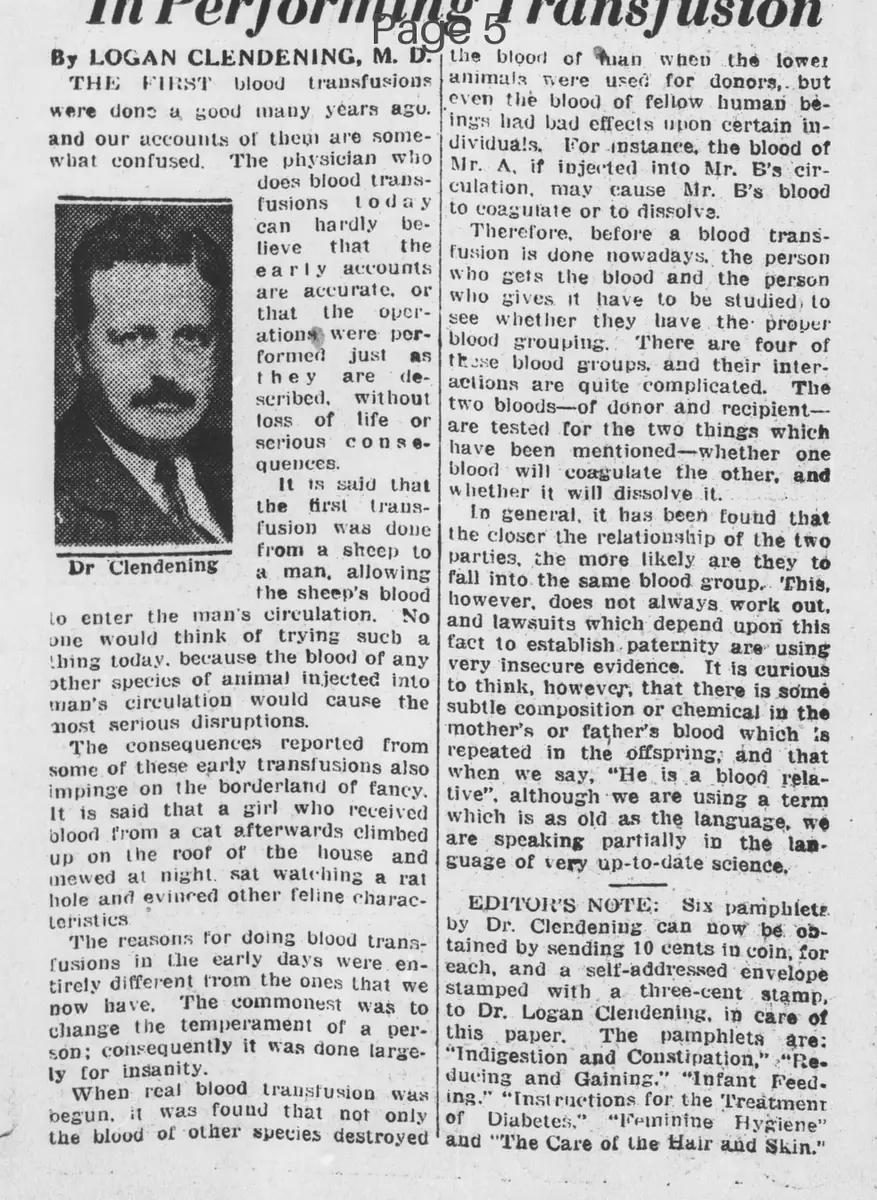
By LOGAN CLENDENING, M. D.
THE FIRST blood transfusions were done a good many years ago, and our accounts of them are somewhat confused. The physician who does blood transfusions today can hardly believe that the early accounts are accurate, or that the operations were performed just as they are described, without loss of life or serious consequences.
It is said that the first transfusion was done from a sheep to a man, allowing the sheep's blood to enter the man's circulation. No one would think of trying such a thing today, because the blood of any other species of animal injected into man's circulation would cause the most serious disruptions. The consequences reported from some of these early transfusions also impinge on the borderland of fancy. It is said that a girl who received blood from a cat afterwards climbed up on the roof of the house and mewed at night, sat watching a rat hole and exhibited other feline characteristics.
The reasons for doing blood transfusions in the early days were entirely different from the ones that we now have. The commonest was to change the temperament of a person; consequently it was done largely for insanity.
When real blood transfusion was begun, it was found that not only the blood of other species destroyed the blood of a man when the lower animals were used for donors, but even the blood of fellow human beings had bad effects upon certain individuals. For instance, the blood of Mr. A, if injected into Mr. B's circulation, may cause Mr. B's blood to coagulate or to dissolve.
Therefore, before a blood transfusion is done nowadays, the person who gets the blood and the person who gives it have to be studied, to see whether they have the proper blood grouping. There are four of these blood groups, and their interactions are quite complicated. The two bloods of donor and recipient are tested for the two things which have been mentioned—whether one blood will coagulate the other, and whether it will dissolve it.
In general, it has been found that the closer the relationship of the two parties, the more likely are they to fall into the same blood group. This, however, does not always work out, and lawsuits which depend upon this fact to establish paternity are using very insecure evidence. It is curious to think, however, that there is some subtle composition or chemical in the mother's or father's blood which is repeated in the offspring, and that when we say, "He is a blood relative," although we are using a term which is as old as the language, we are speaking partially in the language of very up-to-date science.
EDITOR'S NOTE: Six pamphlets by Dr. Clendening can now be obtained by sending 10 cents in coin, for each, and a self-addressed envelope stamped with a three-cent stamp, to Dr. Logan Clendening, in care of this paper. The pamphlets are: "Indigestion and Constipation," "Reducing and Gaining," "Infant Feeding," "Instructions for the Treatment of Diabetes," "Feminine Hygiene" and "The Care of the Hair and Skin."
THE FIRST blood transfusions were done a good many years ago, and our accounts of them are somewhat confused. The physician who does blood transfusions today can hardly believe that the early accounts are accurate, or that the operations were performed just as they are described, without loss of life or serious consequences.
It is said that the first transfusion was done from a sheep to a man, allowing the sheep's blood to enter the man's circulation. No one would think of trying such a thing today, because the blood of any other species of animal injected into man's circulation would cause the most serious disruptions. The consequences reported from some of these early transfusions also impinge on the borderland of fancy. It is said that a girl who received blood from a cat afterwards climbed up on the roof of the house and mewed at night, sat watching a rat hole and exhibited other feline characteristics.
The reasons for doing blood transfusions in the early days were entirely different from the ones that we now have. The commonest was to change the temperament of a person; consequently it was done largely for insanity.
When real blood transfusion was begun, it was found that not only the blood of other species destroyed the blood of a man when the lower animals were used for donors, but even the blood of fellow human beings had bad effects upon certain individuals. For instance, the blood of Mr. A, if injected into Mr. B's circulation, may cause Mr. B's blood to coagulate or to dissolve.
Therefore, before a blood transfusion is done nowadays, the person who gets the blood and the person who gives it have to be studied, to see whether they have the proper blood grouping. There are four of these blood groups, and their interactions are quite complicated. The two bloods of donor and recipient are tested for the two things which have been mentioned—whether one blood will coagulate the other, and whether it will dissolve it.
In general, it has been found that the closer the relationship of the two parties, the more likely are they to fall into the same blood group. This, however, does not always work out, and lawsuits which depend upon this fact to establish paternity are using very insecure evidence. It is curious to think, however, that there is some subtle composition or chemical in the mother's or father's blood which is repeated in the offspring, and that when we say, "He is a blood relative," although we are using a term which is as old as the language, we are speaking partially in the language of very up-to-date science.
EDITOR'S NOTE: Six pamphlets by Dr. Clendening can now be obtained by sending 10 cents in coin, for each, and a self-addressed envelope stamped with a three-cent stamp, to Dr. Logan Clendening, in care of this paper. The pamphlets are: "Indigestion and Constipation," "Reducing and Gaining," "Infant Feeding," "Instructions for the Treatment of Diabetes," "Feminine Hygiene" and "The Care of the Hair and Skin."
What sub-type of article is it?
Historical Event
Medical Curiosity
What themes does it cover?
Recovery
Misfortune
What keywords are associated?
Blood Transfusion
History
Animal Blood
Blood Groups
Compatibility Testing
Insanity Treatment
Paternity Evidence
What entities or persons were involved?
Logan Clendening
Story Details
Key Persons
Logan Clendening
Event Date
A Good Many Years Ago
Story Details
Early blood transfusions involved animal blood to alter human temperament, especially for insanity, with bizarre reported effects; modern transfusions require blood group compatibility to prevent coagulation or dissolution, and blood relations often share groups.