Thank you for visiting SNEWPapers!
Sign up free
The Rhode Island American, And General Advertiser
Providence, Providence County, Rhode Island
What is this article about?
In Bastia prison, Luc Antonie Viterbi, sentenced to death for the assassination of Frediani, committed suicide by voluntary starvation over 18 days in December, refusing food and water despite intense suffering, and documenting his ordeal until death on 21 December.
Clipping
OCR Quality
Full Text
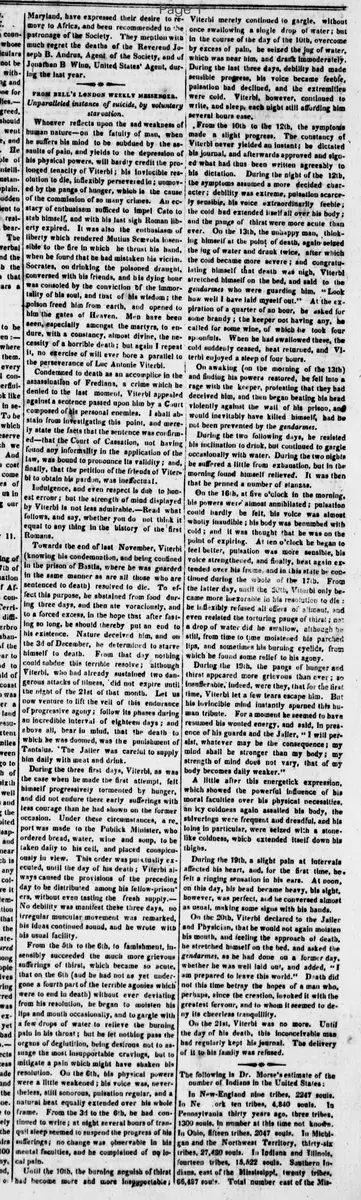
Unparalleled instance of suicide, by voluntary starvation.
Whoever reflects upon the sad weakness of human nature—on the fatuity of man, when he suffers his mind to be subdued by the assaults of pain, and yields to the depression of his physical powers, will hardly credit the prolonged tenacity of Viterbi; his invincible resolution to die, inflexibly persevered in; unmoved by the pangs of hunger, which is the cause of the commission of so many crimes. An ecstasy of enthusiasm sufficed to impel Cato to stab himself, and with his last sigh Roman liberty expired. It was also the enthusiasm of liberty which rendered Mutius Scaevola insensible to the fire in which he thrust his hand, when he found that he had mistaken his victim.
Socrates, on drinking the poisoned draught, conversed with his friends, and his dying hour was consoled by the conviction of the immortality of his soul, and that of his wisdom; the poison freed him from earth, and opened to him the gates of Heaven.
Men have been seen, especially amongst the martyrs, to endure, with a constancy, almost divine, the necessity of a horrible death; but again I repeat it, no exercise of will ever bore a parallel to the perseverance of Luc Antonie Viterbi.
Condemned to death as an accomplice in the assassination of Frediani, a crime which he denied to the last moment, Viterbi appealed against a sentence passed upon him by a Court composed of his personal enemies. I shall abstain from investigating this point, and merely state the facts that the sentence was confirmed—that the Court of Cassation, not having found any informality in the application of the law, was bound to pronounce its validity; and, finally, that the petition of the friends of Viterbi to obtain his pardon, was ineffectual.
Indulgence, and even respect is due to honest error; but the strength of mind displayed by Viterbi is not less admirable.—Read what follows, and say, whether you do not think it equal to anything in the history of the first Romans.
Towards the end of last November, Viterbi (knowing his condemnation, and being confined in the prison of Bastia, where he was guarded in the same manner as are all those who are sentenced to death) resolved to die. To effect this purpose, he abstained from food during three days, and then ate voraciously, and to a forced excess, in the hope that after fasting so long, he should thereby put an end to his existence.
Nature deceived him, and on the 3d of December, he determined to starve himself to death.
From that day nothing could subdue this terrible resolve; although Viterbi, who had already sustained two dangerous attacks of illness, did not expire until the night of the 21st of that month. Let us now venture to lift the veil of this endurance of progressive agony; follow its phases during an incredible interval of eighteen days; and above all, bear in mind, that the death to which he was doomed, was the punishment of Tantalus. The Jailer was careful to supply him daily with meat and drink.
During the three first days, Viterbi, as was the case when he made the first attempt, felt himself progressively tormented by hunger, and did not endure these early sufferings with less courage than he had shown on the former occasion.
Under these circumstances, a report was made to the Public Minister, who ordered bread, water, wine and soup, to be taken daily to his cell, and placed conspicuously in view.
This order was punctually executed, until the day of his death; Viterbi always caused the provisions of the preceding day to be distributed among his fellow-prisoners, without even tasting the fresh supply.—No debility was manifest these three days, no irregular muscular movement was remarked, his ideas continued sound, and he wrote with his usual facility.
From the 5th to the 6th, to fainting, insensibly succeeded the much more grievous sufferings of thirst, which became so acute, that on the 6th (and he had not as yet undergone a fourth part of the terrible agonies which were to end in death) without ever deviating from his resolution, he began to moisten his lips and mouth occasionally, and to gargle with a few drops of water to relieve the burning pain in his throat; but he let nothing pass the organs of deglutition, being desirous not to assuage the most insupportable craving, but to mitigate a pain which might have shaken his resolution. On the 6th, his physical powers were a little weakened; his voice was, nevertheless, still sonorous, pulsation regular, and a natural heat equally extended over his whole frame. From the 3d to the 6th, he had continued to write; at night several hours of tranquil sleep seemed to suspend the progress of his sufferings; no change was observable in his mental faculties, and he complained of no local pain.
Until the 10th, the burning anguish of thirst had become more and more insupportable;
Viterbi merely continued to gargle, without once swallowing a single drop of water; but in the course of the day of the 10th, overcome by excess of pain, he seized the jug of water, which was near him, and drank immoderately.
During the last three days, debility had made sensible progress, his voice became feeble, pulsation had declined, and the extremities were cold. Viterbi, however, continued to write, and sleep, each night still affording him several hours ease.
From the 10th to the 12th, the symptoms made a slight progress. The constancy of Viterbi never yielded an instant; he dictated his journal, and afterwards approved and signed what had thus been written agreeably to his dictation. During the night of the 12th, the symptoms assumed a more decided character; debility was extreme, pulsation scarcely sensible, his voice extraordinarily feeble; the cold had extended itself all over his body; and the pangs of thirst were more acute than ever. On the 13th, the unhappy man, thinking himself at the point of death, again seized the jug of water and drank twice, after which the cold became more severe; and congratulating himself that death was nigh, Viterbi stretched himself on the bed, and said to the gendarmes who were guarding him, "Look how well I have laid myself out." At the expiration of a quarter of an hour, he asked for some brandy; the keeper not having any, he called for some wine, of which he took four spoonfuls. When he had swallowed these, the cold suddenly ceased, heat returned, and Viterbi enjoyed a sleep of four hours.
On awaking (on the morning of the 13th) and finding his powers restored, he fell into a rage with the keeper, protesting that they had deceived him, and then began beating his head violently against the wall of his prison, and would inevitably have killed himself, had he not been prevented by the gendarmes.
During the two following days, he resisted his inclination to drink, but continued to gargle occasionally with water. During the two nights he suffered a little from exhaustion, but in the morning found himself relieved. It was then that he penned a number of stanzas.
On the 16th, at five o'clock in the morning his powers were almost annihilated; pulsation could hardly be felt, his voice was almost wholly inaudible; his body was benumbed with cold; and it was thought that he was on the point of expiring. At ten o'clock he began to feel better, pulsation was more sensible, his voice strengthened, and finally, heat again extended over his frame, and in this state he continued during the whole of the 17th. From the latter day, until the 19th, Viterbi only became more inexorable in his resolution to die : he inflexibly refused all offers of aliment, and even resisted the torturing pangs of thirst; not a drop of water did he swallow, although he still, from time to time moistened his parched lips, and sometimes his burning eyelids, from which he found some relief to his agony.
During the 19th, the pangs of hunger and thirst appeared more grievous than ever; so insufferable, indeed, were they, that for the first time, Viterbi let a few tears escape him. But his invincible mind instantly spurned this human tribute. For a moment he seemed to have resumed his wonted energy, and said, in presence of his guards and the Jailer, "I will persist, whatever may be the consequence; my mind shall be stronger than my body; my strength of mind does not vary, that of my body becomes daily weaker."
A little after this energetick expression, which showed the powerful influence of his moral faculties over his physical necessities, an icy coldness again assailed his body, the shiverings were frequent and dreadful, and his loins in particular, were seized with a stone-like coldness, which extended itself down his thighs.
During the 19th, a slight pain at intervals affected his heart, and, for the first time, he felt a ringing sensation in his ears. At noon, on this day, his head became heavy, his sight, however, was perfect, and he conversed almost as usual, making some signs with his hands.
On the 20th, Viterbi declared to the Jailer and Physician, that he would not again moisten his mouth, and feeling the approach of death, he stretched himself on the bed, and asked the gendarmes, as he had done on a former day, whether he was well laid out, and added, "I am prepared to leave this world." Death did not this time betray the hopes of a man who, perhaps, since the creation, invoked it with the greatest fervour, and to whom it seemed to deny its cheerless tranquillity.
On the 21st, Viterbi was no more. Until the day of his death, this inconceivable man had regularly kept his journal. The delivery of it to his family was refused.
What sub-type of article is it?
What keywords are associated?
What entities or persons were involved?
Where did it happen?
Foreign News Details
Primary Location
Bastia
Event Date
Towards The End Of Last November To The Night Of The 21st Of That Month
Key Persons
Outcome
viterbi died by voluntary starvation after 18 days of fasting
Event Details
Luc Antonie Viterbi, condemned to death as an accomplice in the assassination of Frediani, resolved to die by starvation in Bastia prison starting 3 December. Despite provisions supplied daily, he refused food and mostly water for 18 days, enduring progressive agony, occasional relapses in drinking, and maintaining his journal until his death on the night of 21 December.