Thank you for visiting SNEWPapers!
Sign up free
Gazette Of The United States, & Philadelphia Daily Advertiser
Philadelphia, Philadelphia County, Pennsylvania
What is this article about?
In the U.S. House of Representatives on January 13, reports on petitions including land claims and financial discrepancies were considered and referred. Debate focused on revenue needs, with members discussing direct taxation versus indirect duties on goods like salt, rum, and imports, leading to referrals and resolution into committee.
Merged-components note: This is a continuation of the congressional debate on direct taxation across pages; the content is a unified report on domestic political proceedings, changing the label from 'story' to 'domestic_news' for accuracy.
Clippings
1 of 2
OCR Quality
Full Text
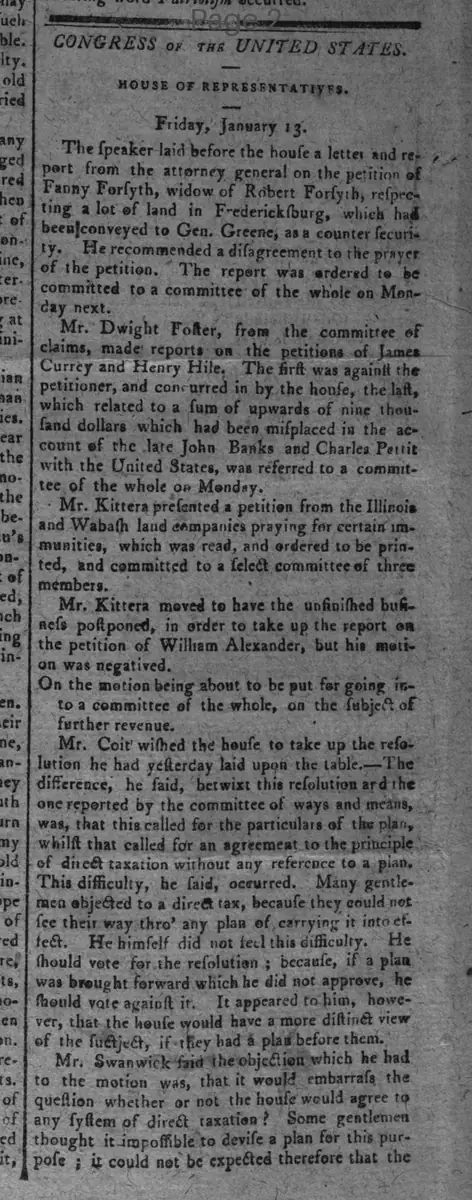
HOUSE OF REPRESENTATIVES.
Friday, January 13.
The Speaker laid before the house a letter and report from the attorney general on the petition of Fanny Forsyth, widow of Robert Forsyth, respecting a lot of land in Fredericksburg, which had been conveyed to Gen. Greene, as a counter security. He recommended a disagreement to the prayer of the petition. The report was ordered to be committed to a committee of the whole on Monday next.
Mr. Dwight Foster, from the committee of claims, made reports on the petitions of James Currey and Henry Hile. The first was against the petitioner, and concurred in by the house, the last, which related to a sum of upwards of nine thousand dollars which had been misplaced in the account of the late John Banks and Charles Pettit with the United States, was referred to a committee of the whole on Monday.
Mr. Kittera presented a petition from the Illinois and Wabash land companies praying for certain immunities, which was read, and ordered to be printed, and committed to a select committee of three members.
Mr. Kittera moved to have the unfinished business postponed in order to take up the report on the petition of William Alexander, but his motion was negatived.
On the motion being about to be put for going into a committee of the whole, on the subject of further revenue.
Mr. Coit wished the house to take up the resolution he had yesterday laid upon the table.—The difference, he said, betwixt this resolution and the one reported by the committee of ways and means, was, that this called for the particulars of the plan, whilst that called for an agreement to the principle of direct taxation without any reference to a plan. This difficulty, he said, occurred. Many gentlemen objected to a direct tax, because they could not see their way thro' any plan of carrying it into effect. He himself did not feel this difficulty. He should vote for the resolution; because, if a plan was brought forward which he did not approve, he should vote against it. It appeared to him, however, that the house would have a more distinct view of the subject, if they had a plan before them.
Mr. Swanwick said the objection which he had to the motion was, that it would embarrass the question whether or not the house would agree to any system of direct taxation? Some gentlemen thought it impossible to devise a plan for this purpose; it could not be expected therefore that the committee of ways and means should produce such an plan as would be wholly unobjectionable. Indeed, when he heard it asserted to be impossible, he trembled for the existence of our government; for it could not exist without revenue, and he could not see how that revenue could be raised but by a land tax. The propriety of laying additional burthens on commerce had been suggested, but, (as he had already stated) this would not probably increase the revenue, as it would most probably promote a spirit of smuggling. Let us go into a committee of the whole on the subject, said Mr. S. and let gentlemen bring forward their different plans, and then the committee will be able to determine which will be most likely to be effectual and attended with the least inconvenience. There was but one sentiment as to the necessity of provision being made; and he was of opinion, if it was once determined to have a direct tax, such a plan might be produced as would prove acceptable, when gentlemen should be convinced that some plan of direct taxation must be adopted.
The speaker said the only motion in order would be, that the committee of the whole on the subject of finance be discharged, in order to refer the present resolution to the committee of ways and means to instruct them to report a plan; or, to commit the resolution to the committee of the whole on the subject of finance.
Mr. Harper asked whether it would not be in order, when the house should be in a committee of the whole, to move the present resolution by way of amendment to that reported?
The speaker said the chairman of the committee of the whole would determine that question.
Mr. Coit moved that the committee of the whole on the subject of finance, might be discharged from the further consideration of the subject, for the purpose of referring his resolution.
Mr. Williams hoped the committee would be discharged. He wished to have the plan in question before them, because if it was not necessary to lay a land-tax at present, it might be necessary at some future day. As to what had been said that government could not be supported without a land tax, he believed other means might be hit upon to raise the money required without a land tax. Not that he would commit himself so far as to say he might not eventually vote for a land tax. But he believed if a small additional duty were to be laid upon salt and rum, and some other articles, there would be no difficulty in the business.
The speaker reminded Mr. Williams of the question.
Mr Williams said he was stating his reasons why the system of direct taxation should not now be determined upon, because he thought there were certain articles upon which a heavier duty might be laid; though he wished, at the same time, to have the plan of a direct tax brought into view, to act upon when necessity should require it.
Mr Craik was in favor of the committee of the whole being discharged, in order that the committee of Ways and Means might be instructed to report a plan. He said he was in favor of this proposition; not so much from any objection he had to vote for the resolution as reported, but because if they were to have a plan reported, they should be more likely to bring the subject to an early conclusion. He did not think, with some other gentlemen, that by voting for that resolution, he should be bound to vote for any plan which might be reported. He had no fears of this sort; he believed himself always at liberty to vote as he pleased, and to change his opinion on any subject when he saw proper. But, as some gentlemen had expressed their objections on this ground, he thought it would be well to refer this resolution.
Mr. C. said, he believed when they considered their real situation; that they were now called upon to determine whether additional revenue should be raised or not, but that revenue must by some means be raised, he trusted that gentlemen would turn their minds in earnest to the subject. He believed this to be the important business of the session: and when he looked at the report of the secretary of the treasury, he could not hesitate a moment in concluding that there was a necessity for acting with energy. Seeing, therefore, that they had no alternative, it became their business to have the subject thoroughly discussed, and to take a view of both sources, viz. direct and indirect taxation, in order to determine upon what system they would act. A resolution, he said, had been referred to the committee of Ways and Means, some days ago, calling upon them to report what further revenue could be raised by indirect taxes. It would be well if that committee would bring into view all the subjects upon which indirect taxes might be raised or increased, in order to enable them to determine betwixt the two systems. It might perhaps be advisable to have recourse both to direct and indirect taxation; for though indirect means might supply our present wants, after the year 1800 they would certainly fall short, and he was not for putting off till to-morrow what might be done to-day. It was necessary the attention of the people should be drawn to the subject, and that government should not be drawn to anticipations and loans, and to give extravagant prices for our own money.
He believed gentlemen opposed to direct taxation, were not so much so from principles as from an idea that it was impossible to adopt a system which would fall equally upon all parts of the union; It was to be wished, therefore, that the plans could be seen and agreed upon, since some gentlemen were apprehensive that by giving their assent to the abstract proposition, they should pledge themselves to support a plan, however objectionable, when it should be reported. He hoped, therefore, the resolution would be referred, and a plan reported.
Mr. W. Smith said it was to be regretted that the gentleman from Connecticut had brought forward this proposition, as it caused them to debate about form, rather than substance. The proposition of the committee of Ways and Means, went to that direct taxes should be laid; this directed the committee to report a bill. He thought it better to decide in the first instance, whether direct taxes were necessary or not. By bringing the subject before the committee of the whole, gentlemen would have an opportunity of proposing their substitutes in place of the plan proposed; and, by contrasting one with the other, they should be able to judge which would prove the best mode. But gentlemen say no, we will have the plan in a bill, and if we do not like it, we will reject it. He thought the best way would be to go fairly into the business, and determine whether they would adopt any system of direct taxation, which could be planned, and so far pledge themselves, as to determine they will agree to any practicable plan which may be produced.
Mr. S. said there could only be two objections to systems of direct taxation; either that by the constitution there is not sufficient power in the government to raise such a tax, or that it is inexpedient. If gentlemen thought there was not sufficient power in the constitution to raise such a tax, it should be so determined; or, if it were thought that money could be raised in a more convenient mode, it was proper to discuss the principle, and come to a determination on the subject. This, he said was the rational way of proceeding; for if once the principle was determined upon that a direct tax was necessary, a number of objections would be lessened down by the necessity which was seen to exist for adopting a plan of this kind.
It had been observed, that a resolution had been referred to the committee of ways and means, instructing them to report on the subject of indirect taxation. He did not object to the reference at that time; but he had yesterday declared that that committee had repeatedly attempted in vain to hit upon subjects of indirect taxation for further revenue, and that they had therefore recommended a system of direct taxation.
He hoped the resolution of the gentleman from Connecticut would not be adopted, and that they should go into a committee of the whole on the business.
Mr. Nicholas said the question was now whether they should determine upon something, or put it off till another time. We want revenue, said Mr. N. and we must have it; and was it not better he asked, to determine upon what principle they should act, than to call upon the committee of ways and means to report a plan. It was well known, be said, nothing but necessity could have obliged any member to have proposed direct taxes. Unless they first determined upon the principle, they should never be able to proceed; because, however perfect the system might be, objections would doubtless be made to it, and these would be made a pretence for doing away the bill altogether. He would have them now go into an investigation of the subject: when the gentleman from New-York, will of course propose his tax on salt and rum, and other gentlemen will bring forward their substitutes, so that they should be able to see, whether any other effectual mode could be determined upon in preference to, the one proposed; if not, they would be obliged to unite in agreeing to a direct tax. But, if they were called upon to decide upon a detailed plan, before they had decided upon the principle, it would never pass.
Mr. Buck said he hoped the committee would not be discharged. It seemed to be agreed on all hands, when the constitution was adopted, that direct taxes should not be gone into, except in cases of urgency and necessity. It seems now to be agreed, that additional revenue was essential. The subject had been before the committee of ways and means, whose peculiar province it was to attend to all money transactions, and they had reported that the period was arrived, when it was become necessary to resort to direct taxation. Why, then should they shrink from the enquiry? Since they had said this was the time, unless it were to be presumed they had erred, or members were ready to propose some other means which they think preferable to direct taxes, they ought to pursue the report made and take up the business. Taxes, he said, were always disagreeable, and it was with reluctance the people consented to pay any, except they saw advantage arising from the payment of them greater than to counterbalance the evil of paying. He knew also that a direct tax would be received with reluctance. He himself would never vote for it, but upon the principle of necessity. He wished, therefore the subject to be discussed, because if there was any other better way of raising the money required, he should vote for it; but if not, and there was an absolute necessity for revenue, then necessity would force him to vote for a direct tax.
The reasons assigned by the gentleman from New-York (Mr. Williams) for wishing the committee to be discharged, viz. because he thought indirect taxes might be found to answer the purpose, induced him to wish the enquiry to be thoroughly gone into, and that they should not amuse themselves by referring the report back to the committee of ways and means, until they had decided that the time was arrived for laying a direct tax.
Mr. Gallatin said, that altho', in appearance the difference between the proposition of the gentleman from Connecticut (Mr. Coit) and that reported by the committee of ways and means, was only in form and not in substance, yet he saw great danger in adopting this proposition. This danger would arise, provided there should be a majority in that House determined to vote against a system of direct taxation at all events. If there were such a majority, he said it would be well to know it as soon as possible, that they might either determine upon some other plan of raising revenue, or determine to retrench the present expences of government.
Many gentlemen might vote for the proposition of the gentleman from Connecticut, who would eventually be against a system of direct taxes; whereas he wished at present to know whether there was a majority in favour or against that system; if the majority was against it, it would be well to have it rejected at once.
Mr. G. said he did not think any gentleman would be pledged by voting for the report of the committee of ways and means, to support any bill which might be brought in in consequence of it, if contrary to his ideas of right. To vote for the resolution, was no more than to say, they were willing to adopt the system, provided it could be satisfactorily carried into effect. He hoped, therefore, there would be no more objections on that ground. He also hoped those who intended to vote against direct taxes, would vote against the proposition of the gentleman from Connecticut, and go into a committee of the whole; when, if they have a majority with them, they will vote out the proposition altogether.
He would not then, he said, say any thing on the subject of direct taxation, as it would not be in order He hoped the committee of the whole would not be discharged.
Mr. Craik said the gentleman from South-Carolina (Mr. W. Smith) called this a question of principle, He agreed it was so; but he thought the measure proposed by the gentleman from Connecticut, would produce the effect much wished for. He believed he should be found to go as far as any gentleman in adopting efficient measures for raising revenue , but he thought the mode of proceeding sketched out by the resolution now proposed the best. He did not consider it as improper to have recourse to direct taxes, whilst there were any sources of indirect taxation existing There might be subjects of indirect taxation which it would be improper at present to resort to; but his objection to deciding upon the abstract principle was this, that many members had greater objections to the business on account of the difficulty which they supposed would attend the carrying of it into effect, than to the principle itself. And it was in vain to tell gentlemen they might vote against the bill, if they did not like it, because they knew it was in the power of a majority to carry the bill, however objectionable, into effect.
The question for discharging the committee of the whole was put and negatived.
Mr. Harper said he was not more disposed than other members of that House, to throw any obstacles in the way of providing revenue; nor of unnecessarily postponing a business with a view of defeating it by indirect methods. But he believed there was always more danger to be apprehended from hasty, than from slow legislation. Large bodies like theirs, he said, suffered more from precipitation than from delay. If this observation was true, as it respected ordinary legislative business, it was much more so as it respected finance, and new objects of finance--measures which were to have an extensive operation on the prosperity and happiness of the country. He was one of those who thought that a certain portion of time devoted to this subject would have been well spent; as the house, however, had not been of the same sentiment, but had determined to come to a decision upon the abstract principle, he should do, what gentlemen had been called upon several times to do, viz. submit to the view of the house, a proposition by which all the revenue which government stands in need of, without having recourse to the tax on land and slaves, proposed by the committee of ways and means, might with ease be raised.
Mr. H. then proposed the following resolution to the house--
" Resolved that the duty now paid on salt be increased [X] cents per bushel.
" That the duty on that class of wares and merchandize imported from foreign countries, which now pays 10 per cent. ad valorem be augmented to [Y] per cent.
" That the duty on such merchandize as pays 12 per cent. be augmented to [Z] per cent.
That the duty on such merchandize as pays 15 per cent. be augmented to [W] per cent.
" That the duty on Madeira wine be augmented [V] per cent. on the present duty.
" That the duty on Sherry, Lisbon and certain unenumerated wines be augmented [U] per cent. on the present duty.
" That the duty on foreign spirits not distilled from grain, be augmented [T] per cent. on the present duty.
That the duty on Bohea tea, be augmented [S] per cent. on the present duty.
" That the duty on brown sugar be augmented [R] per pound.
" That the sum of [P] be raised by a duty on stamps.
" That the sum of [Q] be raised by a tax on windows, by apportionment according to constitutional rules amongst the different states."
Mr. Gallatin enquired whether there was not a resolution referred to the committee of ways and means to the same effect by a gentleman from New-Jersey (Mr. Henderson.)
Mr. W. Smith read that resolution.
Mr. Venable suggested the propriety of referring this resolution to the committee of ways and means.
Mr. W. Smith wished rather that the resolution should be committed to the committee of the whole ? the committee of ways and means, he said, had already determined that sufficient revenue could not be raised from indirect sources. He wished the sense of the committee of the whole to be taken on the subject.
The resolution was referred to the committee of the whole.
The House then resolved itself into a committee of the whole, on the subject, Mr. Dent in the chair, when
Mr. Cooper said the business before the committee was of so important a nature, as to call upon every gentleman to declare his sentiments freely on the subject, direct taxes, he said, had always been considered as only to be justified in times of necessity, This was his opinion. This being the construction, it became a question whether we were now in that situation, whether we can support the expences of government; whether we can pay the interest and principal of our debt ; whether we can meet the Algerine contract ; whether we can keep up our foreign intercourse ; whether we can in short, support the honor and character of the United States, without having recourse, to this method of taxation. If we could do this, he said, then this mode should be left unexplored till the worst of times.
Mr. C. said he had no expectation that a direct tax on land would meet with the general approbation of the citizens of the United States. It did not meet with his; but, perhaps interest, he said, might influence him, since it would bring the whole of his property under a tax. He should, however, vote for the resolution. He should do so because he thought our commerce already sufficiently shackled, and because our citizens had had no experience in window taxes and stamp duties, and therefore would not relish them; and more especially because in times like the present, when all Europe was at war, it was more difficult to support our neutrality and honor as a nation, than in times of peace.
This being the case, Mr. C. said, he was desirous to do all in his power to secure an ample and substantial revenue, in order to enable us to meet our engagements with punctuality ; because it was with governments as with families, when want approached, they were apt to censure each other as a cause of the evil. This had always been the case. The only remedy, he said, was to make provision beforehand ; to keep oil in our lamp, in order to see our way on every side.
What sub-type of article is it?
What keywords are associated?
What entities or persons were involved?
Where did it happen?
Domestic News Details
Primary Location
United States House Of Representatives
Event Date
Friday, January 13.
Key Persons
Outcome
motions on petitions referred to committees; debate on direct taxation vs. indirect duties; resolution on increased duties proposed and referred; house resolves into committee of the whole without discharging prior committee.
Event Details
The House considered reports and petitions on land claims, financial errors, and land company immunities, referring several to committees. Debate ensued on revenue measures, with members arguing for and against prioritizing a plan for direct taxation over the principle, proposing alternatives like duties on salt, rum, imports, wines, and stamps; motion to discharge committee negatived; Harper's resolution on indirect taxes referred; House enters committee of the whole where Cooper supports direct taxes due to necessity.