Thank you for visiting SNEWPapers!
Sign up free
The Chickasaw Messenger
Okolona, Chickasaw County, Mississippi
What is this article about?
The National Grange's role in securing anti-railway abuse legislation, including Supreme Court decisions and the Interstate Commerce Act, with proposed amendments to strengthen it; updates on Grange growth in New Hampshire; reflections on the organization's progress, need amid monopolies, and praise for New England farmers' enterprise.
Clipping
OCR Quality
Full Text
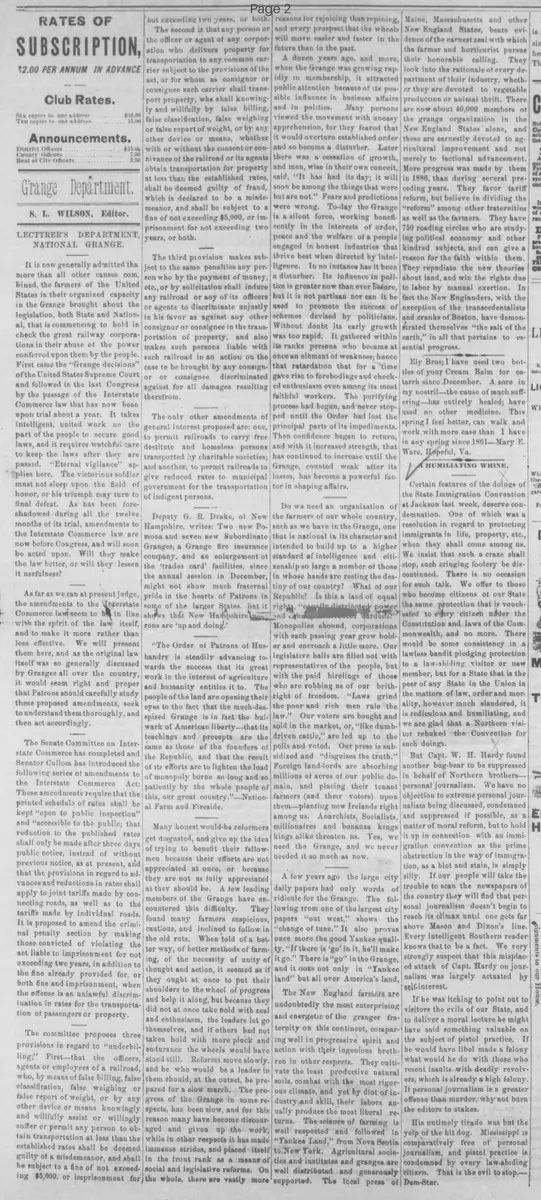
S. L. WILSON, Editor
LECTURER'S DEPARTMENT,
NATIONAL GRANGE.
It is now generally admitted that more than all other causes combined, the farmers of the United States in their organized capacity in the Grange brought about the legislation, both State and National, that is commencing to hold in check the great railway corporations in their abuse of the power conferred upon them by the people. First came the "Grange decisions" of the United States Supreme Court and followed in the last Congress by the passage of the Interstate Commerce law that has now been upon trial about a year. It takes intelligent, united work on the part of the people to secure good laws, and it requires watchful care to keep the laws after they are passed. "Eternal vigilance" applies here. The victorious soldier must not sleep upon the field of honor, or his triumph may turn to final defeat. As has been foreshadowed during all the twelve months of its trial, amendments to the Interstate Commerce law are now before Congress, and will soon be acted upon. Will they make the law better, or will they lessen its usefulness?
As far as we can at present judge, the amendments to the Interstate Commerce law seem to be in line with the spirit of the law itself, and to make it more rather than less effective. We will present them here, and as the original law itself was so generally discussed by Granges all over the country, it would seem right and proper that Patrons should carefully study these proposed amendments, seek to understand them thoroughly, and then act accordingly.
The Senate Committee on Interstate Commerce has completed and Senator Cullom has introduced the following series of amendments to the Interstate Commerce Act:
These amendments require that the printed schedule of rates shall be kept "open to public inspection" and "accessible to the public"; that reduction to the published rates shall only be made after three days public notice, instead of without previous notice, as at present, and that the provisions in regard to advances and reductions in rates shall apply to joint tariffs made by connecting roads, as well as to the tariffs made by individual roads.
It is proposed to amend the criminal penalty section by making those convicted of violating the act liable to imprisonment for not exceeding two years, in addition to the fine already provided for, or both fine and imprisonment, when the offense is an unlawful discrimination in rates for the transportation of passengers or property.
The committee proposes three provisions in regard to "underbilling;" First—that the officers, agents or employees of a railroad, who, by means of false billing, false classification, false weighing or false report of weight, or by any other device or means knowingly and willfully assist or willingly suffer or permit any person to obtain transportation at less than the established rates shall be deemed guilty of a misdemeanor, and shall be subject to a fine of not exceeding $5,000, or imprisonment for not exceeding two years, or both.
The second is that any person or the officer or agent of any corporation who delivers property for transportation to any common carrier subject to the provisions of the act, or for whom as consignor or consignee such carrier shall transport property, who shall knowingly and willfully by false billing, false classification, false weighing or false report of weight, or by any other device or means, whether with or without the consent or connivance of the railroad or its agents obtain transportation for property at less than the established rates, shall be deemed guilty of fraud, which is declared to be a misdemeanor, and shall be subject to a fine of not exceeding $5,000, or imprisonment for not exceeding two years, or both.
The third provision makes subject to the same penalties any person who by the payment of money, etc., or by solicitation shall induce any railroad or any of its officers or agents to discriminate unjustly in his favor as against any other consignor or consignee in the transportation of property, and also makes such persons liable with such railroad in an action on the case to be brought by any consignor or consignee discriminated against for all damages resulting therefrom.
The only other amendments of general interest proposed are: one, to permit railroads to carry free destitute and homeless persons transported by charitable societies; and another, to permit railroads to give reduced rates to municipal government for the transportation of indigent persons.
Deputy G. R. Drake, of New Hampshire, writes: Two new Pomona and seven new Subordinate Granges, a Grange fire insurance company, and an enlargement of the 'trades card' facilities, since the annual session in December, might not show much fraternal pride in the hearts of Patrons in some of the larger States, but it shows that New Hampshire Patrons are 'up and doing.'
"The Order of Patrons of Husbandry is steadily advancing towards the success that its great work in the interest of agriculture and humanity entitles it to. The people of the land are opening their eyes to the fact that the much-despised Grange is in fact the bulwark of American liberty—that its teachings and precepts are the same as those of the founders of the Republic, and that the result of its efforts are to lighten the load of monopoly borne so long and so patiently by the whole people of this, our great country."
—National Farm and Fireside.
Many honest would-be reformers get disgusted, and give up the idea of trying to benefit their fellow-men because their efforts are not appreciated at once, or because they are not as fully appreciated as they should be. A few leading members of the Grange have encountered this difficulty. They found many farmers suspicious, cautious, and inclined to follow in the old ruts. When told of a better way, of better methods of farming, of the necessity of unity of thought and action, it seemed as if they ought at once to put their shoulders to the wheel of progress and help it along, but because they did not at once take hold with zeal and enthusiasm, the leaders let go themselves, and if others had not taken hold with more pluck and endurance the wheels would have stood still. Reforms move slowly, and he who would be a leader in them should, at the outset, be prepared for a slow march. The progress of the Grange in some respects, has been slow, and for this reason many have become discouraged and given up the work; while in other respects it has made immense strides, and placed itself in the front rank as a means of social and legislative reforms. On the whole, there are vastly more reasons for rejoicing than repining and every prospect that the wheels will move easier and faster in the future than in the past.
A dozen years ago, and more, when the Grange was growing rapidly in membership, it attracted public attention because of its possible influence in business affairs and in politics. Many persons viewed the movement with uneasy apprehension, for they feared that it would overturn established order and so become a disturber. Later there was a cessation of growth, and men, wise in their own conceit, said, "It has had its day; it will soon be among the things that were but are not." Fears and predictions were wrong. To-day the Grange is a silent force, working beneficently in the interests of order, peace and the welfare of a people engaged in honest industries that thrive best when directed by intelligence. In no instance has it been a disturber. Its influence in politics is greater now than ever before, but it is not partisan nor can it be used to promote the success of schemes devised by politicians.
Without doubt its early growth was too rapid. It gathered within its ranks persons who became at once an element of weakness; hence that retardation that for a time gave rise to forebodings and checked enthusiasm even among its most faithful workers. The purifying process had begun, and never stopped until the Order had lost the principal parts of its impediments. Then confidence began to return, and with it increased strength, that has continued to increase until the Grange, counted weak after its losses, has become a powerful factor in shaping affairs.
Do we need an organization of the farmers of our whole country, such as we have in the Grange, one that is national in its character and intended to build up to a higher standard of intelligence and citizenship so large a number of those in whose hands are resting the destiny of our country? What of our Republic? Is this a land of equal rights, "equally distributed power and authority?"
Monopolies abound, corporations with each passing year grow bolder and encroach a little more. Our legislative halls are filled not with representatives of the people, but with the paid hirelings of those who are robbing us of our birthright of freedom. "Laws grind the poor and rich men rule the law." Our voters are bought and sold in the market, or, "like dumb-driven cattle," are led up to the polls and voted. Our press is subsidized and "disguises the truth." Foreign land-lords are absorbing millions of acres of our public domain, and placing their tenant farmers (and their voters) upon them—planting new Irelands right among us. Anarchists, Socialists, millionaires and bonanza kings alike threaten us. Yes, we need the Grange, and we never needed it so much as now.
A few years ago the large city daily papers had only words of ridicule for the Grange. The following from one of the largest city papers "out west," shows the "change of tune." It also proves once more the good Yankee quality, "If there is 'go' in it, he'll make it go." There is "go" in the Grange, and it goes not only in "Yankee land" but all over America's land.
The New England farmers are undoubtedly the most enterprising and energetic of the granger fraternity on this continent, comparing well in progressive spirit and action with their ingenious brethren in other respects. They cultivate the least productive natural soils, combat with the most rigorous climate, and yet by dint of industry and skill, their labors annually produce the most liberal returns. The science of farming is well respected and followed in "Yankee Land," from Nova Scotia to New York. Agricultural societies and institutes and granges are well distributed and generously supported. The local press of Maine, Massachusetts and other New England States, bears evidence of the earnest zeal with which the farmer and horticulturist pursue their honorable calling. They look into the rationale of every department of their industry, whether they are devoted to vegetable production or animal thrift. There are now about 40,000 members of the grange organization in the New England States alone, and these are earnestly devoted to agricultural improvement and not merely to factional advancement. More progress was made by them in 1886, than during several preceding years. They favor tariff reform, but believe in dividing the "reform" among other fraternities as well as the farmers. They have 750 reading circles who are studying political economy and other kindred subjects, and can give a reason for the faith within them. They repudiate the new theories about land, and win the rights due to labor by manual exertion. In fact the New Englanders, with the exception of the transcendentalists and cranks of Boston, have demonstrated themselves "the salt of the earth," in all that pertains to essential progress.
What sub-type of article is it?
What themes does it cover?
What keywords are associated?
What entities or persons were involved?
Where did it happen?
Story Details
Key Persons
Location
United States
Event Date
About A Year After Passage Of The Interstate Commerce Law
Story Details
The Grange's influence in achieving Supreme Court decisions and the Interstate Commerce Act to regulate railways; proposed amendments to enhance the law's effectiveness against abuses; reports of Grange growth in New Hampshire; reflections on slow but steady progress, purification, and necessity against monopolies; praise for New England farmers' enterprise and agricultural dedication.