Thank you for visiting SNEWPapers!
Sign up free
Story
February 24, 1870
The Republican Journal
Belfast, Waldo County, Maine
What is this article about?
Admiral Fitzroy's observations on weather prediction using sky colors, cloud formations, bird and animal behavior, dew, fog, and atmospheric signs to forecast fine weather, wind, rain, or storms.
Clipping
OCR Quality
95%
Excellent
Full Text
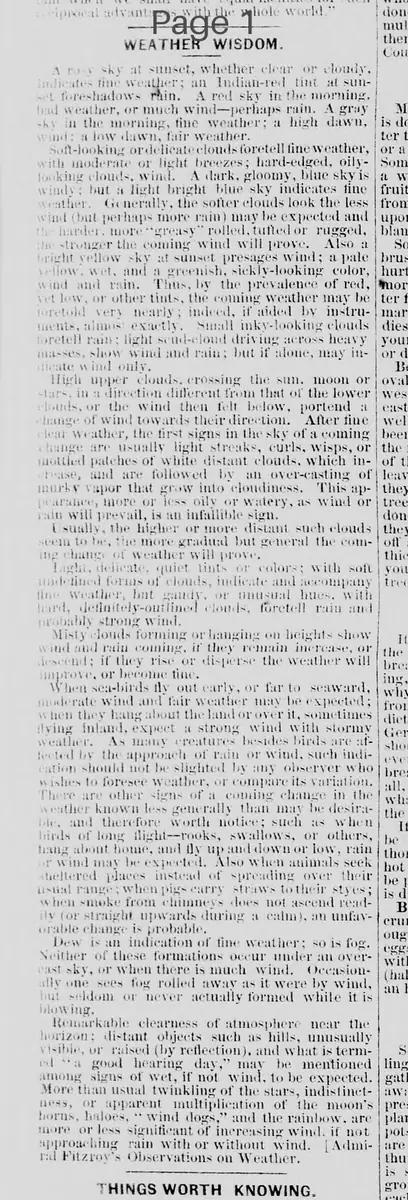
WEATHER WISDOM.
A red sky at sunset, whether clear or cloudy, promises fine weather; an Indian-red tint at sunset foreshadows wind. A red sky in the morning, bad weather, or much wind—perhaps rain. A gray sky in the morning, fine weather; a high dawn, wind: a low dawn, fair weather.
Soft-looking or delicate clouds foretell fine weather, with moderate or light breezes; hard-edged, oily-looking clouds, wind. A dark, gloomy, blue sky is windy; but a light bright blue sky indicates fine weather. Generally, the softer clouds look the less wind (but perhaps more rain) may be expected and the harder, more 'greasy' rolled, tufted or rugged, the stronger the coming wind will prove. Also a bright yellow sky at sunset presages wind; a pale yellow, wet, and a greenish, sickly-looking color, wind and rain. Thus, by the prevalence of red, white, yellow, or other tints, the coming weather may be foretold very nearly; indeed, if aided by instruments, almost exactly. Small inky-looking clouds foretell rain; light scud-cloud driving across heavy masses, show wind and rain; but if alone, may indicate wind only.
High upper clouds, crossing the sun, moon or stars, in a direction different from that of the lower clouds, or the wind then felt below, portend a change of wind towards their direction. 'After fine clear weather, the first signs in the sky of a coming change are usually light streaks, curls, wisps, or mottled patches of white distant clouds, which increase, and are followed by an over-casting of murky vapor that grow into cloudiness. This appearance, more or less oily or watery, as wind or calm will prevail, is an infallible sign.
Usually, the higher or more distant such clouds seem to be, the more gradual but general the coming change of weather will prove. High, light, quiet tints or colors: with soft rounded forms of clouds, indicate and accompany fine weather, but gaudy, or unusual hues, with iridescently-outlined clouds, foretell rain and probably strong wind.
Misty clouds forming or hanging on heights show storm and rain coming, if they remain, increase, or descend; if they rise or disperse the weather will improve, or become fine.
When sea-birds fly out early, or far to seaward, moderate wind and fair weather may be expected; when they hang about the land or over it, sometimes diving inland, expect a strong wind with stormy weather. As many creatures besides birds are affected by the approach of rain or wind, such indication should not be slighted by any observer who wishes to foresee weather, or compare its variation.
There are other signs of a coming change in the weather known less generally than may be desirable, and therefore worth notice; such as when birds of long flight—rooks, swallows, or others, hang about home, and fly up and down or low, rain or wind may be expected. Also when animals seek sheltered places instead of spreading over their usual range; when pigs carry straws to their styes; when smoke from chimneys does not ascend readily (or straight upwards during a calm), an unfavorable change is probable.
Dew is an indication of fine weather; so is fog. Neither of these formations occur under an overcast sky, or when there is much wind. Occasionally one sees fog rolled away as it were by wind, but seldom or never actually formed while it is blowing.
Remarkable clearness of atmosphere near the horizon; distant objects such as hills, unusually visible, or raised (by reflection), and what is termed 'a good hearing day,' may be mentioned among signs of wet, if not wind, to be expected.
More than usual twinkling of the stars, indistinctness, or apparent multiplication of the moon's horns, haloes, 'wind dogs,' and the rainbow, are more or less significant of increasing wind, if not approaching rain with or without wind. [Admiral Fitzroy's Observations on Weather.]
A red sky at sunset, whether clear or cloudy, promises fine weather; an Indian-red tint at sunset foreshadows wind. A red sky in the morning, bad weather, or much wind—perhaps rain. A gray sky in the morning, fine weather; a high dawn, wind: a low dawn, fair weather.
Soft-looking or delicate clouds foretell fine weather, with moderate or light breezes; hard-edged, oily-looking clouds, wind. A dark, gloomy, blue sky is windy; but a light bright blue sky indicates fine weather. Generally, the softer clouds look the less wind (but perhaps more rain) may be expected and the harder, more 'greasy' rolled, tufted or rugged, the stronger the coming wind will prove. Also a bright yellow sky at sunset presages wind; a pale yellow, wet, and a greenish, sickly-looking color, wind and rain. Thus, by the prevalence of red, white, yellow, or other tints, the coming weather may be foretold very nearly; indeed, if aided by instruments, almost exactly. Small inky-looking clouds foretell rain; light scud-cloud driving across heavy masses, show wind and rain; but if alone, may indicate wind only.
High upper clouds, crossing the sun, moon or stars, in a direction different from that of the lower clouds, or the wind then felt below, portend a change of wind towards their direction. 'After fine clear weather, the first signs in the sky of a coming change are usually light streaks, curls, wisps, or mottled patches of white distant clouds, which increase, and are followed by an over-casting of murky vapor that grow into cloudiness. This appearance, more or less oily or watery, as wind or calm will prevail, is an infallible sign.
Usually, the higher or more distant such clouds seem to be, the more gradual but general the coming change of weather will prove. High, light, quiet tints or colors: with soft rounded forms of clouds, indicate and accompany fine weather, but gaudy, or unusual hues, with iridescently-outlined clouds, foretell rain and probably strong wind.
Misty clouds forming or hanging on heights show storm and rain coming, if they remain, increase, or descend; if they rise or disperse the weather will improve, or become fine.
When sea-birds fly out early, or far to seaward, moderate wind and fair weather may be expected; when they hang about the land or over it, sometimes diving inland, expect a strong wind with stormy weather. As many creatures besides birds are affected by the approach of rain or wind, such indication should not be slighted by any observer who wishes to foresee weather, or compare its variation.
There are other signs of a coming change in the weather known less generally than may be desirable, and therefore worth notice; such as when birds of long flight—rooks, swallows, or others, hang about home, and fly up and down or low, rain or wind may be expected. Also when animals seek sheltered places instead of spreading over their usual range; when pigs carry straws to their styes; when smoke from chimneys does not ascend readily (or straight upwards during a calm), an unfavorable change is probable.
Dew is an indication of fine weather; so is fog. Neither of these formations occur under an overcast sky, or when there is much wind. Occasionally one sees fog rolled away as it were by wind, but seldom or never actually formed while it is blowing.
Remarkable clearness of atmosphere near the horizon; distant objects such as hills, unusually visible, or raised (by reflection), and what is termed 'a good hearing day,' may be mentioned among signs of wet, if not wind, to be expected.
More than usual twinkling of the stars, indistinctness, or apparent multiplication of the moon's horns, haloes, 'wind dogs,' and the rainbow, are more or less significant of increasing wind, if not approaching rain with or without wind. [Admiral Fitzroy's Observations on Weather.]
What sub-type of article is it?
Curiosity
What themes does it cover?
Nature
What keywords are associated?
Weather Signs
Sky Colors
Cloud Formations
Bird Behavior
Animal Indicators
Atmospheric Phenomena
Rain Prediction
Wind Forecast
What entities or persons were involved?
Admiral Fitzroy
Story Details
Key Persons
Admiral Fitzroy
Story Details
Collection of natural signs from sky colors, cloud types, bird and animal behaviors, dew, fog, and atmospheric phenomena to predict weather changes like wind, rain, or fine conditions.