Thank you for visiting SNEWPapers!
Sign up free
Foreign News
December 5, 1809
The Rhode Island American, And General Advertiser
Providence, Providence County, Rhode Island
What is this article about?
British commentary on French diplomat Champagny's letter to US General Armstrong, rejecting France's maritime claims that neutral flags protect enemy goods and defending seizures at sea amid Anglo-French tensions.
Clipping
OCR Quality
98%
Excellent
Full Text
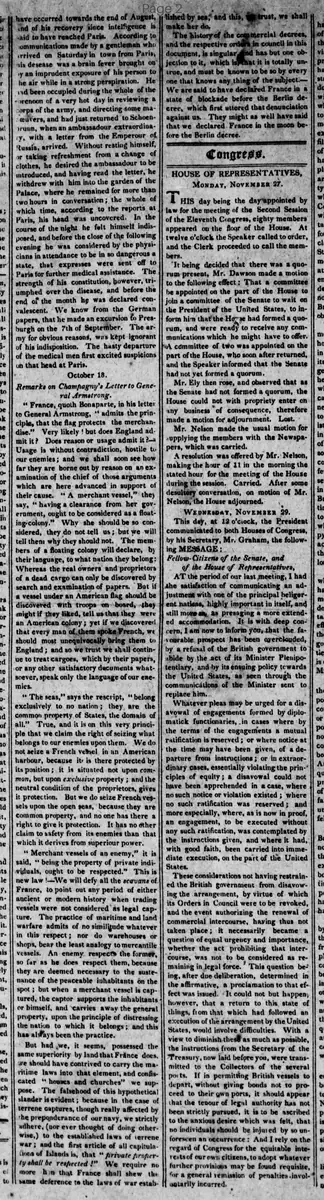
October 18.
Remarks on Champagny's Letter to General
Armstrong.
"France, quoth Bonaparte, in his letter
to General Armstrong, "admits the prin-
ciple, that the flag protects the merchan-
dise." Very likely! but does England ad-
mit it? Does reason or usage admit it?-
Usage is without contradiction, hostile to
our enemies; and we shall soon see how
far they are borne out by reason on an ex-
amination of the chief of those arguments
which are here advanced in support of
their cause. "A merchant vessel," they
say, "having a clearance from her gov-
ernment, ought to be considered as a float-
ing colony." Why she should be so con-
sidered, they do not tell us; but we will
tell them why they should not. The mem-
bers of a floating colony will declare, by
their language, to what nation they belong:
Whereas the real owners and proprietors
of a dead cargo can only be discovered by
search and examination of papers. But if
a vessel under an American flag should be
discovered with troops on board, -they
might if they liked, tell us that they were
an American colony; yet if we discovered
that every man of them spoke French, we
should most unequivocally bring them to
England; and so we trust we shall contin-
ue to treat cargoes, which by their papers,
or any other satisfactory documents what-
soever, speak only the language of our ene-
mies.
"The seas," says the rescript, "belong
exclusively to no nation; they are the
common property of States, the domain of
all." True, and it is on this very princi-
ple that we claim the right of seizing what
belongs to our enemies upon them. We do
not seize a French vessel in an American
harbour, because it is there protected by
its position; it is situated not upon com-
mon, but upon exclusive property; and the
neutral condition of the proprietors, gives
it protection. But we do seize French ves-
sels upon the open seas, because they are
common property, and no one has there a
right to give it protection. It has no other
claim to safety from its enemies than that
which it derives from superior power.
"Merchant vessels of an enemy," it is
said, "being the property of private indi-
viduals, ought to be respected." This is
new law! We will defy all the savans of
France, to point out any period of either
ancient or modern history when trading
vessels were not considered as legal cap-
ture. The practice of maritime and land
warfare admits of no similitude whatever
in this respect; nor do warehouses or
shops, bear the least analogy to mercantile
vessels. An enemy respects the former,
so far as he does respect them, because
they are deemed necessary to the suste-
nance of the peaceable inhabitants on the
spot; but when a merchant vessel is cap-
tured, the captor supports the inhabitants
of himself, and carries away the general
property, upon the principle of distressing
the nation to which it belongs; and this
has always been the practice.
But had we, it seems, possessed the
same superiority by land that France does,
we should have contrived to carry the ma-
ritime laws into that element, and confis-
cated "houses and churches" we sup-
pose. The falsehood of this hypothetical
slander is evident; because in the case of
terrene captures, though really affected by
the preponderance of our navy, we strictly
adhere (nor ever thought of doing other-
wise,) to the established laws of terrene
war; and the first article of all capitula-
tions of Islands is, that "private proper-
ty shall be respected!" We require no
more than that France shall shew the
same deference to the laws of war estab-
lished by sea, and this, trust, we shall
make her do.
The history of the commercial decrees
and the respective order in council in this
document, is singular and has but one ob-
jection to it, which is, that it is totally un-
true, and must be known to be so by every
one that knows any thing of the subject.-
We are said to have declared France in a
state of blockade before the Berlin de-
cree, which first uttered that denunciation
against us. They might as well have said
that we declared France in the moon be-
fore the Berlin decree.
Remarks on Champagny's Letter to General
Armstrong.
"France, quoth Bonaparte, in his letter
to General Armstrong, "admits the prin-
ciple, that the flag protects the merchan-
dise." Very likely! but does England ad-
mit it? Does reason or usage admit it?-
Usage is without contradiction, hostile to
our enemies; and we shall soon see how
far they are borne out by reason on an ex-
amination of the chief of those arguments
which are here advanced in support of
their cause. "A merchant vessel," they
say, "having a clearance from her gov-
ernment, ought to be considered as a float-
ing colony." Why she should be so con-
sidered, they do not tell us; but we will
tell them why they should not. The mem-
bers of a floating colony will declare, by
their language, to what nation they belong:
Whereas the real owners and proprietors
of a dead cargo can only be discovered by
search and examination of papers. But if
a vessel under an American flag should be
discovered with troops on board, -they
might if they liked, tell us that they were
an American colony; yet if we discovered
that every man of them spoke French, we
should most unequivocally bring them to
England; and so we trust we shall contin-
ue to treat cargoes, which by their papers,
or any other satisfactory documents what-
soever, speak only the language of our ene-
mies.
"The seas," says the rescript, "belong
exclusively to no nation; they are the
common property of States, the domain of
all." True, and it is on this very princi-
ple that we claim the right of seizing what
belongs to our enemies upon them. We do
not seize a French vessel in an American
harbour, because it is there protected by
its position; it is situated not upon com-
mon, but upon exclusive property; and the
neutral condition of the proprietors, gives
it protection. But we do seize French ves-
sels upon the open seas, because they are
common property, and no one has there a
right to give it protection. It has no other
claim to safety from its enemies than that
which it derives from superior power.
"Merchant vessels of an enemy," it is
said, "being the property of private indi-
viduals, ought to be respected." This is
new law! We will defy all the savans of
France, to point out any period of either
ancient or modern history when trading
vessels were not considered as legal cap-
ture. The practice of maritime and land
warfare admits of no similitude whatever
in this respect; nor do warehouses or
shops, bear the least analogy to mercantile
vessels. An enemy respects the former,
so far as he does respect them, because
they are deemed necessary to the suste-
nance of the peaceable inhabitants on the
spot; but when a merchant vessel is cap-
tured, the captor supports the inhabitants
of himself, and carries away the general
property, upon the principle of distressing
the nation to which it belongs; and this
has always been the practice.
But had we, it seems, possessed the
same superiority by land that France does,
we should have contrived to carry the ma-
ritime laws into that element, and confis-
cated "houses and churches" we sup-
pose. The falsehood of this hypothetical
slander is evident; because in the case of
terrene captures, though really affected by
the preponderance of our navy, we strictly
adhere (nor ever thought of doing other-
wise,) to the established laws of terrene
war; and the first article of all capitula-
tions of Islands is, that "private proper-
ty shall be respected!" We require no
more than that France shall shew the
same deference to the laws of war estab-
lished by sea, and this, trust, we shall
make her do.
The history of the commercial decrees
and the respective order in council in this
document, is singular and has but one ob-
jection to it, which is, that it is totally un-
true, and must be known to be so by every
one that knows any thing of the subject.-
We are said to have declared France in a
state of blockade before the Berlin de-
cree, which first uttered that denunciation
against us. They might as well have said
that we declared France in the moon be-
fore the Berlin decree.
What sub-type of article is it?
Diplomatic
Naval Affairs
War Report
What keywords are associated?
Champagny Letter
Maritime Law
Neutral Flag
Enemy Merchandise
Blockade
Berlin Decree
What entities or persons were involved?
Bonaparte
General Armstrong
Champagny
Where did it happen?
France
Foreign News Details
Primary Location
France
Event Date
October 18
Key Persons
Bonaparte
General Armstrong
Champagny
Event Details
Remarks critiquing Champagny's letter to General Armstrong on maritime principles, arguing against France's claim that a neutral flag protects enemy merchandise, defending British seizure practices on the high seas, and refuting French assertions on blockades and historical maritime law.