Thank you for visiting SNEWPapers!
Sign up free
Editorial
March 14, 1959
Jackson Advocate
Jackson, Hinds County, Mississippi
What is this article about?
Editorial reflects on a school bus accident in Georgia involving Negro children, highlighting interracial rescue efforts and southern personal regard for individuals despite racial tensions, quoting James McBride Dabbs on shared humanity and optimism for future racial accommodation.
Clipping
OCR Quality
98%
Excellent
Full Text
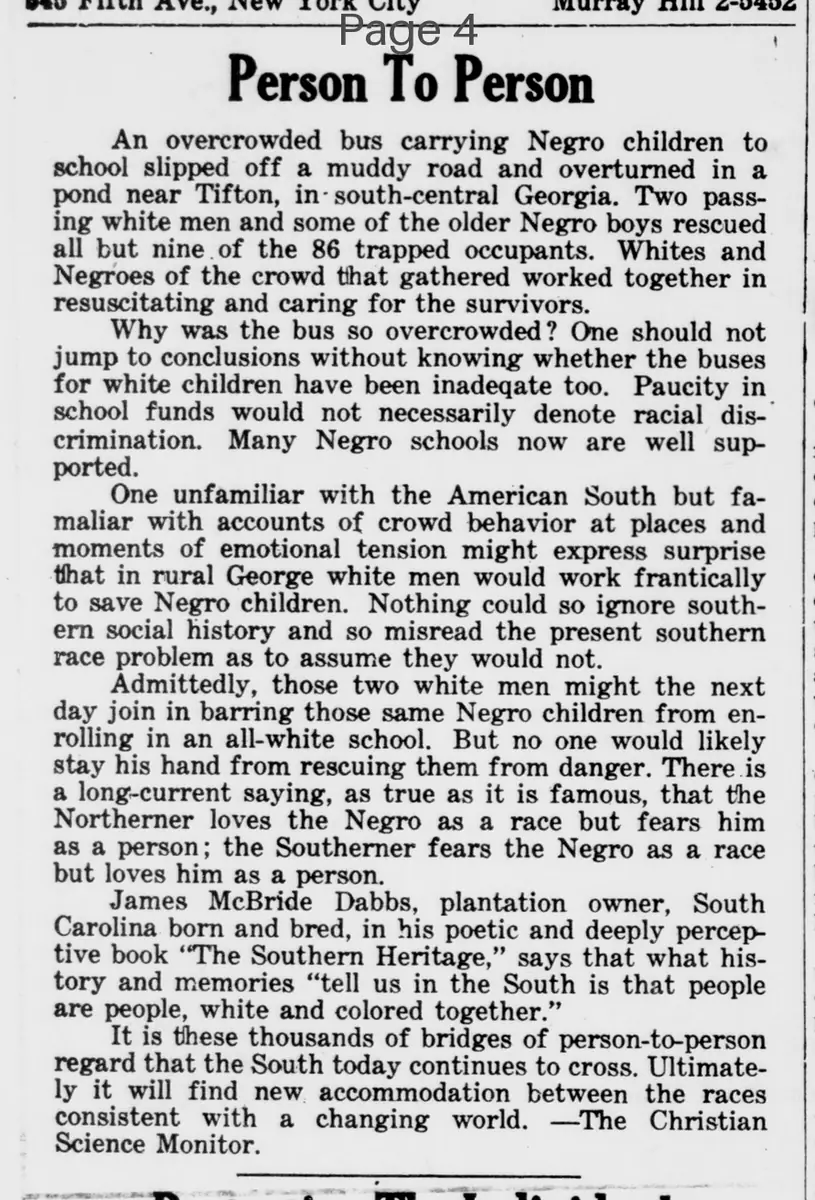
Person To Person
An overcrowded bus carrying Negro children to school slipped off a muddy road and overturned in a pond near Tifton, in south-central Georgia. Two passing white men and some of the older Negro boys rescued all but nine of the 86 trapped occupants. Whites and Negroes of the crowd that gathered worked together in resuscitating and caring for the survivors.
Why was the bus so overcrowded? One should not jump to conclusions without knowing whether the buses for white children have been inadequate too. Paucity in school funds would not necessarily denote racial discrimination. Many Negro schools now are well supported.
One unfamiliar with the American South but familiar with accounts of crowd behavior at places and moments of emotional tension might express surprise that in rural Georgia white men would work frantically to save Negro children. Nothing could so ignore southern social history and so misread the present southern race problem as to assume they would not.
Admittedly, those two white men might the next day join in barring those same Negro children from enrolling in an all-white school. But no one would likely stay his hand from rescuing them from danger. There is a long-current saying, as true as it is famous, that the Northerner loves the Negro as a race but fears him as a person; the Southerner fears the Negro as a race but loves him as a person.
James McBride Dabbs, plantation owner, South Carolina born and bred, in his poetic and deeply perceptive book "The Southern Heritage," says that what history and memories "tell us in the South is that people are people, white and colored together."
It is these thousands of bridges of person-to-person regard that the South today continues to cross. Ultimately it will find new accommodation between the races consistent with a changing world. -The Christian Science Monitor.
An overcrowded bus carrying Negro children to school slipped off a muddy road and overturned in a pond near Tifton, in south-central Georgia. Two passing white men and some of the older Negro boys rescued all but nine of the 86 trapped occupants. Whites and Negroes of the crowd that gathered worked together in resuscitating and caring for the survivors.
Why was the bus so overcrowded? One should not jump to conclusions without knowing whether the buses for white children have been inadequate too. Paucity in school funds would not necessarily denote racial discrimination. Many Negro schools now are well supported.
One unfamiliar with the American South but familiar with accounts of crowd behavior at places and moments of emotional tension might express surprise that in rural Georgia white men would work frantically to save Negro children. Nothing could so ignore southern social history and so misread the present southern race problem as to assume they would not.
Admittedly, those two white men might the next day join in barring those same Negro children from enrolling in an all-white school. But no one would likely stay his hand from rescuing them from danger. There is a long-current saying, as true as it is famous, that the Northerner loves the Negro as a race but fears him as a person; the Southerner fears the Negro as a race but loves him as a person.
James McBride Dabbs, plantation owner, South Carolina born and bred, in his poetic and deeply perceptive book "The Southern Heritage," says that what history and memories "tell us in the South is that people are people, white and colored together."
It is these thousands of bridges of person-to-person regard that the South today continues to cross. Ultimately it will find new accommodation between the races consistent with a changing world. -The Christian Science Monitor.
What sub-type of article is it?
Social Reform
Moral Or Religious
What keywords are associated?
Race Relations
Southern Heritage
School Bus Accident
Interracial Rescue
Racial Accommodation
What entities or persons were involved?
James Mcbride Dabbs
The Christian Science Monitor
Negro Children
White Men
Tifton, Georgia
Editorial Details
Primary Topic
Person To Person Racial Regard In The South
Stance / Tone
Optimistic About Interracial Accommodation
Key Figures
James Mcbride Dabbs
The Christian Science Monitor
Negro Children
White Men
Tifton, Georgia
Key Arguments
Overcrowded Bus May Not Indicate Racial Discrimination If White Buses Are Also Inadequate
White Men In Rural Georgia Would Rescue Negro Children Despite Social Tensions
Southerners Love Negroes As Persons But Fear Them As A Race, Unlike Northerners
History And Memories Affirm That People Are People, White And Colored Together
Person To Person Bridges Will Lead To New Racial Accommodation In A Changing World