Thank you for visiting SNEWPapers!
Sign up free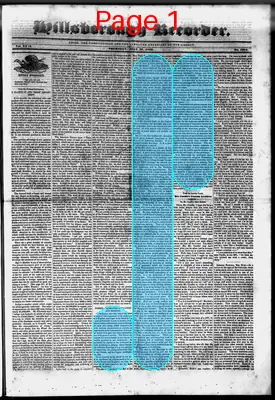
Editorial
July 10, 1845
The Hillsborough Recorder
Hillsboro, Orange County, North Carolina
What is this article about?
Editorial argues that American women's superior domestic happiness and respect stem not from intellectual education, as German writer Dr. Veher claims, but from voluntary marriages and deep moral/religious principles, contrasting with European norms. Praises practical liberty education but emphasizes piety's role in society.
Clipping
OCR Quality
95%
Excellent
Full Text
WOMEN-MARRIAGES-EDUCATION AND READING.
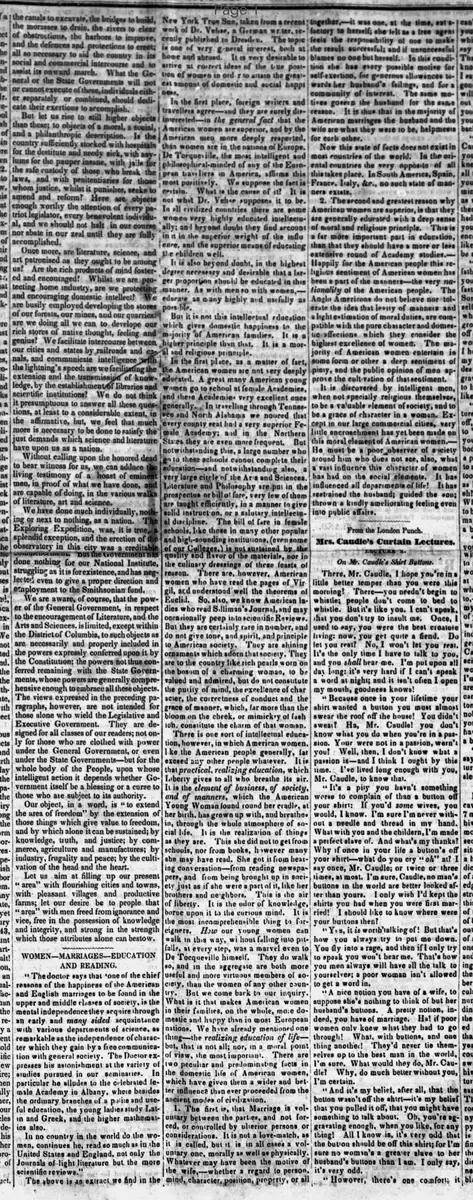
" The doctor says that 'one of the chief reasons of the happiness of the American and English marriages to be found in the upper and middle classes of society, is the mental independence they acquire through an early and many sided acquaintance with various departments of science, as remarkable as the independence of character which they gain by a free communication with general society. The Doctor expresses his astonishment at the variety of studies pursued in our seminaries. In particular he alludes to the celebrated female Academy in Albany, where besides the ordinary branches of a polite and useful education, the young ladies study Latin and Greek, and the higher mathematics also.
In no country in the world do the women, continues he, read so much as in the United States and England, not only the Journals of light literature but the more scientific reviews."
The above is an extract we find in the New York Tribune Sun, taken from a recent work of Dr. Veher, a German writer, recently published in Dresden. The topic is one of very general interest, both at home and abroad. It is very desirable to arrive at correct ideas of the true position of woman in order to attain the greatest amount of domestic and social happiness.
In the first place, foreign writers and travellers agree—and they are surely disinterested in the general fact—that the American women are superior, and by the American men more deeply respected, than women are in the nations of Europe. De Tocqueville, the most intelligent and philosophical-minded of any of the European travellers in America, affirms this most positively. We suppose the fact is certain. What is the cause of it? It is not what Dr. Veher supposes it to be.
In all civilized countries there are some women very highly educated intellectually; and beyond doubt they find account in it in the superior weight of the influence, and the superior means of educating the children well. It is also beyond doubt, in the highest degree necessary and desirable that a larger proportion should be educated in this manner. As with men so with women,—educate as many highly and usefully as possible.
But it is not this intellectual education which gives domestic happiness to the majority of American families. It is a higher principle than that. It is a moral and religious principle.
In the first place, as a matter of fact, the American women are not very deeply educated. A great many American young women go to school at Female Academies, and these Academies very excellent ones generally. In travelling through Tennessee and North Alabama we noticed that every county seat had a very superior Female Academy: and in the Northern States they are even more frequent. But notwithstanding this, a large number who go to these schools cannot complete their education—and notwithstanding also, a very large circle of the Arts and Sciences, Literature and Philosophy are put in the prospectus or bill of fare, very few of them are taught efficiently, in a manner to give solid instruction, or a salutary, intellectual discipline. The bill of fare in female schools, like those in many other popular and high-sounding institutions, (even some of our Colleges,) is not sustained by the quality and flavor of the materials, nor in the culinary dressings of these feasts of reason. There are, however, American women who have read the pages of Virgil, and understood well the theorems of Euclid. So, also, we know American ladies who read Silliman's Journal, and may occasionally peep into scientific Reviews. But they are certainly rare in number, and do not give tone, and spirit, and principle to American society. They are shining ornaments which adorn that society. They are to the country like rich pearls worn on the bosom of a charming woman, to be valued and admired, but do not constitute the purity of mind, the excellence of character, the correctness of conduct and the grace of manner, which, far more than the bloom on the cheek, or mimicry of fashion, constitute the charm of that woman.
There is one sort of intellectual education, however, in which American women, like the American people generally, far exceed any other people whatever. It is that practical, realizing education, which liberty gives to all who breathe its air. It is the element of business, of society, and of manners, which the American Young Woman found round her cradle, at her birth, has grown up with, and breathes in, through the whole atmosphere of social life. It is the realization of things as they are. This she did not get from schools, nor from books, however many she may have read. She got it from hearing conversation—from reading newspapers, and from being brought up in society just as if she were a part of it, like her brothers and neighbors. This is the air of liberty. It is the odor of knowledge, borne upon it to the curious mind. It is the most incomprehensible thing to foreigners. How our young women can walk in this way, without falling into pitfalls, at every step, was a marvel even to De Tocqueville himself. They do walk so, and in the aggregate are both more useful and more virtuous members of society, than the women of any other country. But we come back to our inquiry. What is it that makes American women in their families, on the whole, more domestic and happy than in most European nations. We have already mentioned one thing—the realizing education of life—but, that is not all; nor, in a moral point of view, the most important. There are two peculiar and predominating facts in the domestic life of American women, which have given them a wider and better influence than ever proceeded from the ancient modes of civilization.
1. The first is, that Marriage is voluntary between the parties, and not forced, or controlled by ulterior persons or considerations. It is not a love-match, as it is called, but it is in all cases a voluntary one, morally as well as physically. Whatever may have been the motive of the wife,—whether a regard to person, mind, character, position, property, or all together, it was one, at the time, satisfactory to herself; she felt the responsibility of one to make the result successful; and if unsuccessful blames no one but herself. In this condition she has every possible motive for self-exertion, or generous allowances towards her husband's failings, and for a community of interest. The same motives govern the husband for the same reason. It is thus that in the majority of American marriages the husband and the wife are what they were to be, helpmeets for each other.
Now this state of facts does not exist in most countries of the world. In the oriental countries the very opposite of all this takes place. In South America, Spain, France, Italy, &c., no such state of manners exists.
2. The second and greatest reason why American women are superior, is that they are generally educated with a deep sense of moral and religious principle. This is a far more important part in education, than that they should have a more or less extensive round of Academy studies.—Happily for the American people this religious sentiment of American women has been a part of the manners—the very nationality of the American people. The Anglo Americans do not believe nor tolerate the idea that levity of manners and a light estimation of moral duties, are compatible with the pure character and domestic affections which they consider the highest excellence of women. The majority of American women entertain in some form or other a deep sentiment of piety, and the public opinion of men approve the cultivation of that sentiment. It is discovered by intelligent men, when not specially religious themselves, to be a valuable element of society, and to be a grace of character in a woman. Except in our large commercial cities, very little encroachment has yet been made on this moral element of American women.—He must be a poor observer of society around him who does not see, also, what a vast influence this character of women has had on the social elements. It has influenced all departments of life! It has restrained the husband; guided the son; thrown a kindly ameliorating feeling even into public affairs.
" The doctor says that 'one of the chief reasons of the happiness of the American and English marriages to be found in the upper and middle classes of society, is the mental independence they acquire through an early and many sided acquaintance with various departments of science, as remarkable as the independence of character which they gain by a free communication with general society. The Doctor expresses his astonishment at the variety of studies pursued in our seminaries. In particular he alludes to the celebrated female Academy in Albany, where besides the ordinary branches of a polite and useful education, the young ladies study Latin and Greek, and the higher mathematics also.
In no country in the world do the women, continues he, read so much as in the United States and England, not only the Journals of light literature but the more scientific reviews."
The above is an extract we find in the New York Tribune Sun, taken from a recent work of Dr. Veher, a German writer, recently published in Dresden. The topic is one of very general interest, both at home and abroad. It is very desirable to arrive at correct ideas of the true position of woman in order to attain the greatest amount of domestic and social happiness.
In the first place, foreign writers and travellers agree—and they are surely disinterested in the general fact—that the American women are superior, and by the American men more deeply respected, than women are in the nations of Europe. De Tocqueville, the most intelligent and philosophical-minded of any of the European travellers in America, affirms this most positively. We suppose the fact is certain. What is the cause of it? It is not what Dr. Veher supposes it to be.
In all civilized countries there are some women very highly educated intellectually; and beyond doubt they find account in it in the superior weight of the influence, and the superior means of educating the children well. It is also beyond doubt, in the highest degree necessary and desirable that a larger proportion should be educated in this manner. As with men so with women,—educate as many highly and usefully as possible.
But it is not this intellectual education which gives domestic happiness to the majority of American families. It is a higher principle than that. It is a moral and religious principle.
In the first place, as a matter of fact, the American women are not very deeply educated. A great many American young women go to school at Female Academies, and these Academies very excellent ones generally. In travelling through Tennessee and North Alabama we noticed that every county seat had a very superior Female Academy: and in the Northern States they are even more frequent. But notwithstanding this, a large number who go to these schools cannot complete their education—and notwithstanding also, a very large circle of the Arts and Sciences, Literature and Philosophy are put in the prospectus or bill of fare, very few of them are taught efficiently, in a manner to give solid instruction, or a salutary, intellectual discipline. The bill of fare in female schools, like those in many other popular and high-sounding institutions, (even some of our Colleges,) is not sustained by the quality and flavor of the materials, nor in the culinary dressings of these feasts of reason. There are, however, American women who have read the pages of Virgil, and understood well the theorems of Euclid. So, also, we know American ladies who read Silliman's Journal, and may occasionally peep into scientific Reviews. But they are certainly rare in number, and do not give tone, and spirit, and principle to American society. They are shining ornaments which adorn that society. They are to the country like rich pearls worn on the bosom of a charming woman, to be valued and admired, but do not constitute the purity of mind, the excellence of character, the correctness of conduct and the grace of manner, which, far more than the bloom on the cheek, or mimicry of fashion, constitute the charm of that woman.
There is one sort of intellectual education, however, in which American women, like the American people generally, far exceed any other people whatever. It is that practical, realizing education, which liberty gives to all who breathe its air. It is the element of business, of society, and of manners, which the American Young Woman found round her cradle, at her birth, has grown up with, and breathes in, through the whole atmosphere of social life. It is the realization of things as they are. This she did not get from schools, nor from books, however many she may have read. She got it from hearing conversation—from reading newspapers, and from being brought up in society just as if she were a part of it, like her brothers and neighbors. This is the air of liberty. It is the odor of knowledge, borne upon it to the curious mind. It is the most incomprehensible thing to foreigners. How our young women can walk in this way, without falling into pitfalls, at every step, was a marvel even to De Tocqueville himself. They do walk so, and in the aggregate are both more useful and more virtuous members of society, than the women of any other country. But we come back to our inquiry. What is it that makes American women in their families, on the whole, more domestic and happy than in most European nations. We have already mentioned one thing—the realizing education of life—but, that is not all; nor, in a moral point of view, the most important. There are two peculiar and predominating facts in the domestic life of American women, which have given them a wider and better influence than ever proceeded from the ancient modes of civilization.
1. The first is, that Marriage is voluntary between the parties, and not forced, or controlled by ulterior persons or considerations. It is not a love-match, as it is called, but it is in all cases a voluntary one, morally as well as physically. Whatever may have been the motive of the wife,—whether a regard to person, mind, character, position, property, or all together, it was one, at the time, satisfactory to herself; she felt the responsibility of one to make the result successful; and if unsuccessful blames no one but herself. In this condition she has every possible motive for self-exertion, or generous allowances towards her husband's failings, and for a community of interest. The same motives govern the husband for the same reason. It is thus that in the majority of American marriages the husband and the wife are what they were to be, helpmeets for each other.
Now this state of facts does not exist in most countries of the world. In the oriental countries the very opposite of all this takes place. In South America, Spain, France, Italy, &c., no such state of manners exists.
2. The second and greatest reason why American women are superior, is that they are generally educated with a deep sense of moral and religious principle. This is a far more important part in education, than that they should have a more or less extensive round of Academy studies.—Happily for the American people this religious sentiment of American women has been a part of the manners—the very nationality of the American people. The Anglo Americans do not believe nor tolerate the idea that levity of manners and a light estimation of moral duties, are compatible with the pure character and domestic affections which they consider the highest excellence of women. The majority of American women entertain in some form or other a deep sentiment of piety, and the public opinion of men approve the cultivation of that sentiment. It is discovered by intelligent men, when not specially religious themselves, to be a valuable element of society, and to be a grace of character in a woman. Except in our large commercial cities, very little encroachment has yet been made on this moral element of American women.—He must be a poor observer of society around him who does not see, also, what a vast influence this character of women has had on the social elements. It has influenced all departments of life! It has restrained the husband; guided the son; thrown a kindly ameliorating feeling even into public affairs.
What sub-type of article is it?
Education
Moral Or Religious
Feminism
What keywords are associated?
American Women
Education
Marriage
Moral Principles
Religious Sentiment
Domestic Happiness
Voluntary Marriage
What entities or persons were involved?
Dr. Veher
De Tocqueville
Albany Female Academy
New York Tribune Sun
Editorial Details
Primary Topic
Superiority Of American Women Through Moral And Religious Principles Over Intellectual Education
Stance / Tone
Supportive Of American Women's Moral Education And Voluntary Marriage As Keys To Domestic Happiness
Key Figures
Dr. Veher
De Tocqueville
Albany Female Academy
New York Tribune Sun
Key Arguments
American Women's Happiness Derives From Moral And Religious Principles, Not Intellectual Education
Voluntary Marriages Foster Mutual Responsibility And Success
Practical Education From Liberty And Society Exceeds Formal Schooling
Foreign Observers Note American Women's Superiority And Respect
Religious Sentiment Influences Society Broadly