Thank you for visiting SNEWPapers!
Sign up free
Story
June 28, 1889
The Washington Critic
Washington, District Of Columbia
What is this article about?
An article criticizes John Habberton's piece in Lippincott's Magazine for wrongly crediting John Ericsson with inventing the USS Monitor, asserting it was Theodore R. Timby's creation, patented in 1843, and detailing the historical facts and associations involved during the Civil War era.
Clipping
OCR Quality
95%
Excellent
Full Text
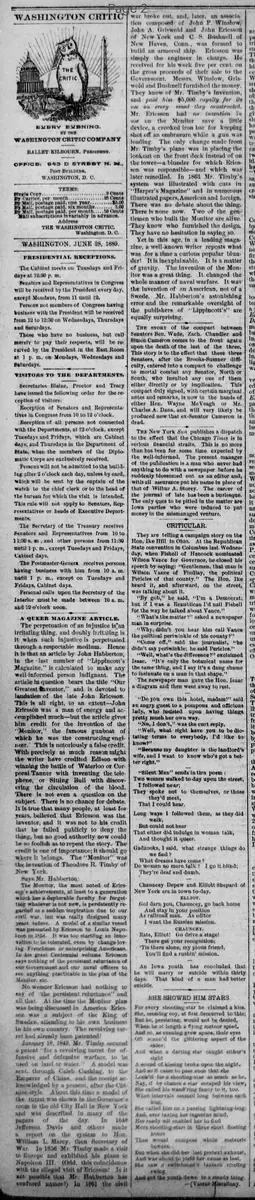
A QUEER MAGAZINE ARTICLE.
The perpetuation of an injustice is an irritating thing, and doubly irritating is it when such injustice is perpetuated through a respectable medium. Hence it is that an article by John Habberton, in the last number of "Lippincott's Magazine," is calculated to make any well-informed person indignant. The article in question bears the title "Our Greatest Inventor," and is devoted to laudation of the late John Ericsson.
This is all right, to an extent—John Ericsson was a man of energy and accomplished much—but the article gives him credit for the invention of the "Monitor," the famous gunboat of which he was the constructing engineer. This is notoriously a false credit. With precisely as much reason might the writer have credited Edison with winning the battle of Waterloo or Corporal Tanner with inventing the telephone, or Sitting Bull with discovering the circulation of the blood.
There is not even a question on the subject. There is no chance for debate. It is true—that many people, at least for years, believed that Ericsson was the inventor, and it was not to his credit that he failed publicly to deny the thing, but no good authority now could be so foolish as to repeat the story. The credit is one of importance; it should go where it belongs. The "Monitor" was the invention of Theodore R. Timby of New York.
Says Mr. Habberton:
The Monitor, the most noted of Ericsson's achievements, at least to a generation which has a deplorable faculty for forgetting whatever is not new, is persistently regarded as a sudden inspiration due to our civil war, but was really designed many years before. A model of a similar vessel was presented by Ericsson to Louis Napoleon in 1854. It was too startling an innovation to be tolerated, even by change-loving Frenchmen or enterprising Americans.
In his great Centennial volume Ericsson says nothing of the persistent reluctance of our Government and our naval officers to see anything practicable in the plan of the Monitor, etc.
No wonder Ericsson had nothing to say of "the persistent reluctance" and all that. At the time the Monitor plan was being discussed in America Ericsson was a subject of the King of Sweden, attending to his own business in his own country. The revolving turret had already been patented January 18, 1848, Mr. Timby secured a patent "for a revolving turret for offensive and defensive warfare, to be used on land or water." A model was sent, through Caleb Cushing, to the Emperor of China, and the receipt acknowledged by a present, after the Chinese style. About this time a model of the turret was shown in the Governor's room in the old City Hall in New York and was described in many of the papers of the day. In 1848 Jefferson Davis and others made a report on the system to Hon. William L. Marcy, then Secretary of War. In 1856 Mr. Timby made a visit to Europe and exhibited his plans to Napoleon III. (Odd, this coincidence with the alleged visit of Ericsson! Is it not possible that Mr. Habberton has confused names?) In 1861 the civil war broke out, and, later, an association composed of John F. Winslow, John A. Griswold and John Ericsson of New York and C. S. Bushnell of New Haven, Conn., was formed to build an armored ship. Ericsson was simply the engineer in charge. He received for his work five per cent. on the gross proceeds of their sale to the Government. Messrs. Winslow, Griswold and Bushnell furnished the money. They knew of Mr. Timby's invention, and paid him $5,000 royally for its use on every vessel they constructed.
Mr. Ericsson had no invention in use on the Monitor save a little device, a crooked iron bar for keeping shot off an embrasure while a gun was loading. The only change made—from Mr. Timby's plans was in placing the lookout on the front deck instead of on the tower—a blunder for which Ericsson was responsible—and which was later remedied. In 1863 Mr. Timby's system was illustrated with cuts in "Harper's Magazine" and in numerous illustrated papers, American and foreign.
There was no debate about the thing. There is none now. Two of the gentlemen who built the Monitor are alive. They know who furnished the design. They have no hesitation in saying so. Yet in this age, in a leading magazine, a well-known writer repeats what was for a time a curious popular blunder! It is inexplicable. It is a matter of gravity. The invention of the Monitor was a great thing. It changed the whole manner of naval warfare. It was the invention of an American, not of a Swede. Mr. Habberton's astonishing error and the remarkable oversight of the publishers of "Lippincott's" are equally surprising.
The perpetuation of an injustice is an irritating thing, and doubly irritating is it when such injustice is perpetuated through a respectable medium. Hence it is that an article by John Habberton, in the last number of "Lippincott's Magazine," is calculated to make any well-informed person indignant. The article in question bears the title "Our Greatest Inventor," and is devoted to laudation of the late John Ericsson.
This is all right, to an extent—John Ericsson was a man of energy and accomplished much—but the article gives him credit for the invention of the "Monitor," the famous gunboat of which he was the constructing engineer. This is notoriously a false credit. With precisely as much reason might the writer have credited Edison with winning the battle of Waterloo or Corporal Tanner with inventing the telephone, or Sitting Bull with discovering the circulation of the blood.
There is not even a question on the subject. There is no chance for debate. It is true—that many people, at least for years, believed that Ericsson was the inventor, and it was not to his credit that he failed publicly to deny the thing, but no good authority now could be so foolish as to repeat the story. The credit is one of importance; it should go where it belongs. The "Monitor" was the invention of Theodore R. Timby of New York.
Says Mr. Habberton:
The Monitor, the most noted of Ericsson's achievements, at least to a generation which has a deplorable faculty for forgetting whatever is not new, is persistently regarded as a sudden inspiration due to our civil war, but was really designed many years before. A model of a similar vessel was presented by Ericsson to Louis Napoleon in 1854. It was too startling an innovation to be tolerated, even by change-loving Frenchmen or enterprising Americans.
In his great Centennial volume Ericsson says nothing of the persistent reluctance of our Government and our naval officers to see anything practicable in the plan of the Monitor, etc.
No wonder Ericsson had nothing to say of "the persistent reluctance" and all that. At the time the Monitor plan was being discussed in America Ericsson was a subject of the King of Sweden, attending to his own business in his own country. The revolving turret had already been patented January 18, 1848, Mr. Timby secured a patent "for a revolving turret for offensive and defensive warfare, to be used on land or water." A model was sent, through Caleb Cushing, to the Emperor of China, and the receipt acknowledged by a present, after the Chinese style. About this time a model of the turret was shown in the Governor's room in the old City Hall in New York and was described in many of the papers of the day. In 1848 Jefferson Davis and others made a report on the system to Hon. William L. Marcy, then Secretary of War. In 1856 Mr. Timby made a visit to Europe and exhibited his plans to Napoleon III. (Odd, this coincidence with the alleged visit of Ericsson! Is it not possible that Mr. Habberton has confused names?) In 1861 the civil war broke out, and, later, an association composed of John F. Winslow, John A. Griswold and John Ericsson of New York and C. S. Bushnell of New Haven, Conn., was formed to build an armored ship. Ericsson was simply the engineer in charge. He received for his work five per cent. on the gross proceeds of their sale to the Government. Messrs. Winslow, Griswold and Bushnell furnished the money. They knew of Mr. Timby's invention, and paid him $5,000 royally for its use on every vessel they constructed.
Mr. Ericsson had no invention in use on the Monitor save a little device, a crooked iron bar for keeping shot off an embrasure while a gun was loading. The only change made—from Mr. Timby's plans was in placing the lookout on the front deck instead of on the tower—a blunder for which Ericsson was responsible—and which was later remedied. In 1863 Mr. Timby's system was illustrated with cuts in "Harper's Magazine" and in numerous illustrated papers, American and foreign.
There was no debate about the thing. There is none now. Two of the gentlemen who built the Monitor are alive. They know who furnished the design. They have no hesitation in saying so. Yet in this age, in a leading magazine, a well-known writer repeats what was for a time a curious popular blunder! It is inexplicable. It is a matter of gravity. The invention of the Monitor was a great thing. It changed the whole manner of naval warfare. It was the invention of an American, not of a Swede. Mr. Habberton's astonishing error and the remarkable oversight of the publishers of "Lippincott's" are equally surprising.
What sub-type of article is it?
Historical Event
Curiosity
Deception Fraud
What themes does it cover?
Deception
Justice
What keywords are associated?
Monitor Invention
Theodore Timby
John Ericsson
Civil War
Revolving Turret
Patent Dispute
Naval Innovation
What entities or persons were involved?
Theodore R. Timby
John Ericsson
John Habberton
John F. Winslow
John A. Griswold
C. S. Bushnell
Caleb Cushing
Jefferson Davis
William L. Marcy
Napoleon Iii
Where did it happen?
New York, United States
Story Details
Key Persons
Theodore R. Timby
John Ericsson
John Habberton
John F. Winslow
John A. Griswold
C. S. Bushnell
Caleb Cushing
Jefferson Davis
William L. Marcy
Napoleon Iii
Location
New York, United States
Event Date
1843 1863
Story Details
Critique of misattribution in Habberton's article crediting Ericsson with the Monitor's invention; asserts Timby's 1843 patent for revolving turret, details historical demonstrations, Civil War construction by association using Timby's design, and Ericsson's limited role as engineer.