Thank you for visiting SNEWPapers!
Sign up free
Alexandria Gazette, Commercial And Political
Alexandria, Virginia
What is this article about?
The London Courier discusses a US House bill passed 89-33 to exclude foreign seamen from American vessels, penalizing commanders. It defends Britain's right to impress its subjects from US ships, citing allegiance, European practices, and US treaties with Britain and France admitting search rights. The core war issue is framed as US aiding British deserters vs. Britain's reclaiming subjects.
Clipping
OCR Quality
Full Text
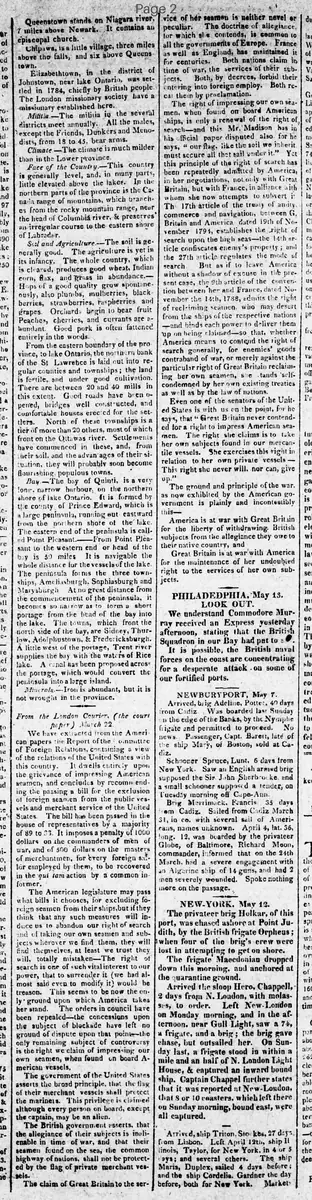
We have extracted from the American papers the Report of the committee of Foreign Relations, containing a view of the relations of the United States with this country. It dwells entirely upon the grievance of impressing American seamen, and concludes by recommending the passing a bill for the exclusion of foreign seamen from the public vessel and merchant service of the United States. The bill has been passed in the house of representatives by a majority of 89 to 33. It imposes a penalty of 1000 dollars on the commanders of men of war, and of 500 dollars on the masters of merchantmen, for every foreign seaman employed by them, to be recovered in the qui tam action by a common informer.
The American legislature may pass what bills it chooses, or excluding foreign seamen from their ships, but if they think that any such measures will induce us to abandon our right of search and of taking our own seamen and subjects wherever we find them, they will find themselves, at least we trust they will, totally mistaken. The right of search is one of such vital interest to our power, that to surrender it (we had almost said even to modify it would be treason. This seems to be now the only ground upon which America takes her stand. The orders in council have been repealed. The concessions upon the subject of blockade have left no ground of dispute upon that point. The only remaining subject of controversy is the right we claim of impressing our own seamen, when found on board American vessels.
The government of the United States asserts the broad principle, that the flag of their merchant vessels shall protect the mariners. This privilege is claimed although every person on board, except the captain, may be an alien.
The British government asserts, that the allegiance of their subjects is inalienable in time of war, and that their seamen found on the sea, the common highway of nations, shall not be protected by the flag of private merchant vessels.
The claim of Great Britain to the service of her seamen is neither novel or peculiar. The doctrine of allegiance, for which she contends, is common to all the governments of Europe. France as well as England, has maintained it for centuries. Both nations claim in time of war, the services of their subjects. Both, by decrees, forbid their entering into foreign employ. Both reclaim them by proclamation.
The right of impressing our own seamen, when found on board American ships, is only a renewal of the right of search. and this Mr. Madison has in his official paper disputed also. for he says, "our flag, like the soil we inherit must secure all that sail under it." Yet this principle of the right of search has been repeatedly admitted by America, in her negotiations, not only with Great Britain, but with France, in alliance with whom she now attempts to subvert it The 17th article of the treaty of amity, commerce and navigation, between G. Britain and America dated 19th of November 1794, establishes the right of search upon the high seas. the 14th article confiscates enemy's property ; and the 27th article regulates the mode of search. But as if to leave America without a shadow of excuse in the present case, the 9th article of the convention between her and France, dated November the 14th, 1788, admits the right of reclaiming seamen, who may desert from the ships of the respective nations .and binds each power to deliver them up on being claimed so that, whether America means to contend the right of search generally, or enemies' goods contraband of war, or merely against the particular right of Great Britain reclaiming her own seamen, she stands self-condemned by her own existing treaties as well as by the law of nations.
Even one of the senators of the United States is with us on the point, for he says, that "Great Britain never contended for a right to impress American seamen. The right she claims is to take her own subjects found in our mercantile vessels. She exercises this right in relation to her own private vessels- This right she never will, nor can, give up."
The ground and principle of the war, as now exhibited by the American government is plainly and incontestably this.
America is at war with Great Britain for the liberty of withdrawing British subjects from the allegiance they owe to their native country, and
Great Britain is at war with America for the maintenance of her undoubted right to the services of her own subjects.
What sub-type of article is it?
What keywords are associated?
What entities or persons were involved?
Where did it happen?
Foreign News Details
Primary Location
United States
Event Date
March 22
Key Persons
Outcome
bill passed in us house of representatives by 89 to 33; penalties of 1000 dollars for warship commanders and 500 dollars for merchant masters per foreign seaman employed.
Event Details
Report from American papers on US Committee of Foreign Relations focusing on impressment grievances; recommends and passes bill excluding foreign seamen from US vessels. British commentary defends right of search and impressment of own subjects, citing inalienable allegiance, European practices, and US treaties with Britain (1794) and France (1788) that admit search and reclamation rights. Frames war as US enabling British subject withdrawal vs. Britain's maintenance of allegiance.