Thank you for visiting SNEWPapers!
Sign up free
Daily National Intelligencer
Washington, District Of Columbia
What is this article about?
On the 7th instant, Henry Clay was honored at a public dinner by constituents in Lexington, KY area, with a toast praising his advocacy for liberty. In response, Clay expressed gratitude, explained his retirement due to family duty, discussed internal improvements, domestic manufactures, and support for South American independence, noting alignment with the Executive despite differences in approach.
Clipping
OCR Quality
Full Text
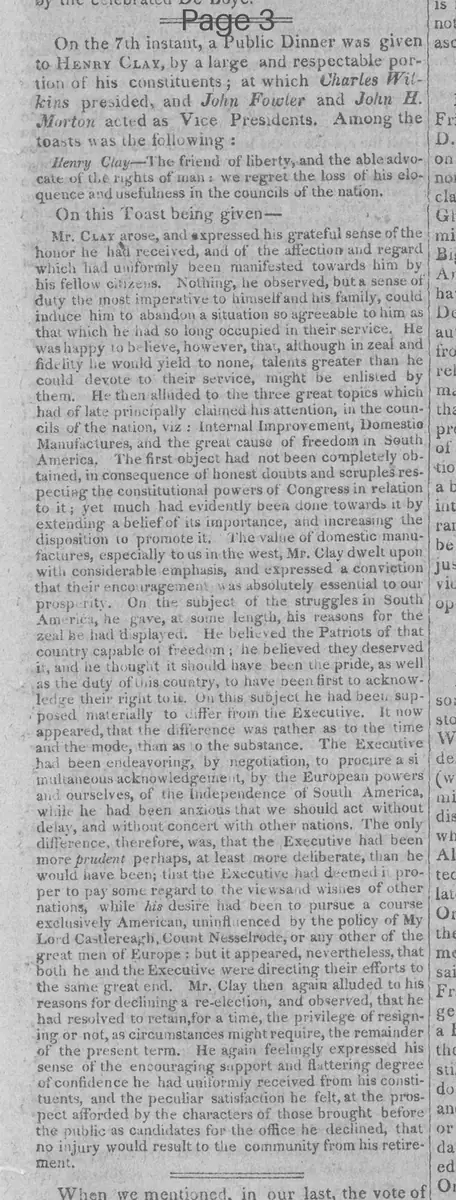
Henry Clay—The friend of liberty, and the able advocate of the rights of man: we regret the loss of his eloquence and usefulness in the councils of the nation,
On this Toast being given—
Mr. Clay arose, and expressed his grateful sense of the honor he had received, and of the affection and regard which had uniformly been manifested towards him by his fellow citizens. Nothing, he observed, but a sense of duty the most imperative to himself and his family, could induce him to abandon a situation so agreeable to him as that which he had so long occupied in their service. He was happy to believe, however, that, although in zeal and fidelity he would yield to none, talents greater than he could devote to their service, might be enlisted by them. He then alluded to the three great topics which had of late principally claimed his attention, in the councils of the nation, viz: Internal Improvement, Domestic Manufactures, and the great cause of freedom in South America. The first object had not been completely obtained, in consequence of honest doubts and scruples respecting the constitutional powers of Congress in relation to it; yet much had evidently been done towards it by extending a belief of its importance, and increasing the disposition to promote it. The value of domestic manufactures, especially to us in the west, Mr. Clay dwelt upon with considerable emphasis, and expressed a conviction that their encouragement was absolutely essential to our prosperity. On the subject of the struggles in South America, he gave, at some length, his reasons for the zeal he had displayed. He believed the Patriots of that country capable of freedom; he believed they deserved it, and he thought it should have been the pride, as well as the duty of this country, to have been first to acknowledge their right to it. On this subject he had been supposed materially to differ from the Executive. It now appeared, that the difference was rather as to the time and the mode, than as to the substance. The Executive had been endeavoring, by negotiation, to procure a simultaneous acknowledgement, by the European powers and ourselves, of the Independence of South America, while he had been anxious that we should act without delay, and without concert with other nations. The only difference, therefore, was, that the Executive had been more prudent perhaps, at least more deliberate, than he would have been; that the Executive had deemed it proper to pay some regard to the views and wishes of other nations, while his desire had been to pursue a course exclusively American, uninfluenced by the policy of My Lord Castlereagh, Count Nesselrode, or any other of the great men of Europe: but it appeared, nevertheless, that both he and the Executive were directing their efforts to the same great end. Mr. Clay then again alluded to his reasons for declining a re-election, and observed, that he had resolved to retain, for a time, the privilege of resigning or not, as circumstances might require, the remainder of the present term. He again feelingly expressed his sense of the encouraging support and flattering degree of confidence he had uniformly received from his constituents, and the peculiar satisfaction he felt, at the prospect afforded by the characters of those brought before the public as candidates for the office he declined, that no injury would result to the community from his retirement.
What sub-type of article is it?
What themes does it cover?
What keywords are associated?
What entities or persons were involved?
Story Details
Key Persons
Event Date
On The 7th Instant
Story Details
Public dinner honoring Henry Clay with toast to his liberty advocacy; Clay responds gratefully, explains retirement for family duty, discusses internal improvements, domestic manufactures' importance to the West, and urges prompt U.S. recognition of South American independence, aligning ultimately with Executive's goals despite procedural differences.