Thank you for visiting SNEWPapers!
Sign up free
Richmond Palladium
Richmond, Wayne County, Indiana
What is this article about?
The Investigating Committee exonerates Chief Engineer J.L. Williams of charges related to retaining E.M. Beckwith despite complaints of misconduct on the Madison Railroad, political dismissals, and other accusations, finding his actions justified and diligent.
Merged-components note: Continuation of the report on the Investigating Committee regarding J. L. Williams; text flows directly from one component to the next across columns.
Clipping
OCR Quality
Full Text
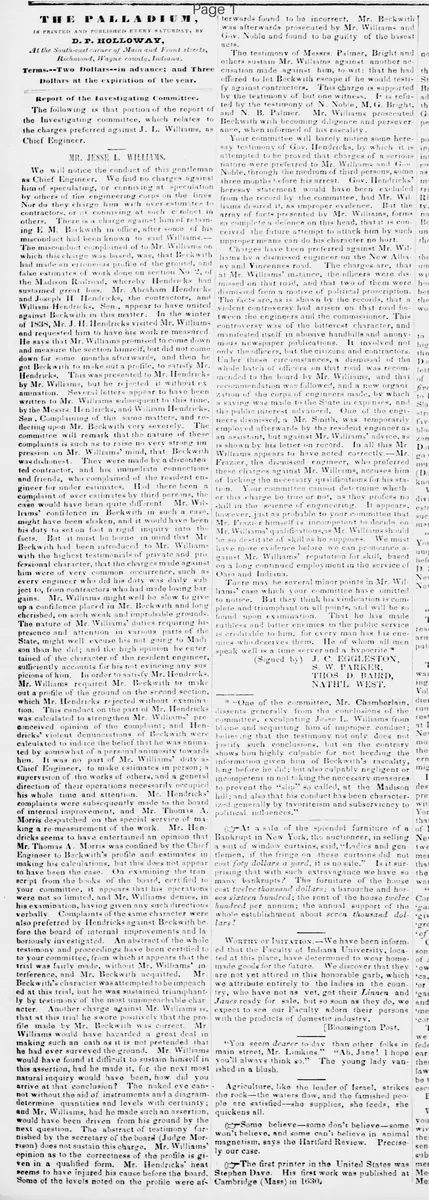
The following is that portion of the report of the Investigating committee, which relates to the charges preferred against J. L. Williams, as Chief Engineer.
MR. JESSE L. WILLIAMS.
We will notice the conduct of this gentleman as Chief Engineer. We find no charges against him of speculating, or conniving at speculation by others of the engineering corps on the lines. Nor do they charge him with over-estimates to contractors, or at conniving at such conduct in others. There is a charge against him of retaining E. M. Beckwith in office, after some of his misconduct had been known to said Williams. The misconduct complained of to Mr. Williams on which this charge was based, was, that Beckwith had made an erroneous profile of the ground, and false estimates of work done on section No 2, of the Madison Railroad, whereby Hendricks had sustained great loss. Mr. Abraham Hendricks and Joseph H. Hendricks, the contractors, and William Hendricks, Sen, appear to have united against Beckwith in this matter. In the winter of 1839, Mr. J. H. Hendricks visited Mr. Williams and requested him to have his work re-measured. He says that Mr. Williams promised to come down and measure the section himself, but did not come down for some months afterwards, and then he got Beckwith to make out a profile, to satisfy Mr. Hendricks. Thus was presented to Mr. Hendricks by Mr. Williams, but he rejected it without examination. Several letters appear to have been written to Mr. Williams subsequent to this time, by the Messrs. Hendricks, and William Hendricks, Sen, complaining of the same matters, and reflecting upon Mr. Beckwith very severely. The committee will remark that the nature of these complaints is such as to raise no very strong impression on Mr. Williams' mind, that Beckwith was dishonest. They were made by a discontented contractor, and his immediate connections and friends, who complained of the resident engineer for under estimates. Had there been a complaint of over estimates by third persons, the case would have been quite different. Mr. Williams' confidence in Beckwith in such a case might have been shaken, and it would have been his duty to set on foot a rigid inquiry into the facts. But it must be borne in mind that Mr. Beckwith had been introduced to Mr. Williams with the highest testimonials of private and professional character, that the charges made against him were of very common occurrence, such as every engineer who did his duty was daily subject to, from contractors who had made losing bargains. Mr. Williams might well be slow to give up a confidence placed in Mr. Beckwith and long cherished, on such weak and improbable grounds. The nature of Mr. Williams' duties requiring his presence and attention in various parts of the State, might well excuse his not going to Madison than he did; and the high opinion he entertained of the character of the resident engineer, sufficiently accounts for his not evincing any suspicions of him. In order to satisfy Mr. Hendricks, Mr. Williams required Mr. Beckwith to make out a profile of the ground on the second section, which Mr. Hendricks rejected without examination. This conduct on the part of Mr. Hendricks was calculated to strengthen Mr. Williams' preconceived opinion of the complaint; and Hendricks' violent denunciations of Beckwith were calculated to induce the belief that he was animated by somewhat of a personal animosity towards him. It was no part of Mr. Williams' duty as Chief Engineer, to make estimates in person; a supervision of the works of others, and a general direction of their operations necessarily occupied his whole time and attention. Mr. Hendricks' complaints were subsequently made to the board of internal improvement, and Mr. Thomas A. Morris despatched on the special service of making a re-measurement of the work. Mr. Hendricks seems to have entertained an opinion that Mr. Thomas A. Morris was confined by the Chief Engineer to Beckwith's profile and estimates in making his calculations, but this does not appear to have been the case. On examining the transcript from the books of the board, certified to your committee, it appears that his operations were not so limited, and Mr. Williams denies, in his examination, having given any such directions verbally. Complaints of the same character were also preferred by Hendricks against Beckwith before the board of internal improvements and laboriously investigated. An abstract of the whole testimony and proceedings have been certified to your committee, from which it appears that the trial was fairly made, without Mr. Williams' interference, and Mr. Beckwith acquitted. Mr. Beckwith's character was attempted to be impeached at this trial, but he was sustained triumphantly by testimony of the most unimpeachable character. Another charge against Mr. Williams is, that at this trial he swore positively that the profile made by Mr. Beckwith was correct. Mr. Williams would have hazarded a great deal in making such an oath as it is not pretended that he had ever surveyed the ground. Mr. Williams would have found it difficult to sustain himself in this assertion, had he made it, for the next most natural inquiry would have been, how did you arrive at that conclusion? The naked eye cannot without the aid of instruments and a diagram determine quantities and levels with certainty; and Mr. Williams, had he made such an assertion, would have been driven from his ground by the next question. The abstract of testimony furnished by the secretary of the board (Judge Morrison) does not sustain this charge. Mr. Williams' opinion as to the correctness of the profile is given in a qualified form. Mr. Hendricks neat seems to have injured his cause before the board. Some of the levels noted on the profile were afterwards found to be incorrect. Mr. Beckwith was afterwards prosecuted by Mr. Williams and Gov. Noble and found to be guilty of the basest acts.
The testimony of Messrs. Palmer, Bright and others sustain Mr. Williams against another accusation made against him, to wit: that he had offered to let Beckwith escape if he would testify against contractors. This charge is supported by the testimony of but one witness. It is refuted by the testimony of N. Noble, M. G. Bright, and N. B. Palmer. Mr. Williams prosecuted Beckwith with becoming diligence and perseverance, when informed of his rascality.
Your committee will barely notice some hearsay testimony of Gov. Hendricks, by which it is attempted to be proved that charges of a serious nature were preferred to Mr. Williams and Gov. Noble, through the medium of third persons, some three months before his arrest. Gov. Hendricks' hearsay statement would have been excluded from the record by the committee, had Mr. Williams desired, as improper evidence. But the array of facts presented by Mr. Williams, forms so complete a defence on this head, that it is conceived the future attempt to attack him by such improper means can do his character no hurt.
Charges have been preferred against Mr. Williams by a dismissed engineer on the New Albany and Vincennes road. The charges are, that at Mr. Williams' instance, the officers were dismissed on that road, and that two of them were dismissed from a motive of political proscription. The facts are, as is shown by the records, that a violent controversy had arisen on that road between the engineers and the commissioner. This controversy was of the bitterest character, and manifested itself in abusive handbills and anonymous newspaper publications. It involved not only the officers, but the citizens and contractors. Under these circumstances, a dismissal of the whole batch of officers on that road was recommended to the board by Mr. Williams, and that recommendation was followed, and a new organization of the corps of engineers made, by which a saving was made to the State in expenses, and the public interest advanced. One of the engineers dismissed, a Mr. Smith, was temporarily employed afterwards by the resident engineer as an assistant, but against Mr. Williams' advice, as is shown by his letter on record. In all this Mr. Williams appears to have acted correctly. Mr. Frazier, the dismissed engineer, who preferred these charges against Mr. Williams, accuses him of lacking the necessary qualifications for his station. Your committee cannot determine whether this charge be true or not, as they profess no skill in the science of engineering. It appears, however, just as probable to your committee that Mr. Frazier himself is incompetent to decide on Mr. Williams' qualifications, as Mr. Williams should be so destitute of skill as he supposes. We must have more evidence before we can pronounce against Mr. Williams' reputation for skill, based on a long continued employment in the service of Ohio and Indiana.
There may be several minor points in Mr. Williams' case which your committee have omitted to notice. But they think his vindication is complete and triumphant on all points, and will be so found upon examination. That he has made ruthless and bitter enemies in the public service is creditable to him, for every man has his enemies who deserves them. He of whom all men speak well is a time server and a hypocrite.
(Signed) J. C. EGGLESTON,
S. W. PARKER.
THOS. D. BAIRD,
NATH'L. WEST.
* "One of the committee, Mr. Chamberlain, dissents generally from the conclusions of the committee, exculpating Jesse L. Williams from blame and acquitting him of improper conduct; believing that the testimony not only does not justify such conclusions, but on the contrary shows him highly culpable for not heeding the information given him of Beckwith's rascality, long before he did; but also culpably negligent or incompetent in not taking the necessary measures to prevent the "slip" so called, at the Madison hill: and also that his conduct has been characterized generally by favoritism and subserviency to political influences."
What sub-type of article is it?
What themes does it cover?
What keywords are associated?
What entities or persons were involved?
Where did it happen?
Story Details
Key Persons
Location
Madison Railroad, Indiana
Event Date
Winter Of 1839
Story Details
The committee examines charges against Chief Engineer Jesse L. Williams for retaining E.M. Beckwith despite complaints of erroneous profiles and estimates on the Madison Railroad, political dismissals on another road, and other misconduct allegations. They defend Williams, noting complaints from discontented contractors, Beckwith's later conviction, and Williams' diligent prosecution, ultimately vindicating him completely except for one dissenting member.