Thank you for visiting SNEWPapers!
Sign up free
True Democrat
Paulding, Jasper County, Mississippi
What is this article about?
Mark Valentine announces his independent candidacy for U.S. Congress in Mississippi's southwestern district, criticizing the Democratic nominee's opposition to the original Briscoe Bill, which enforces quo warranto against abusive bank charters to protect citizens' rights.
Clipping
OCR Quality
Full Text
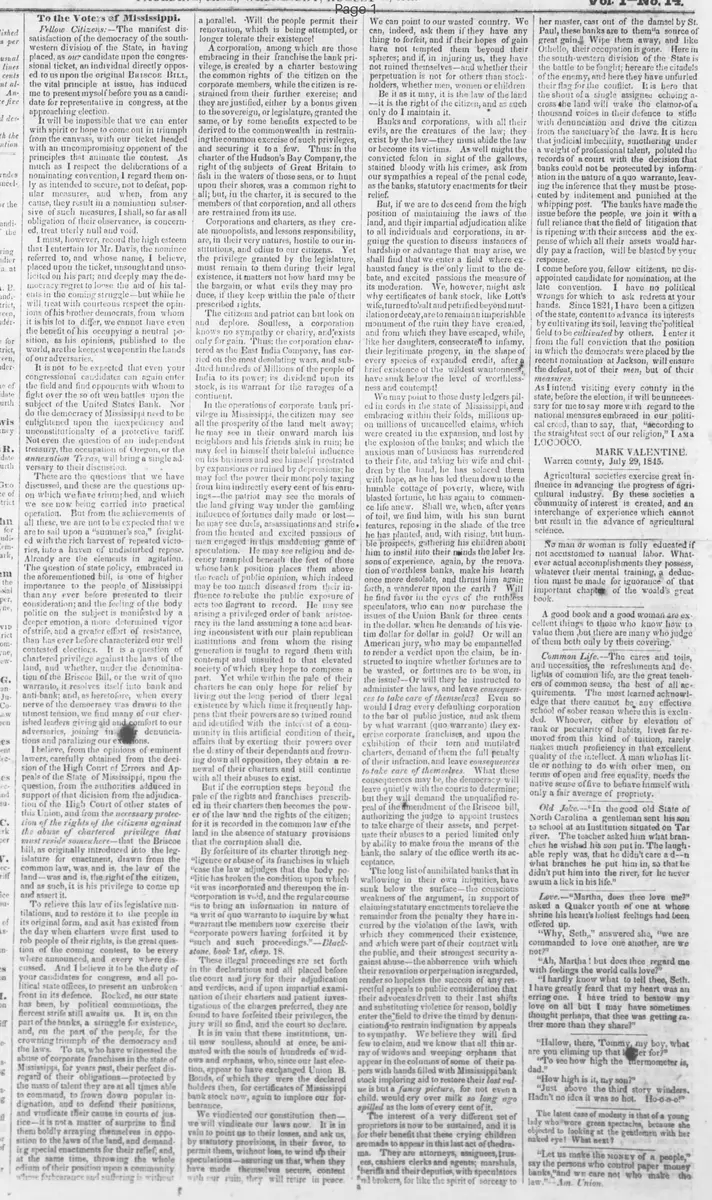
Fellow Citizens:—The manifest dissatisfaction of the democracy of the southwestern division of the State, in having placed, as our candidate upon the congressional ticket, an individual directly opposed to us upon the original Briscoe Bill, the vital principle at issue, has induced me to present myself before you as a candidate for representative in congress, at the approaching election.
It will be impossible that we can enter with spirit or hope to come out in triumph from the canvass, with our ticket headed with an uncompromising opponent of the principles that animate the contest. As much as I respect the deliberations of a nominating convention, I regard them only as intended to secure, not to defeat, popular measures, and when, from any cause, they result in a nomination subversive of such measures, I shall, so far as all obligation of their observance, is concerned, treat them utterly null and void.
I must, however, record the high esteem that I entertain for Mr. Davis, the nominee referred to, and whose name, I believe, placed upon the ticket, unsought and unsolicited on his part; and deeply may the democracy regret to loose the aid of his talents in the coming struggle—but while he will treat with courteous respect the opinions of his brother democrats, from whom it is his lot to differ, we cannot have even the benefit of his occupying a neutral position, as his opinions, published to the world, are the keenest weapons in the hands of our adversaries.
It is not to be expected that even your congressional candidates can again enter the field and find opponents with whom to fight over the so oft won battles upon the subject of the United States Bank. Nor do the democracy of Mississippi need to be enlightened upon the inexpediency and unconstitutionality of a protective tariff. Not even the question of an independent treasury, the occupation of Oregon, or the annexation of Texas, will bring a single adversary to their discussion.
These are the questions that we have discussed, and these are the questions upon which we have triumphed, and which we see now being carried into practical operation. But from these achievements of all these, we are not to be expected that we are to sail upon a "summer's sea," freighted with the rich harvest of repeated victories, into a haven of undisturbed repose.
Already are the elements in agitation. The question of state policy, embraced in the aforementioned bill, is one of higher importance to the people of Mississippi than any ever before presented to their consideration; and the feeling of the body politic on the subject is manifested by a deeper emotion, a more determined vigor of strife, and a greater effort of resistance, than has ever before characterized our well contested elections. It is a question of chartered privilege against the laws of the land, and whether, under the denomination of the Briscoe Bill, or the writ of quo warranto, it resolves itself into bank and anti-bank: and, as heretofore, when every nerve of the democracy was drawn to the utmost tension, we find many of our cherished leaders giving aid and comfort to our adversaries, joining in denunciations and paralyzing our exertions.
I believe, from the opinions of eminent lawyers, carefully obtained from the decision of the High Court of Errors and Appeals of the State of Mississippi, upon the question, from the authorities adduced in support of that decision from the adjudication of the High Court of other states of this Union, and from the necessary protection of the rights of the citizens against the abuse of chartered privilege that must reside somewhere—that the Briscoe bill, as originally introduced into the legislature for enactment, drawn from the common law, was, and is, the law of the land—was and is, the right of the citizen, and as such, it is his privilege to come up and assert it.
To relieve this law of its legislative mutilations, and to restore it to the people in its original form, and as it has existed from the day when charters were first used to rob people of their rights, is the great question of the coming contest, to be everywhere announced, and everywhere discussed. And I believe it to be the duty of your candidates for congress, and all political state offices, to present an unbroken front in its defence. Rocked, as our state has been, by political commotions, the fiercest strife still awaits us. It is, on the part of the banks, a struggle for existence, and, on the part of the people, for the crowning triumph of the democracy and the laws. To us, who have witnessed the abuse of corporate franchises in the state of Mississippi, for years past, their perfect disregard of their obligations—protected by the mass of talent they are at all times able to command, to frown down popular indignation, and to defend their positions, and vindicate their cause in courts of justice—it is not a matter of surprise to find them boldly arraying themselves in opposition to the laws of the land, and demanding special enactments for their relief, and, at the same time, throwing the whole odium of their position upon a community where the bankruptcy and suffering is without a parallel. Will the people permit their renovation, which is being attempted, or longer tolerate their existence!
A corporation, among which are those embracing in their franchise the bank privilege, is created by a charter bestowing the common rights of the citizen on the corporate members, while the citizen is restrained from their further exercise; and they are justified, either by a bonus given to the sovereign, or legislature, granted the same, or by some benefits expected to be derived to the commonwealth in restraining the common exercise of such privileges, and securing it to a few. Thus: in the charter of the Hudson's Bay Company, the right of the subjects of Great Britain to fish in the waters of those seas, or to hunt upon their shores, was a common right to all; but, in the charter, it is secured to the members of that corporation, and all others are restrained from its use.
Corporations and charters, as they create monopolists, and lessen responsibility, are, in their very natures, hostile to our institutions, and odious to our citizens. Yet the privilege granted by the legislature, must remain to them during their legal existence, it matters not how hard may be the bargain, or what evils they may produce, if they keep within the pale of their prescribed rights.
The citizens and patriot can but look on and deplore. Soulless, a corporation knows no sympathy or charity, and exists only for gain. Thus: the corporation chartered as the East India Company, has carried on the most desolating wars, and subdued hundreds of millions of the people of India to its power; its dividend upon its stock, is its warrant for the ravages of a continent.
In the operations of corporate bank privilege in Mississippi, the citizen may see all the prosperity of the land melt away; he may see in their onward march his neighbors and his friends sink in ruin; he may feel in himself their baleful influence on his business and see himself prostrated by expansions or ruined by depressions; he may feel the power their monopoly taxing from him indirectly every cent of his earnings—the patriot may see the morals of the land giving way under the gambling influence of fortunes daily made or lost—he may see duels, assassinations and strife from the heated and excited passions of men engaged in this maddening game of speculation. He may see religion and decency trampled beneath the feet of those whose bank position places them above the reach of public opinion, which indeed may be too much diseased from their influence to rebuke the public exposure of acts too flagrant to record. He may see arising a privileged order of bank aristocracy in the land assuming a tone and bearing inconsistent with our plain republican institutions and from whom the rising generation is taught to regard them with contempt and unsuited to that elevated society of which they hope to compose a part.
Yet while within the pale of their charters he can only hope for relief by living out the long period of their legal existence by which time it frequently happens that their powers are so twined round and identified with the interest of a community in this artificial condition of their affairs that by exerting their powers over the destiny of their dependants and frowning down all opposition, they obtain a renewal of their charters and still continue with all their abuses to exist.
But if the corruption steps beyond the pale of the rights and franchises prescribed in their charters then becomes the power of the law and the rights of the citizen; for it is recorded in the common law of the land in the absence of statutory provisions that the corruption shall die.
By forfeiture of its charter through negligence or abuse of its franchises in which case the law adjudges that the body politic has broken the condition upon which it was incorporated and thereupon the incorporation is void, and the regular course is to bring an information in nature of a writ of quo warranto to inquire by what warrant the members now exercise their corporate powers having forfeited it by such and such proceedings.—Blackstone, book 1st, chap. 18.
These illegal proceedings are set forth in the declarations and all placed before the court and jury for their adjudication and verdicts, and if upon impartial examination of their charters and patient investigations of the charges preferred, they are found to have forfeited their privileges, the jury will so find, and the court so declare.
It is in vain that these institutions, until now soulless, should at once, be animated with the souls of hundreds of widows and orphans, who, since our last election, appear to have exchanged Union B. Bonds, of which they were the declared holders, for certificates of Mississippi bank stock now, again to implore our forbearance.
We vindicated our constitution then—we will vindicate our laws now.
It is in vain to point us to their losses, and ask us, by statutory provisions, in their favor, to permit them, without loss, to wind up their speculations—assuring us that, when they have made themselves secure, content with our ruin they will retire in peace.
We can point to our wasted country. We can, indeed, ask them if they have any thing to forfeit, and if their hopes of gain have not tempted them "beyond their spheres; and if, in injuring us, they have not ruined themselves—and whether their perpetuation is not for others than stockholders, whether men, women or children.
Be it as it may, it is the law of the land—it is the right of the citizen, and as such only do I maintain it.
Banks and corporations, with all their evils, are the creatures of the law; they exist by the law—they must abide the law or become its victims. As well might the convicted felon in sight of the gallows, stained bloody with his crimes, ask from our sympathies a repeal of the penal code, as the banks, statutory enactments for their relief.
But, if we are to descend from the high position of maintaining the laws of the land, and their impartial adjudication alike to all individuals and corporations, in arguing the question to discuss instances of hardship or advantage that may arise, we shall find that we enter a field where exhausted fancy is the only limit to the debate, and excited passions the measure of its moderation. We, however, might ask why certificates of bank stock, like Lot's wife, turned to 'salt and petrified beyond mutilation or decay, are to remain an imperishable monument of the ruin they have created, and from which they have escaped, while, like her daughters, consecrated to infamy, their legitimate progeny, in the shape of every species of expanded credit, after a brief existence of the wildest wantonness, have sunk below the level of worthlessness and contempt!
We may point to those dusty ledgers piled in cords in the state of Mississippi, and embracing within their folds, millions upon millions of uncancelled claims, which were created in the expansion, and lost by the explosion of the banks; and which the anxious man of business has surrendered to their fate, and taking his wife and children by the hand, he has solaced them with hope, as he has led them down to the humble cottage of poverty, where, with blasted fortune, he has again to commence life anew. Shall we, when, after years of toil, we find him, with his sun burnt features, reposing in the shade of the tree he has planted, and, with rising, but humble prospects, gathering his children about him to instil into their minds the lessons of experience, again, by the renovation of worthless banks, make his heart once more desolate, and thrust him again forth, a wanderer upon the earth? Will he find favor in the eyes of the ruthless speculators, who can now purchase the issues of the Union Bank for three cents in the dollar, when he demands of his victim dollar for dollar in gold? Or will an American jury, who may be empannelled to render a verdict upon the claim, be instructed to inquire whether fortunes are to be wasted, or fortunes are to be won, in the issue?—Or will they be instructed to administer the laws, and leave consequences to take care of themselves? Even so would I drag every defaulting corporation to the bar of public justice, and ask them by what warrant (quo warranto) they exercise corporate franchises, and upon the exhibition of their torn and mutilated charters, demand of them the full penalty of their infraction, and leave consequences to take care of themselves. What these consequences may be, the democracy will leave quietly with the courts to determine; but they will demand the unqualified repeal of the amendment of the Briscoe bill, authorizing the judge to appoint trustees to take charge of their assets, and perpetuate their abuses to a period limited only by ability to make from the means of the bank, the salary of the office worth its acceptance.
The long list of annihilated banks that in wallowing in their own iniquities, have sunk below the surface—the conscious weakness of the argument, in support of claiming statutory enactments to relieve the remainder from the penalty they have incurred by the violation of the laws, with which they commenced their existence, and which were part of their contract with the public, and their strongest security against abuse—the abhorrence with which their renovation or perpetuation is regarded, render so hopeless the success of any respectful appeals to public consideration that their advocates driven to their last shifts and substituting violence for reason, boldly enter the field to drive the timid by denunciation—to restrain indignation by appeals to sympathy.
We believe they will find few to claim, and we know that all this array of widows and weeping orphans that appear in the columns of some of their papers with hands filled with Mississippi bank stock imploring aid to restore their lost value is but a fancy picture, for not even a child would cry over milk so long ago spilled as the loss of every cent of it.
The interest of a very different set of proprietors is now to be sustained, and it is for their benefit that these crying children are made to appear in this last act of the drama.
They are attorneys, assignees, trustees, cashiers clerks and agents; marshals, sheriffs and their deputies, with speculators and brokers, for like the spirit of sorcery to her master, cast out of the damsel by St. Paul, these banks are to them "a source of great gain." Wipe them away, and like Othello, their occupation is gone. Here in the south-western division of the State is the battle to be fought; here are the citadels of the enemy, and here they have unfurled their flag for the conflict. It is here that the shout of a single assignee echoing across the land will wake the clamor of a thousand voices in their defence to stifle with denunciation and drive the citizen from the sanctuary of the laws. It is here that judicial imbecility, smothering under a weight of professional talent, polluted the records of a court with the decision that banks could not be prosecuted by information in the nature of a quo warranto, leaving the inference that they must be prosecuted by indictment and punished at the whipping post. The banks have made the issue before the people, we join it with a full reliance that the field of litigation that is ripening with their success and the expense of which all their assets would hardly pay a fraction, will be blasted by your response.
I come before you, fellow citizens, no disappointed candidate for nomination, at the late convention. I have no political wrongs for which to ask redress at your hands. Since 1821, I have been a citizen of the state, content to advance its interests by cultivating its soil, leaving the political field to be cultivated by others. I enter it from the full conviction that the position in which the democrats were placed by the recent nomination at Jackson, will ensure the defeat, not of their men, but of their measures.
As I intend visiting every county in the state, before the election, it will be unnecessary for me to say more with regard to the national measures embraced in our political creed, than to say, that, "according to the straightest sect of our religion," I am a LOCO FOCO.
MARK VALENTINE
Warren county, July 29, 1845.
What sub-type of article is it?
What themes does it cover?
What keywords are associated?
What entities or persons were involved?
Letter to Editor Details
Author
Mark Valentine
Recipient
Voters Of Mississippi
Main Argument
due to dissatisfaction with the democratic congressional nominee's opposition to the original briscoe bill—a vital measure to enforce laws against abusive bank corporations via quo warranto—valentine offers himself as an alternative candidate to ensure the triumph of democratic principles and citizens' rights over chartered privileges.
Notable Details