Thank you for visiting SNEWPapers!
Sign up free
Story
June 14, 1817
Daily National Intelligencer
Washington, District Of Columbia
What is this article about?
In 1817, Virginia Representative Johnson delivers a speech advocating repeal of internal taxes, arguing financial reports show surplus revenue suffices for debts and expenditures, critiquing committee plans and unequal taxation on distillers and farmers.
Clipping
OCR Quality
98%
Excellent
Full Text
CONGRESSIONAL
HOUSE OF REPRESENTATIVES.
REMARKS OF MR. JOHNSON, OF VA.
ON THE PROPOSITION TO REPEAL THE INTERNAL
TAXES.
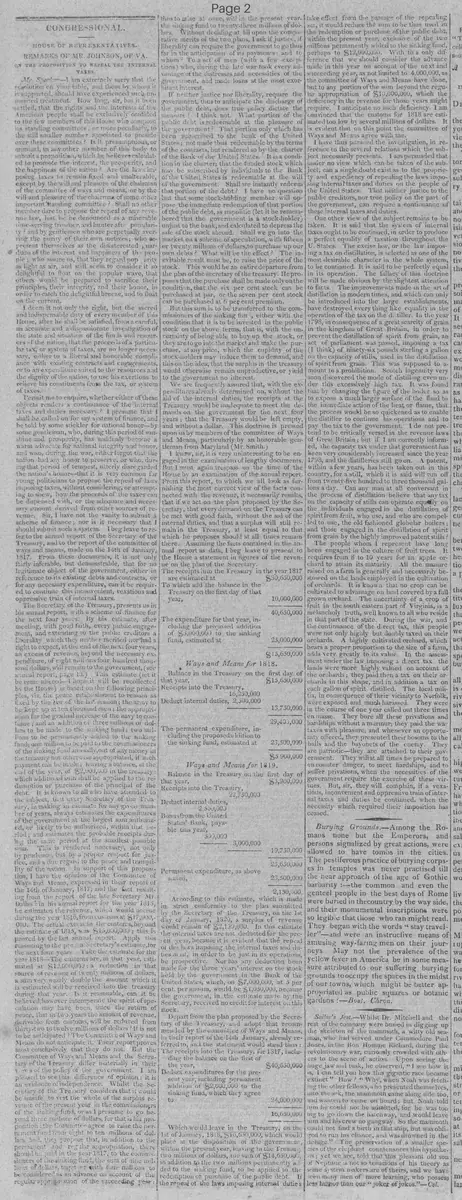
Sir—I am extremely sorry that the resolution on your table, and those by whom it is supported, should have experienced such unmerited treatment. How long, sir, has it been settled, that the rights and the interests of the American people shall be exclusively confided to the few members of this House who compose its standing committees: or more peculiarly, to the still smaller number appointed to preside over these committees? Is it presumptuous, or criminal, in any other member of this body to submit a proposition, which he believes calculated to promote the interest, the prosperity, and the happiness of the nation? Are the laws imposing taxes to remain fixed and unalterable, except by the will and pleasure of the chairman of the committee of ways and means, or by the will and pleasure of the chairmen of some other important standing committee? Shall no other member dare to propose the repeal of any revenue law, lest he be denounced as a miserable time-serving trimmer, and hunter after popularity—and by gentlemen who are perpetually averring the purity of their own motives; who present themselves as the disinterested guardians of the interest and happiness of the people; who assure us, that they regard popularity as light as air, and still seem to consider it so delightful to float on the popular wave, that others would be prepared to sacrifice their principles, their integrity, and their honor, in order to catch the delightful breeze, and to float on the current.
I deem it not only the right, but the sacred and indispensable duty of every member of this House, after he shall be satisfied, from a careful, an accurate and a dispassionate investigation of the state and situation of the finances and resources of the nation, that the proceeds of a particular tax, or system of taxes, are no longer necessary, either to a liberal and honorable compliance with existing contracts and engagements, or to an expenditure suited to the resources and the dignity of the nation, to use his exertions to relieve his constituents from the tax, or system of taxes.
Permit me to enquire, whether either of these objects renders a continuance of the internal taxes and duties necessary? I presume that I shall be called on for my system of finance, and be told by some stickler for national honor—by some gentleman, who, during this period of sunshine and prosperity, has suddenly become a warm advocate for national integrity and honor, and who, during the war, either forgot that the nation had any honor to preserve, or who, during that period of tempest, utterly disregarded the nation's honor—that it is very common for young politicians to propose the repeal of laws imposing taxes, without considering, or attempting to shew, how the proceeds of the taxes can be dispensed with, or the adequate and necessary amount derived from other sources of revenue. Sir, I have not the vanity to submit a scheme of finance; nor is it necessary that I should submit such a system. I beg leave to refer to the annual report of the Secretary of the Treasury, and to the report of the committee of ways and means, made on the 14th of January, 1817. From these documents, it is not only fairly inferable, but demonstrable, that for no legitimate object of the government, either in reference to its existing debts and contracts, or for any necessary expenditure, can it be required to continue this inconvenient, vexatious and oppressive train of internal taxes.
The Secretary of the Treasury, presents us in his annual report, with a scheme of finance for the next four years. By his estimate, after meeting, with good faith, every public engagement, and extending to the public creditors a liberality which they neither merited nor had a right to expect, at the end of the next four years, an excess of revenue, beyond the necessary expenditure, of eight millions four hundred thousand dollars, will remain to the government, (see annual report, page 13.) This estimate (let it be remembered—I hope it will be recollected by the House) is based on the following principles, viz, the peace establishment to remain as fixed by the law of the last session; the army to be kept up at ten thousand men; the appropriation for the gradual increase of the navy to continue; and an addition of three millions of dollars to be made to the sinking fund; two millions to be permanently added to the sinking fund; one million to be paid to the commissioners of the sinking fund annually, out of any money in the treasury not otherwise appropriated, if such payment can be made; leaving a balance, at the end of the year, of $2,000,000 in the treasury: which additional sum shall be applied to the redemption or purchase of the principal of the debt. It is known to all who have attended to the subject, that every Secretary of the Treasury, in making an estimate for any given number of years, always estimates the expenditures of the government at the largest sum authorized, or likely to be authorized, within that period; and estimates the probable receipts during the same period at the smallest possible sum. This is rendered necessary, not only by prudence, but by a proper respect for justice, and a due regard to the peace and tranquility of the nation. In support of this proposition, I have the opinion of the Committee of Ways and Means, expressed in their report of the 14th of January, 1817, and the fact resulting from the report of the late Secretary Mr. Dallas: in his annual report for the year 1815, he estimated the revenue, which would accrue during the year 1816, from customs at $17,000,000. The actual excess in the customs, beyond the estimate of 1815, was $15,000,000; this is proved by the last annual report. Apply this reasoning to the present Secretary's estimate, for the next four years. Take the estimate for the year 1818—The customs are, in that year, estimated at $18,000,000: a reduction in that source of revenue of twenty millions of dollars, a sum very nearly double the amount which it is estimated will be received into the treasury during that year. Is it reasonable, can it be believed however intemperate the spirit of speculation may have been, since the return of peace, that in two years the amount of revenue, derivable from customs, will be reduced from thirty-two to twelve millions of dollars? It is not to be anticipated? The Committee of Ways and Means do not anticipate it. Their report proves most conclusively that they do not. But the Committee of Ways and Means and the Secretary of the Treasury differ materially in their views of the policy of the government. I am pleased to see this difference of opinion: it is an evidence of independence. Whilst the Secretary of the Treasury considers that it would be unsafe to vest the whole of the surplus revenue of the present year in the commissioners of the sinking fund, or as I presume to go beyond three millions of dollars, for that is his proposition: the Committee agree to raise the permanent fund from eight to ten millions of dollars, and, they propose that, in addition to the permanent and regular appropriation, there should be paid in the year 1817, to the commissioners of the sinking fund, the sum of nine millions of dollars, together with four millions to be considered as an advance on account of the regular appropriation of the succeeding year: thus to raise at once, within the present year, the sinking fund to twenty-three millions of dollars. Without deciding at all upon the comparative merits of the two plans, I ask if justice, if liberality can require the government to go thus far in the anticipation of its payments: and to whom? To a set of men (with a few exceptions) who, during the late war took every advantage of the distresses and necessities of the government, and made loans at the most exorbitant interest.
If neither justice nor liberality, require the government, thus to anticipate the discharge of the public debt, does true policy dictate the measure? I think not. What portion of the public debt is redeemable at the pleasure of the government? That portion only which has been subscribed to the bank of the United States; not made thus redeemable by the terms of the contracts, but rendered so by the charter of the Bank of the United States. It is a condition in the charter; that the funded stock which may be subscribed by individuals to the Bank of the United States is redeemable at the will of the government. Shall we instantly redeem that portion of the debt? I have no question but that some stock-holding member will oppose the immediate redemption of that portion of the public debt, as impolitic (let it be remembered that the government is a stock-holder) unjust to the bank, and calculated to depress the sale of the stock abroad. Shall we go into the market on a scheme of speculation, with fifteen or twenty millions of dollars, to purchase up our own debts? What will be the effect? The inevitable result must be, to raise the price of the stock. This would be an entire departure from the plan of the secretary of the treasury. He proposes that the purchase shall be made only on the condition, that the six per cent stock can be purchased at par, or the seven per cent stock can be purchased at 6 per cent premium. But this sum is to be transferred to the commissioners of the sinking fund, either with the condition that it is to be invested in the public stock on the above terms, that is, with the uncertainty of being able to buy up the stock, or they are to go into the market and make the purchase, at any price, which the cupidity of the stock-holders may induce them to demand, and this on the idea, that the surplus in the treasury would otherwise remain unproductive, or yield to the government no interest.
We are frequently assured that, with the expenditures already determined on, without the aid of the internal duties, the receipts at the Treasury would be inadequate to meet the demands on the government for the next four years; that the Treasury would be left empty, and without a dollar. This doctrine is pressed upon us by members of the committee of Ways and Means, particularly by an honorable gentleman from Maryland (Mr. Smith.)
I know, sir, it is very uninteresting to be engaged in the examination of lengthy documents. But I must again trespass on the time of the House by an examination of the annual report. From this report, to which we all look as furnishing the most correct view of the facts connected with the revenue, it necessarily results, that if we act on the plan proposed by the Secretary, that every demand on the Treasury can be met with good faith, without the aid of the internal duties, and that a surplus will still remain in the Treasury, at least equal to that which he proposes should at all times remain there. Assuming the facts contained in the annual report as data, I beg leave to present to the House a statement in figures of the revenue on the plan of the Secretary.
The receipts into the Treasury in the year 1817 are estimated at $30,650,000
To which add the balance in the Treasury on the first day of that year, 10,000,000
$40,650,000
The expenditure for that year, including the proposed addition of $3,000,000 to the sinking fund, estimated 25,000,000
$15,650,000 Ways and Means.
For 1818.
Balance in the Treasury on the first day of that year, $15,650,000
Receipts into the Treasury 16,259,000
Deduct, internal duties, 2,500,000
$13,759,000
29,405,000
The permanent expenditure, including the proposed addition to the sinking fund, estimated at 23,500,000
$5,905,000 Ways and Means for 1819.
Balance in the Treasury on the first day of that year, $5,905,000
Receipts into the Treasury 22,750,000
Deduct internal duties. 2,530,000
Loans from the United States' Bank, payable this year, 500,000
$3,000,000
19,750,000
25,650,000
Permanent expenditure, as above stated 23,500,000
$2,150,000
According to this estimate, which is made in strict conformity to the plan submitted by the Secretary of the Treasury, on the 1st day of January, 1820, a surplus of revenue would remain of $2,150,000. In this estimate the internal taxes are not deducted for the present year, because it is evident that the repeal of the laws imposing the internal taxes and duties in 1817, in order to be just in its operations, be prospective. Nor has any deduction been made for the three years' interest on the stock held by the government in the Bank of the United States, which, on $7,000,000, at 5 per cent. per annum, would be $1,050,000, because the government, in the estimate made by the Secretary, received no credit for interest on this stock.
Depart from the plan proposed by the Secretary of the Treasury, and adopt that recommended by the committee of Ways and Means, in their report of the 14th January, already referred to, and the statement would stand thus:
The receipts into the Treasury, for 1817, including the balance on the first of the year, $40,650,000
Deduct expenditures for the present year, including permanent addition of $2,000,000 to the sinking fund, which they agree to 24,000,000
16,650,000
Which would leave in the Treasury, on the 1st of January, 1818, 16,650,000, which would place at the disposition of the government, within the present year, leaving in the Treasury two millions of dollars, the sum of $14,650,000 in addition to the two millions permanently added to the sinking fund, to be applied to the redemption or purchase of the public debt. If the repeal of the laws imposing internal duties take effect from the passage of the repealing act, it would reduce the sum to be thus used in the redemption or purchase of the public debt, within the present year, exclusive of the two millions permanently added to the sinking fund, perhaps to $12,000,000. With this only difference that we should consider the advance made in this year on account of the next and succeeding year, as not limited to 4,000,000, as the committee of Ways and Means have done, but to any portion of the sum beyond the regular appropriation of $10,000,000, which the deficiency in the revenue for those years might require. I anticipate no such deficiency. I am convinced that the customs for 1818 are estimated too low by several millions of dollars. It is evident that on this point the committee of Ways and Means agree with me.
I have thus pursued the investigation, in reference to the several relations which the subject necessarily presents. I am persuaded that under no view which can be taken of the subject, can a single doubt exist as to the propriety and expediency of repealing the laws imposing internal taxes and duties on the people of the United States. That neither justice to the public creditors, nor true policy on the part of the government, can require a continuance of these internal taxes and duties.
One other view of the subject remains to be taken. It is said that the system of internal taxes ought to be continued, in order to produce a perfect equality of taxation throughout the U. States. The excise law, or the law imposing a tax on distillation, is selected as one of the most desirable character in the whole system, to be continued. It is said to be perfectly equal in its operation. The fallacy of this doctrine will be made obvious by the slightest attention to facts. The improvements made in the art of distillation in modern times, and which can only be introduced into the large establishments, have destroyed every thing like equality in the operation of the tax on the distiller. In the year 1798, in consequence of a great scarcity of grain in the kingdom of Great Britain, in order to prevent the distillation of spirit from grain, an act of parliament was passed, imposing a tax (I think) of ninety-six pounds sterling a gallon on the capacity of stills, used in the distillation of spirit from grain. This was supposed to amount to a prohibition. Scotch ingenuity very soon discovered the mode of distilling even under this excessively high tax. It was found that by changing the figure of the boiler so as to expose a much larger surface of the fluid to the immediate action of the heat or flame, that the process would be so quickened as to enable the distiller to continue his operations and to pay the tax to the government. I do not pretend to be critically versed in the revenue laws of Great Britain; but if I am correctly informed, the capacity tax under that government has been very considerably increased since the year 1798, and the distilleries still go on. A patent, within a few years, has been taken out in this country, for a still, which it is said will run off from twenty-five hundred to three thousand gallons a day. Can any man at all conversant in the process of distillation believe that any tax on the capacity of stills can operate equally on the individuals engaged in the distillation of spirit from fruit, who use, and who are compelled to use, the old fashioned globular boilers; and those engaged in the distillation of spirit from grain by the highly improved patent stills?
The people whom I represent have long been engaged in the culture of fruit trees. It requires from 8 to 10 years for an apple orchard to attain its maturity. All the manure raised on a farm is generally and necessarily bestowed on the lands employed in the cultivation of orchards. It is known that no crop can be cultivated to advantage on land covered by a full grown orchard. The uncertainty of a crop of fruit in the south eastern part of Virginia, is a melancholy truth, well known to all who reside in that part of the state. During the war, and the continuance of the direct tax, this people were not only highly but doubly taxed on their orchards. A highly cultivated orchard, which bears a proper proportion to the size of a farm, adds very greatly to its value. In the assessment under the law imposing a direct tax the lands were more highly valued on account of the orchards; they paid then a tax on their orchards in this shape, and in addition a tax on each gallon of spirit distilled. The local militia, in consequence of their vicinity to Norfolk, were exposed and much harassed. They were in the course of one year called out three times en masse. They bore all these privations and hardships without a murmur; they paid the war taxes with pleasure; and whenever an opportunity offered, they presented their bosoms to the balls and the bayonets of the enemy. They are patriotic—they are attached to their government. They will at all times be prepared to encounter danger, to meet hardships, and to suffer privations, when the necessities of the government require the exercise of these virtues. But, sir, they will complain, if a vexatious, inconvenient and oppressive train of internal taxes and duties be continued, when the necessity which required their imposition has ceased.
HOUSE OF REPRESENTATIVES.
REMARKS OF MR. JOHNSON, OF VA.
ON THE PROPOSITION TO REPEAL THE INTERNAL
TAXES.
Sir—I am extremely sorry that the resolution on your table, and those by whom it is supported, should have experienced such unmerited treatment. How long, sir, has it been settled, that the rights and the interests of the American people shall be exclusively confided to the few members of this House who compose its standing committees: or more peculiarly, to the still smaller number appointed to preside over these committees? Is it presumptuous, or criminal, in any other member of this body to submit a proposition, which he believes calculated to promote the interest, the prosperity, and the happiness of the nation? Are the laws imposing taxes to remain fixed and unalterable, except by the will and pleasure of the chairman of the committee of ways and means, or by the will and pleasure of the chairmen of some other important standing committee? Shall no other member dare to propose the repeal of any revenue law, lest he be denounced as a miserable time-serving trimmer, and hunter after popularity—and by gentlemen who are perpetually averring the purity of their own motives; who present themselves as the disinterested guardians of the interest and happiness of the people; who assure us, that they regard popularity as light as air, and still seem to consider it so delightful to float on the popular wave, that others would be prepared to sacrifice their principles, their integrity, and their honor, in order to catch the delightful breeze, and to float on the current.
I deem it not only the right, but the sacred and indispensable duty of every member of this House, after he shall be satisfied, from a careful, an accurate and a dispassionate investigation of the state and situation of the finances and resources of the nation, that the proceeds of a particular tax, or system of taxes, are no longer necessary, either to a liberal and honorable compliance with existing contracts and engagements, or to an expenditure suited to the resources and the dignity of the nation, to use his exertions to relieve his constituents from the tax, or system of taxes.
Permit me to enquire, whether either of these objects renders a continuance of the internal taxes and duties necessary? I presume that I shall be called on for my system of finance, and be told by some stickler for national honor—by some gentleman, who, during this period of sunshine and prosperity, has suddenly become a warm advocate for national integrity and honor, and who, during the war, either forgot that the nation had any honor to preserve, or who, during that period of tempest, utterly disregarded the nation's honor—that it is very common for young politicians to propose the repeal of laws imposing taxes, without considering, or attempting to shew, how the proceeds of the taxes can be dispensed with, or the adequate and necessary amount derived from other sources of revenue. Sir, I have not the vanity to submit a scheme of finance; nor is it necessary that I should submit such a system. I beg leave to refer to the annual report of the Secretary of the Treasury, and to the report of the committee of ways and means, made on the 14th of January, 1817. From these documents, it is not only fairly inferable, but demonstrable, that for no legitimate object of the government, either in reference to its existing debts and contracts, or for any necessary expenditure, can it be required to continue this inconvenient, vexatious and oppressive train of internal taxes.
The Secretary of the Treasury, presents us in his annual report, with a scheme of finance for the next four years. By his estimate, after meeting, with good faith, every public engagement, and extending to the public creditors a liberality which they neither merited nor had a right to expect, at the end of the next four years, an excess of revenue, beyond the necessary expenditure, of eight millions four hundred thousand dollars, will remain to the government, (see annual report, page 13.) This estimate (let it be remembered—I hope it will be recollected by the House) is based on the following principles, viz, the peace establishment to remain as fixed by the law of the last session; the army to be kept up at ten thousand men; the appropriation for the gradual increase of the navy to continue; and an addition of three millions of dollars to be made to the sinking fund; two millions to be permanently added to the sinking fund; one million to be paid to the commissioners of the sinking fund annually, out of any money in the treasury not otherwise appropriated, if such payment can be made; leaving a balance, at the end of the year, of $2,000,000 in the treasury: which additional sum shall be applied to the redemption or purchase of the principal of the debt. It is known to all who have attended to the subject, that every Secretary of the Treasury, in making an estimate for any given number of years, always estimates the expenditures of the government at the largest sum authorized, or likely to be authorized, within that period; and estimates the probable receipts during the same period at the smallest possible sum. This is rendered necessary, not only by prudence, but by a proper respect for justice, and a due regard to the peace and tranquility of the nation. In support of this proposition, I have the opinion of the Committee of Ways and Means, expressed in their report of the 14th of January, 1817, and the fact resulting from the report of the late Secretary Mr. Dallas: in his annual report for the year 1815, he estimated the revenue, which would accrue during the year 1816, from customs at $17,000,000. The actual excess in the customs, beyond the estimate of 1815, was $15,000,000; this is proved by the last annual report. Apply this reasoning to the present Secretary's estimate, for the next four years. Take the estimate for the year 1818—The customs are, in that year, estimated at $18,000,000: a reduction in that source of revenue of twenty millions of dollars, a sum very nearly double the amount which it is estimated will be received into the treasury during that year. Is it reasonable, can it be believed however intemperate the spirit of speculation may have been, since the return of peace, that in two years the amount of revenue, derivable from customs, will be reduced from thirty-two to twelve millions of dollars? It is not to be anticipated? The Committee of Ways and Means do not anticipate it. Their report proves most conclusively that they do not. But the Committee of Ways and Means and the Secretary of the Treasury differ materially in their views of the policy of the government. I am pleased to see this difference of opinion: it is an evidence of independence. Whilst the Secretary of the Treasury considers that it would be unsafe to vest the whole of the surplus revenue of the present year in the commissioners of the sinking fund, or as I presume to go beyond three millions of dollars, for that is his proposition: the Committee agree to raise the permanent fund from eight to ten millions of dollars, and, they propose that, in addition to the permanent and regular appropriation, there should be paid in the year 1817, to the commissioners of the sinking fund, the sum of nine millions of dollars, together with four millions to be considered as an advance on account of the regular appropriation of the succeeding year: thus to raise at once, within the present year, the sinking fund to twenty-three millions of dollars. Without deciding at all upon the comparative merits of the two plans, I ask if justice, if liberality can require the government to go thus far in the anticipation of its payments: and to whom? To a set of men (with a few exceptions) who, during the late war took every advantage of the distresses and necessities of the government, and made loans at the most exorbitant interest.
If neither justice nor liberality, require the government, thus to anticipate the discharge of the public debt, does true policy dictate the measure? I think not. What portion of the public debt is redeemable at the pleasure of the government? That portion only which has been subscribed to the bank of the United States; not made thus redeemable by the terms of the contracts, but rendered so by the charter of the Bank of the United States. It is a condition in the charter; that the funded stock which may be subscribed by individuals to the Bank of the United States is redeemable at the will of the government. Shall we instantly redeem that portion of the debt? I have no question but that some stock-holding member will oppose the immediate redemption of that portion of the public debt, as impolitic (let it be remembered that the government is a stock-holder) unjust to the bank, and calculated to depress the sale of the stock abroad. Shall we go into the market on a scheme of speculation, with fifteen or twenty millions of dollars, to purchase up our own debts? What will be the effect? The inevitable result must be, to raise the price of the stock. This would be an entire departure from the plan of the secretary of the treasury. He proposes that the purchase shall be made only on the condition, that the six per cent stock can be purchased at par, or the seven per cent stock can be purchased at 6 per cent premium. But this sum is to be transferred to the commissioners of the sinking fund, either with the condition that it is to be invested in the public stock on the above terms, that is, with the uncertainty of being able to buy up the stock, or they are to go into the market and make the purchase, at any price, which the cupidity of the stock-holders may induce them to demand, and this on the idea, that the surplus in the treasury would otherwise remain unproductive, or yield to the government no interest.
We are frequently assured that, with the expenditures already determined on, without the aid of the internal duties, the receipts at the Treasury would be inadequate to meet the demands on the government for the next four years; that the Treasury would be left empty, and without a dollar. This doctrine is pressed upon us by members of the committee of Ways and Means, particularly by an honorable gentleman from Maryland (Mr. Smith.)
I know, sir, it is very uninteresting to be engaged in the examination of lengthy documents. But I must again trespass on the time of the House by an examination of the annual report. From this report, to which we all look as furnishing the most correct view of the facts connected with the revenue, it necessarily results, that if we act on the plan proposed by the Secretary, that every demand on the Treasury can be met with good faith, without the aid of the internal duties, and that a surplus will still remain in the Treasury, at least equal to that which he proposes should at all times remain there. Assuming the facts contained in the annual report as data, I beg leave to present to the House a statement in figures of the revenue on the plan of the Secretary.
The receipts into the Treasury in the year 1817 are estimated at $30,650,000
To which add the balance in the Treasury on the first day of that year, 10,000,000
$40,650,000
The expenditure for that year, including the proposed addition of $3,000,000 to the sinking fund, estimated 25,000,000
$15,650,000 Ways and Means.
For 1818.
Balance in the Treasury on the first day of that year, $15,650,000
Receipts into the Treasury 16,259,000
Deduct, internal duties, 2,500,000
$13,759,000
29,405,000
The permanent expenditure, including the proposed addition to the sinking fund, estimated at 23,500,000
$5,905,000 Ways and Means for 1819.
Balance in the Treasury on the first day of that year, $5,905,000
Receipts into the Treasury 22,750,000
Deduct internal duties. 2,530,000
Loans from the United States' Bank, payable this year, 500,000
$3,000,000
19,750,000
25,650,000
Permanent expenditure, as above stated 23,500,000
$2,150,000
According to this estimate, which is made in strict conformity to the plan submitted by the Secretary of the Treasury, on the 1st day of January, 1820, a surplus of revenue would remain of $2,150,000. In this estimate the internal taxes are not deducted for the present year, because it is evident that the repeal of the laws imposing the internal taxes and duties in 1817, in order to be just in its operations, be prospective. Nor has any deduction been made for the three years' interest on the stock held by the government in the Bank of the United States, which, on $7,000,000, at 5 per cent. per annum, would be $1,050,000, because the government, in the estimate made by the Secretary, received no credit for interest on this stock.
Depart from the plan proposed by the Secretary of the Treasury, and adopt that recommended by the committee of Ways and Means, in their report of the 14th January, already referred to, and the statement would stand thus:
The receipts into the Treasury, for 1817, including the balance on the first of the year, $40,650,000
Deduct expenditures for the present year, including permanent addition of $2,000,000 to the sinking fund, which they agree to 24,000,000
16,650,000
Which would leave in the Treasury, on the 1st of January, 1818, 16,650,000, which would place at the disposition of the government, within the present year, leaving in the Treasury two millions of dollars, the sum of $14,650,000 in addition to the two millions permanently added to the sinking fund, to be applied to the redemption or purchase of the public debt. If the repeal of the laws imposing internal duties take effect from the passage of the repealing act, it would reduce the sum to be thus used in the redemption or purchase of the public debt, within the present year, exclusive of the two millions permanently added to the sinking fund, perhaps to $12,000,000. With this only difference that we should consider the advance made in this year on account of the next and succeeding year, as not limited to 4,000,000, as the committee of Ways and Means have done, but to any portion of the sum beyond the regular appropriation of $10,000,000, which the deficiency in the revenue for those years might require. I anticipate no such deficiency. I am convinced that the customs for 1818 are estimated too low by several millions of dollars. It is evident that on this point the committee of Ways and Means agree with me.
I have thus pursued the investigation, in reference to the several relations which the subject necessarily presents. I am persuaded that under no view which can be taken of the subject, can a single doubt exist as to the propriety and expediency of repealing the laws imposing internal taxes and duties on the people of the United States. That neither justice to the public creditors, nor true policy on the part of the government, can require a continuance of these internal taxes and duties.
One other view of the subject remains to be taken. It is said that the system of internal taxes ought to be continued, in order to produce a perfect equality of taxation throughout the U. States. The excise law, or the law imposing a tax on distillation, is selected as one of the most desirable character in the whole system, to be continued. It is said to be perfectly equal in its operation. The fallacy of this doctrine will be made obvious by the slightest attention to facts. The improvements made in the art of distillation in modern times, and which can only be introduced into the large establishments, have destroyed every thing like equality in the operation of the tax on the distiller. In the year 1798, in consequence of a great scarcity of grain in the kingdom of Great Britain, in order to prevent the distillation of spirit from grain, an act of parliament was passed, imposing a tax (I think) of ninety-six pounds sterling a gallon on the capacity of stills, used in the distillation of spirit from grain. This was supposed to amount to a prohibition. Scotch ingenuity very soon discovered the mode of distilling even under this excessively high tax. It was found that by changing the figure of the boiler so as to expose a much larger surface of the fluid to the immediate action of the heat or flame, that the process would be so quickened as to enable the distiller to continue his operations and to pay the tax to the government. I do not pretend to be critically versed in the revenue laws of Great Britain; but if I am correctly informed, the capacity tax under that government has been very considerably increased since the year 1798, and the distilleries still go on. A patent, within a few years, has been taken out in this country, for a still, which it is said will run off from twenty-five hundred to three thousand gallons a day. Can any man at all conversant in the process of distillation believe that any tax on the capacity of stills can operate equally on the individuals engaged in the distillation of spirit from fruit, who use, and who are compelled to use, the old fashioned globular boilers; and those engaged in the distillation of spirit from grain by the highly improved patent stills?
The people whom I represent have long been engaged in the culture of fruit trees. It requires from 8 to 10 years for an apple orchard to attain its maturity. All the manure raised on a farm is generally and necessarily bestowed on the lands employed in the cultivation of orchards. It is known that no crop can be cultivated to advantage on land covered by a full grown orchard. The uncertainty of a crop of fruit in the south eastern part of Virginia, is a melancholy truth, well known to all who reside in that part of the state. During the war, and the continuance of the direct tax, this people were not only highly but doubly taxed on their orchards. A highly cultivated orchard, which bears a proper proportion to the size of a farm, adds very greatly to its value. In the assessment under the law imposing a direct tax the lands were more highly valued on account of the orchards; they paid then a tax on their orchards in this shape, and in addition a tax on each gallon of spirit distilled. The local militia, in consequence of their vicinity to Norfolk, were exposed and much harassed. They were in the course of one year called out three times en masse. They bore all these privations and hardships without a murmur; they paid the war taxes with pleasure; and whenever an opportunity offered, they presented their bosoms to the balls and the bayonets of the enemy. They are patriotic—they are attached to their government. They will at all times be prepared to encounter danger, to meet hardships, and to suffer privations, when the necessities of the government require the exercise of these virtues. But, sir, they will complain, if a vexatious, inconvenient and oppressive train of internal taxes and duties be continued, when the necessity which required their imposition has ceased.
What sub-type of article is it?
Historical Event
What themes does it cover?
Justice
Moral Virtue
What keywords are associated?
Internal Taxes
Repeal
Congressional Debate
National Finance
Sinking Fund
Post War Economy
What entities or persons were involved?
Mr. Johnson Of Va
Secretary Of The Treasury
Mr. Dallas
Mr. Smith Of Maryland
Where did it happen?
House Of Representatives
Story Details
Key Persons
Mr. Johnson Of Va
Secretary Of The Treasury
Mr. Dallas
Mr. Smith Of Maryland
Location
House Of Representatives
Event Date
1817
Story Details
Mr. Johnson argues for repealing internal taxes, citing Treasury reports showing surplus revenue without them, criticizing committee opposition, and highlighting unequal tax burdens on constituents.