Thank you for visiting SNEWPapers!
Sign up free
The Enquirer
Richmond, Henrico County, Virginia
What is this article about?
Testimonies in the impeachment trial of Judge Samuel Chase on February 26, 1805, regarding his May 1803 charge to the grand jury in Baltimore's circuit court. Witnesses describe the charge as read from a book, focused on Maryland's judiciary and suffrage, without mention or criticism of the federal administration.
Merged-components note: Continuation of the detailed narrative report on the impeachment trial of Judge Chase across pages.
Clippings
1 of 2
OCR Quality
Full Text
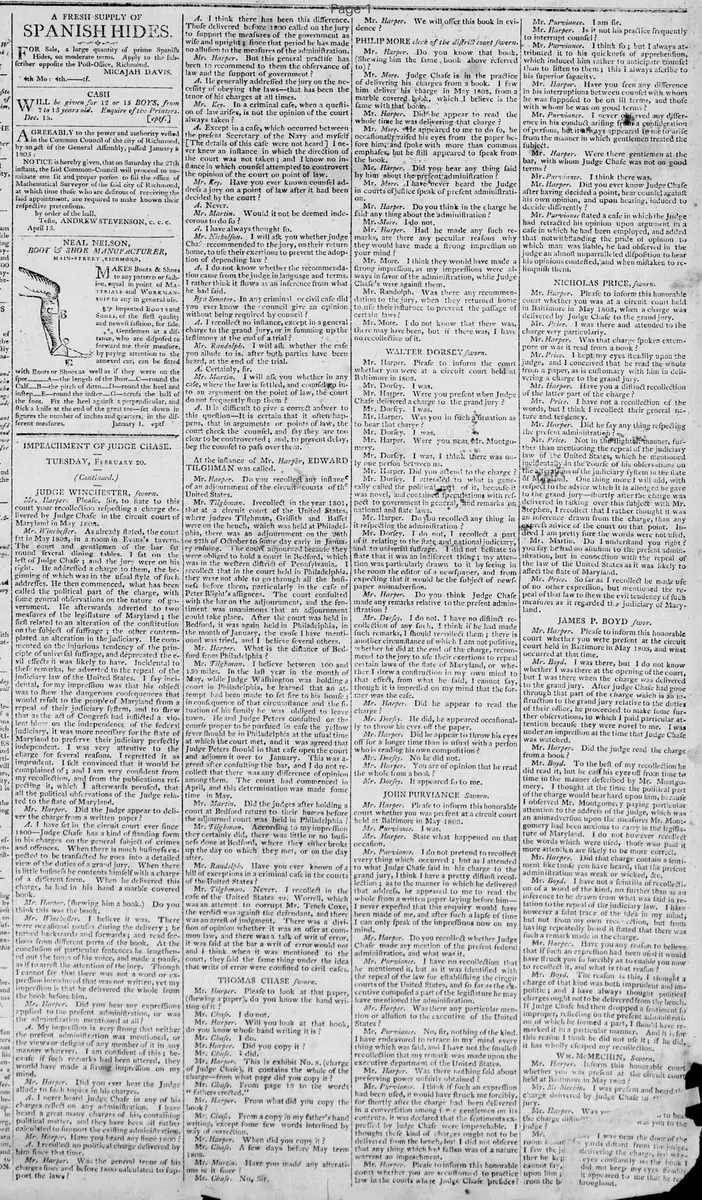
TUESDAY, FEBRUARY 26.
(Continued.)
JUDGE WINCHESTER, Sworn.
Mr. Harper. Please, Sir, to state to this court your recollection respecting a charge delivered by Judge Chase in the circuit court of Maryland in May 1803.
Mr. Winchester. As already stated, the court sat in May 1803, in a room in Evans's tavern. The court and gentlemen of the bar sat round several dining tables. I sat on the left of Judge Chase; and the jury were on his right. He addressed a charge to them, the beginning of which was in the usual style of such addresses. He then commenced, what has been called the political part of the charge, with some general observations on the nature of government. He afterwards adverted to two measures of the legislature of Maryland; the first related to an alteration of the constitution on the subject of suffrage; the other contemplated an alteration in the judiciary. He commented on the injurious tendency of the principle of universal suffrage, and deprecated the evil effects it was likely to have. Incidental to these remarks, he adverted to the repeal of the judiciary law of the United States. I say incidental, for my impression was that his object was to show the dangerous consequences that would result to the people of Maryland from a repeal of their judiciary system, and to show that as the act of Congress had inflicted a violent blow on the independence of the federal judiciary, it was more necessary for the state of Maryland to preserve their judiciary perfectly independent. I was very attentive to the charge for several reasons. I regretted it as imprudent. I felt convinced that it would be complained of; and I am very confident from my recollection, and from the publications respecting it, which I afterwards perused, that all the political observations of the Judge related to the state of Maryland.
Mr. Harper. Did the Judge appear to deliver the charge from a written paper?
A. I have sat in the circuit court ever since 1800—Judge Chase has a kind of standing form in his charges on the general subject of crimes and offences. When there is much business expected to be transacted he goes into a detailed view of the duties of a grand jury. When there is little business he contents himself with a charge of a different form. When he delivered this charge, he had in his hand a marble covered book.
Mr. Harper. (showing him a book.) Do you think this was the book.
Mr. Winchester. I believe it was. There were occasional pauses during the delivery; he turned backwards and forwards; and read sections from different parts of the book. At the conclusion of particular sentences he lengthened out the tones of his voice, and made a pause, as if to arrest the attention of the jury. Though I cannot say that there was not a word or expression introduced that was not written, yet my impression is that he delivered the whole from the book before him.
Mr. Harper. Did you hear any expressions applied to the present administration, or was the administration mentioned at all?
A. My impression is very strong that neither the present administration was mentioned, or the views or designs of any member of it in any manner whatever. I am confident of this: because if such remarks had been uttered, they would have made a strong impression on my mind.
Mr. Harper. Did you ever hear the Judge allude to such topics in his charges.
A. I never heard judge Chase in any of his charges reflect on any administration. I have heard a great many charges of his, containing political matter, and they have been all rather calculated to support the existing administration.
Mr. Harper. Have you heard any since 1800?
A. I recollect no political charge delivered by him since that time.
Mr. Harper. Was the general tenor of his charges since and before 1800 calculated to support the laws?
A. I think there has been this difference. Those delivered before 1800 called on the jury to support the measures of the government as wise and upright; since that period he has made no allusion to the measures of the administration.
Mr. Harper. But this general practice has been to recommend to them the observance of law and the support of government?
A. He generally addressed the jury on the necessity of obeying the laws—that has been the tenor of his charges at all times.
Mr. Key. In a criminal case, when a question of law arises, is not the opinion of the court always taken?
A. Except in a case, which occurred between the present Secretary of the Navy and myself [The details of this case were not heard] I never knew an instance in which the direction of the court was not taken; and I know no instance in which counsel attempted to controvert the opinion of the court on point of law.
Mr. Key. Have you ever known counsel address a jury on a point of law after it had been decided by the court?
A. Never.
Mr. Martin. Would it not be deemed indecorous to do so:
A. I have always thought so.
Mr. Nicholson. I will ask you whether judge Chase recommended to the jury, on their return home, to use their exertions to prevent the adoption of depending law?
A. I do not know whether the recommendation came from the judge in language and terms. I rather think it flows as an inference from what he had said.
By a Senator.—In any criminal or civil case did you ever know the council give an opinion without being required by council?
A. I recollect no instance, except in a general charge to the grand jury, or in summing up the testimony at the end of a trial?
Mr. Randolph. I will ask whether the case you allude to is, after both parties have been heard, at the end of the trial.
A. Certainly, sir.
Mr. Martin. I will ask you whether in any case, where the law is settled, and counsel go into an argument on the point of law, the court do not frequently stop them?
A. It is difficult to give a correct answer to this question—It is certain that it often happens, that in arguments or points of law, the court check the counsel, and say they are too clear to be controverted; and, to prevent delay, beg the counsel to pass over them.
At the instance of Mr. Harper, EDWARD TILGHMAN was called.
Mr. Harper. Do you recollect any instance of an adjournment of the circuit courts of the United States.
Mr. Tilghman. I recollect in the year 1801, that at a circuit court of the United States, where judges Tilghman, Griffith and Bassett were on the bench, which was held at Philadelphia, there was an adjournment on the 26th or 27th of October to some day early in January ensuing. The court adjourned because they were obliged to hold a court in Bedford, which was in the western district of Pennsylvania. I recollect that in the court held in Philadelphia, they were not able to go through all the business before them, particularly in the case of Peter Blight's assignees. The court consulted with the bar on the adjournment, and the sentiment was unanimous that an adjournment could take place. After the court was held in Bedford, it was again held in Philadelphia, in the month of January, the cause I have mentioned was tried, and I believe several others.
Mr. Harper. What is the distance of Bedford from Philadelphia?
Mr. Tilghman. I believe between 100 and 150 miles. In the last year in the month of May, while Judge Washington was holding a court in Philadelphia, he learned that an attempt had been made to set fire to his house: in consequence of that circumstance and the situation of his family he was obliged to leave town. He and Judge Peters consulted on the course proper to be pursued in case the yellow fever should be in Philadelphia at the usual time at which the court met, and it was agreed that Judge Peters should in that case open the court and adjourn it over to January. This was agreed after consulting the bar, and I do not recollect that there was any difference of opinion among them. The court had commenced in April, and this determination was made some time in May.
Mr. Martin. Did the judges after holding a court at Bedford return to their homes before the adjourned court was held in Philadelphia?
Mr. Tilghman. According to my impression they certainly did, there was little or no business done at Bedford, where they either broke up the day on which they met, or on the day after.
Mr. Randolph. Have you ever known of a bill of exceptions in a criminal case in the courts of the United States?
Mr. Tilghman. Never. I recollect in the case of the United States vs. Worrell, which was an attempt to corrupt Mr. Tench Coxe, the verdict was against the defendant, and there was an arrest of judgment. There was a division of opinion whether it was an offer at common law, and there was a talk of writ of error, it was said at the bar a writ of error would not lie and I think when it was mentioned to the court, they said the same thing under the idea that writs of error were confined to civil cases.
THOMAS CHASE sworn.
Mr. Harper. Please to look at that paper (showing a paper), do you know the hand writing of it?
Mr. Chase. I do not.
Mr. Harper. Will you look at that book, do you know whose hand writing it is?
Mr. Chase. I do.
Mr. Harper. Did you copy it?
Mr. Chase. I did.
Mr. Harper. This is exhibit No. 8. (charge of Judge Chase), it contains the whole of the charge—from what page did you copy it?
Mr. Chase. From page 13 to the words "fathers erected."
Mr. Harper. From what did you copy the book?
Mr. Chase. From a copy in my father's hand writing, except some few words interlined by way of correction.
Mr. Harper. When did you copy it?
Mr. Chase. A few days before May term 1803.
Mr. Martin. Have you made any alterations in it since?
Mr. Chase. No, Sir.
Mr. Harper. We will offer this book in evidence.
PHILIP MOORE clerk of the district court sworn
Mr. Harper. Do you know that book, (Shewing him the same, book above referred to)?
Mr. Moore. Judge Chase is in the practice of delivering his charges from a book. I saw him deliver his charge in May 1803, from a marble covered book, which I believe is the same with that book.
Mr. Harper. Did he appear to read the whole time he was delivering that charge?
Mr. Moore. He appeared to me to do so, he occasionally raised his eyes from the paper before him, and spoke with more than common emphasis, but he still appeared to speak from the book.
Mr. Harper. Did you hear any thing said by him about the present administration?
Mr. Moore. I have never heard the Judge in courts of justice speak of present administration.
Mr. Harper. Do you think in the charge he said any thing about the administration?
Mr. More. I do not.
Mr. Harper. Had he made any such remarks, are there any peculiar reasons why they would have made a strong impression on your mind?
Mr. More. I think they would have made a strong impression, as my impressions were always in favor of the administration, while Judge Chase's were against them.
Mr. Randolph. Was there any recommendation to the jury, when they returned home to, use their influence to prevent the passage of certain laws?
Mr. More. I do not know that there was, there may have been, but if there was, I have no recollection of it.
WALTER DORSEY sworn.
Mr. Harper. Please to inform the court whether you were at a circuit court held at Baltimore in 1803.
Mr. Dorsey. I was.
Mr. Harper. Were you present when Judge Chase delivered a charge to the grand jury?
Mr. Dorsey. I was.
Mr. Harper. Was you in such a situation as to hear that charge?
Mr. Dorsey. I was.
Mr. Harper. Were you near Mr. Montgomery.
Mr. Dorsey. I was, I think there was only one person between us.
Mr. Harper. Did you attend to the charge?
Mr. Dorsey. I attended to what is generally called the political part of it, because it was novel, and contained speculations with respect to government in general, and remarks on national and state laws.
Mr. Harper. Do you recollect any thing in it respecting the administration?
Mr. Dorsey. I do not, I recollect a part of it relating to the state and national judiciary, and to universal suffrage. I did not hesitate to state that it was an indiscreet thing; my attention was particularly drawn to it by seeing in the room the editor of a newspaper, and from expecting that it would be the subject of newspaper animadversion.
Mr. Harper. Do you think Judge Chase made any remarks relative to the present administration?
Mr. Dorsey. I do not. I have no distinct recollection of any such, I think if he had made such remarks, I should recollect them; there is another circumstance of which I am not positive, whether he did at the end of the charge, recommend to the jury to use their exertions to repeal certain laws of the state of Maryland, or whether I drew a construction in my own mind to that effect, from what he said, I cannot say, though it is impressed on my mind that the former was the case.
Mr. Harper. Did he appear to read the charge?
Mr. Dorsey. He did, he appeared occasionally to throw his eyes off the paper.
Mr. Harper. Did he appear to throw his eyes off for a longer time than is usual with a person who is reading his own composition?
Mr. Dorsey. No he did not.
Mr. Harper. You are of opinion that he read the whole from a book?
Mr. Dorsey. It appeared so to me.
JOHN PURVIANCE Sworn.
Mr. Harper. Please to inform this honorable court whether you was present at a circuit court held at Baltimore in May 1803.
Mr. Purviance. I was.
Mr. Harper. State what happened on that occasion.
Mr. Purviance. I do not pretend to recollect every thing which occurred; but as I attended to what Judge Chase said in his charge to the grand jury, I think I have a pretty distinct recollection; as to the manner in which he delivered that address, he appeared to me to read the whole from a written paper laying before him— I never expected that this enquiry would have been made of me, and after such a lapse of time I can only speak of the impressions now on my mind.
Mr. Harper. Do you recollect whether Judge Chase made any mention of the present federal administration, and what was it.
Mr. Purviance. I have no recollection that he mentioned it, but as it was identified with the repeal of the law for establishing the circuit courts of the United States, and so far as the executive composed a part of the legislature he may have mentioned the administration.
Mr. Harper. Was there any particular mention or allusion to the executive of the United States?
Mr. Purviance. No, sir, nothing of the kind. I have endeavored to retrace in my mind every thing which was said, and I have not the smallest recollection that any remark was made upon the executive department of the United States.
Mr. Harper. Was there nothing said about preserving power unfairly obtained?
Mr. Purviance. I think if such an expression had been used, it would have struck me forcibly, for shortly after the charge had been delivered in a conversation among several gentlemen on its contents, it was declared that the sentiments expressed by judge Chase were impeachable. I thought these kind of charges ought not to be delivered from the bench, but I did not observe that any thing which had fallen was of a nature warrant an impeachment.
Mr. Harper. Please to inform this honorable court whether you are accustomed to practice law in the courts where Judge Chase presides?
Mr. Purviance. I am sir.
Mr. Harper. Is it not his practice frequently to interrupt counsel?
Mr. Purviance. I think so; but I always attributed it to his quickness of apprehension, which induced him rather to anticipate counsel than to listen to them; this I always ascribe to his superior sagacity.
Mr. Harper. Have you seen any difference in his interruptions between counsel with whom he was supposed to be on ill terms, and those with whom he was on good terms?
Mr. Purviance. I never observed any difference in his conduct arising from a consideration of persons, but it always appeared to me to arise from the manner in which gentlemen treated the subject.
Mr. Harper. Were there gentlemen at the bar, with whom Judge Chase was not on good terms?
Mr. Purviance. I think there was.
Mr. Harper. Did you ever know Judge Chase after having decided a point, hear counsel against his own opinion, and upon hearing, induced to decide differently?
Mr. Purviance stated a case in which the Judge had retracted his opinion upon argument in a case in which he had been employed, and added that notwithstanding the pride of opinion to which man was liable, he had observed in the judge an almost unparalleled disposition to hear his opinions contested, and when mistaken to relinquish them.
NICHOLAS PRICE, sworn.
Mr. Harper. Please to inform this honorable court whether you was at a circuit court held at Baltimore in May 1803, when a charge was delivered by Judge Chase to the grand jury.
Mr. Price. I was there and attended to the charge very particularly.
Mr. Harper. Was that charge spoken extempore or was it read from a book?
Mr. Price. I kept my eyes steadily upon the judge, and I conceived that he read the whole from a paper, as is customary with him in delivering a charge to the grand jury.
Mr. Harper. Have you a distinct recollection of the latter part of the charge?
Mr. Price. I have not a recollection of the words, but I think I recollect their general nature and tendency.
Mr. Harper. Did he say any thing respecting the present administration?
Mr. Price. Not in the slightest manner, further than mentioning the repeal of the judiciary law of the United States, which he mentioned incidentally in the course of his observations on the alterations of the judiciary system in the state of Maryland. One thing more I will add, with respect to the advice which it is alleged he gave to the grand jury—shortly after the charge was delivered in talking over this subject with Mr. Stephen, I recollect that I rather thought it was an inference drawn from the charge, than any express advice of the court on that point. Indeed I am pretty sure the words were not used.
Mr. Martin. Do I understand you right? you say he had no allusion to the present administration, but in connection with the repeal of the law of the United States as it was likely to affect the state of Maryland.
Mr. Price. So far as I recollect he made use of no other expression, but mentioned the repeal of that law to show the evil tendency of such measures as it regarded the judiciary of Maryland.
JAMES P. BOYD sworn.
Mr. Harper. Please to inform this honorable court whether you were present at the circuit court held at Baltimore in May 1803, and what occurred at that time.
Mr. Boyd. I was there, but I do not know whether I was there at the opening of the court, but I was there when the charge was delivered to the grand jury. After judge Chase had gone through that part of the charge which is an instruction to the grand jury relative to the duties of their office, he proceeded to make some further observations, to which I paid particular attention because they were novel to me. I was under an impression at the time that Judge Chase was watched.
Mr. Harper. Did the judge read the charge from a book?
Mr. Boyd. To the best of my recollection he did read it, but he cast his eyes off from time to time in the manner described by Mr. Montgomery. I thought at the time the political part of the charge would bear hard upon him, because I observed Mr. Montgomery paying particular attention to the address of the judge, which was an animadversion upon the measures Mr. Montgomery had been anxious to carry in the legislature of Maryland. I do not however recollect the words which were used, those who paid it more attention are likely to be more correct.
Mr. Harper. Did that charge contain a sentiment like those you have heard, that the present administration was weak or wicked, &c.
Mr. Boyd. I have not a scintilla of recollection of a word of the kind, no further than as an inference to be drawn from what was said in relation to the repeal of the judiciary law. I have however a faint trace of the idea in my mind; but not from my own recollection, but from having repeatedly heard it stated that there was such a remark made in the charge.
Mr. Harper. Have you any reason to believe that if such an expression had been used it would have struck you so forcibly as to enable you now to recollect it, and what is that reason?
Mr. Boyd. The reason is this, I thought a charge of that kind was both imprudent and impolitic; and I have always thought political charges ought not to be delivered from the bench. If Judge Chase had then dropped a sentiment so improper, reflecting on the present administration of which he formed a part, I should have remarked it in a particular manner. And it is for this reason I think he did not use it; if he did, it has wholly escaped my recollection.
WM. McMECHIN, Sworn.
Mr. Harper. Inform this honorable court whether you was present at the circuit court held at Baltimore in May 1803?
Mr. McMechin. I was present and heard a charge delivered by judge Chase to the jury.
Mr. Harper. Was you to hear the judge?
Mr. McMechin. I was near the door of the room about 10 or 12 yards distant from the judge. I saw the judge while delivering the charge, but whether he kept his eyes constantly on the book I cannot say, I did not keep my eyes steadily upon him; it appeared to me that he read from the book throughout.
Mr. Harper. Have you a recollection of the latter part of that charge?
Mr. McMechin. I think I have.
Mr. Harper. Have you any recollection of his having said anything against the present administration?
Mr. McMechin. I have no recollection of anything of the kind, either that they were weak, or of their having unfairly acquired power; such an idea was mentioned in no way unless it be inferred from the remark on the repeal of the law establishing the sixteen circuit judges.
Mr. Harper. If such a sentiment had been uttered it would not have escaped your notice?
Mr. McMechin. I think it would not.
Mr. Harper. Had you any conversation about this charge, if you please to inform when, with whom, and what was it?
Mr. McMechin. About five minutes after the charge was delivered I left the court room: going down stairs I met Mr. Montgomery and I asked him, or he asked me, what was thought of the charge; after a few observations, he said it was such an one as Mr. Chase would be impeached for; this drew my attention pointedly to the charge itself; after this I heard of the publication in the American, but I did not see it. I met afterwards with a publication in the Anti-Democrat which paper I took, purporting to be the charge of Judge Chase. I have conversed with gentlemen of both parties on the publication, and it appeared to them as it did appear to me, and as I still think it is, substantially the charge delivered by the judge.
Mr. Harper. Has that opinion rested on your mind ever since you heard the charge and read the publication?
Mr. McMechin. It has always so rested on my mind, and I have never read anything on the subject since?
WM. S. GOVANE Sworn.
Mr. Harper. Were you at the circuit court of Baltimore in May 1803?
Mr. Govane. I was, and heard the charge delivered by Judge Chase. The room in which the court was held was a long one in a tavern, a range of tables formed the bar, and the seats around it were occupied by professional gentlemen. I went to the bottom of the table opposite to Judge Chase and directed my attention towards him. Whilst he was delivering his charge he appeared to read it from a book, but generally ended the sentences by looking toward the grand jury; except this circumstance he appeared to read the whole time.
Mr. Harper. Do you retain a distinct recollection of the substance of what the judge said?
Mr. Govane. I think I do.
Mr. Harper. Do you remember any part containing animadversions on the present administration, such as that they were weak, feeble or incompetent?
Mr. Govane. I think no such words were used. If I could swear to a fact negatively after such a lapse of time, I could swear that no such expressions fell from the judge. He said that a monarchy might be free and a republic a tyranny, and then proceeded to define what a free government was.
Mr. Harper. Then you have no recollection of any reflection made upon the present administration?
Mr. Govane. I have not the most distant idea that such an expression was used.
Mr. Harper. Would you have remembered them if they had been used?
Mr. Govane. I think I should, as I had a conversation with a friend respecting it soon after it was delivered; and I paid particular attention to the charge, because it came from Judge Chase as a man of great celebrity, and I wished to draw what information I could from such a respectable source; everything arrested my attention, and it appeared that the attention of the whole company was fixed upon the judge.
JOHN CAMPBELL sworn.
Mr. Harper. Did you attend the circuit court held at Baltimore in 1803, and in what capacity?
Mr. Campbell. I attended that court as a grand juror and was appointed foreman.
Mr. Harper. Do you recollect the charge that was then delivered by Judge Chase?
Mr. Campbell. I recollect some parts of it, but not the whole. I paid a particular attention to that part which described my duties as a grand juror, and have some recollection of the latter part. I kept my eyes constantly upon the judge.
Mr. Harper. Did he read or speak that charge?
Mr. Campbell. He appeared generally to read it, taking off his eyes from the book from time to time, but never for a longer time than what is usual for men to express the words they retain in their memory from their own composition.
Mr. Harper. Have you a distinct recollection of the latter part of the charge?
Mr. Campbell. I cannot say I have a distinct recollection of any particular part of the charge, though I remember its general tendency.
Mr. Harper. Do you remember to have heard the present administration censured as weak, feeble, or incompetent &c.?
Mr. Campbell. I have not the slightest recollection of any such expressions, if they were used they have altogether escaped my memory.
Mr. Harper. Was there any allusion to the present administration?
Mr. Campbell. No, sir.
Mr. Harper. If such words were uttered, is there any circumstance which would have impressed them on your memory?
Mr. Campbell. I should have thought them very improper, and that would have fixed them in my mind, but I have no trace of any such impression.
Mr. Nicholson. You gave a deposition before the committee on this point?
Mr. Campbell. I did sir.
Mr. Nicholson. Did you say that the Judge recommended to the jury when they returned home that they should use their influence to prevent the passage of certain laws then pending before the legislature of Maryland?
Mr. Campbell. It does appear still to me that I heard some such expression. I have thought of it repeatedly since, and I continue to believe that the Judge gave the jury that advice.
Mr. Harper. Was the exhortation made by the Judge, or is it an inference you draw in your own mind?
Mr. Campbell. Some such expression fell from him, and it is not an inference formed in my mind.
WILLIAM CRANCH sworn.
Mr. Harper. Were you present at the circuit court held at Baltimore in 1803?
Mr. Cranch. I was—the court was held at Evans's tavern in Baltimore,—Judge Chase was seated in an armed chair at the end of a long table placed before him, the grand jury were on his right, some sitting on benches placed along the wall and others standing. I stood myself about fifteen feet from the Judge, who was sitting during the whole time he was delivering his charge: he generally held the book in his hand.
Mr. Harper. (showing a book) Is that the book?
Mr. Cranch. He appeared to be reading from such a book?
Mr. Harper. Did he read the whole, and did he read constantly?
Mr. Cranch. He appeared to me to read the whole charge, but I did not keep my eyes so constantly fixed upon him as to declare positively that he did.
Mr. Harper. Was there variations in his manner delivering the charge, as if he was at one time reading and at another speaking ex tempore?
Mr. Cranch. He delivered parts with more emphasis than others. He often raised his eyes from the book, but I did not observe that he repeated more than one sentence without recurring to the book—he repeated no more than a man might repeat after running his eyes hastily over a passage.
Mr. Harper. Did he raise his eyes for a longer time than a man might be supposed to do, who was reading a composition of his own?
Mr. Cranch. I do not think he did.
(To be continued.)
What sub-type of article is it?
What themes does it cover?
What keywords are associated?
What entities or persons were involved?
Where did it happen?
Story Details
Key Persons
Location
Baltimore, Maryland
Event Date
May 1803
Story Details
Multiple witnesses testify in Judge Chase's impeachment trial that his charge to the grand jury in Baltimore's circuit court was delivered from a written book, focused on Maryland's suffrage and judiciary reforms with incidental reference to the federal judiciary repeal, without direct criticism of the current federal administration or explicit calls to action against pending laws.