Thank you for visiting SNEWPapers!
Sign up free
Story
November 30, 1850
Fremont Weekly Freeman
Fremont, Sandusky County, Ohio
What is this article about?
Descriptive account of the Territory of Utah's unique geography, Mormon settlements in the Great Basin, including Great Salt Lake City, Provo, and San Pete, highlighting fertile valleys, irrigation needs, healthy climate, city layout, and its role as a waypoint for emigrants to California and Oregon.
Clipping
OCR Quality
98%
Excellent
Full Text
From the Hartford Courant.
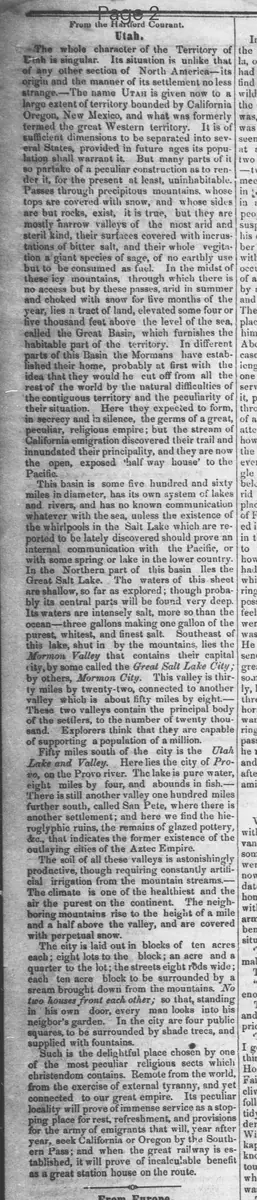
The whole character of the Territory of Utah is singular. Its situation is unlike that of any other section of North America—its origin and the manner of its settlement no less strange. The name Utah is given now to a large extent of territory bounded by California, Oregon, New Mexico, and what was formerly termed the great Western territory. It is of sufficient dimensions to be separated into several States, provided in future ages its population shall warrant it. But many parts of it so partake of a peculiar construction as to render it, for the present at least, uninhabitable. Passes through precipitous mountains, whose tops are covered with snow, and whose sides are but rocks, exist, it is true, but they are mostly narrow valleys of the most arid and steril kind, their surfaces covered with incrustations of bitter salt, and their whole vegetation a giant species of sage, of no earthly use but to be consumed as fuel. In the midst of these icy mountains, through which there is no access but by these passes, arid in summer and choked with snow for five months of the year, lies a tract of land, elevated some four or five thousand feet above the level of the sea, called the Great Basin, which furnishes the habitable part of the territory. In different parts of this Basin the Mormons have established their home, probably at first with the idea that they would be cut off from all the rest of the world by the natural difficulties of the contiguous territory and the peculiarity of their situation. Here they expected to form, in secrecy and in silence, the germs of a great, peculiar, religious empire; but the stream of California emigration discovered their trail and inundated their principality, and they are now the open, exposed half way house to the Pacific.
This basin is some five hundred and sixty miles in diameter, has its own system of lakes and rivers, and has no known communication whatever with the sea, unless the existence of the whirlpools in the Salt Lake which are reported to be lately discovered should prove an internal communication with the Pacific, or with some spring or lake in the lower country. In the Northern part of this basin lies the Great Salt Lake. The waters of this sheet are shallow, so far as explored; though probably its central parts will be found very deep. Its waters are intensely salt, more so than the ocean—three gallons making one gallon of the purest, whitest, and finest salt. Southeast of this lake, shut in by the mountains, lies the Mormon Valley that contains their capital city, by some called the Great Salt Lake City; by others, Mormon City. This valley is thirty miles by twenty-two, connected to another valley which is about fifty miles by eight.—These two valleys contain the principal body of the settlers, to the number of twenty thousand. Explorers think that they are capable of supporting a population of a million.
Fifty miles south of the city is the Utah Lake and Valley. Here lies the city of Provo, on the Provo river. The lake is pure water, eight miles by four, and abounds in fish. There is still another valley one hundred miles further south, called San Pete, where there is another settlement; and here we find the hieroglyphic ruins, the remains of glazed pottery, &c., that indicates the former existence of the outlaying cities of the Aztec Empire.
The soil of all these valleys is astonishingly productive, though requiring constantly artificial irrigation from the mountain streams.—The climate is one of the healthiest and the air the purest on the continent. The neighboring mountains rise to the height of a mile and a half above the valley, and are covered with perpetual snow.
The city is laid out in blocks of ten acres each; eight lots to the block; an acre and a quarter to the lot; the streets eight rods wide; each ten acre block to be surrounded by a stream brought down from the mountains. No two houses front each other; so that, standing in his own door, every man looks into his neighbor's garden. In the city are four public squares, to be surrounded by shade trees, and supplied with fountains.
Such is the delightful place chosen by one of the most peculiar religious sects which Christendom contains. Remote from the world, from the exercise of external tyranny, and yet connected to our great empire. Its peculiar locality will prove of immense service as a stopping place for rest, refreshment, and provisions for the army of emigrants that will, year after year, seek California or Oregon by the Southern Pass; and when the great railway is established, it will prove of incalculable benefit as a great station house on the route.
The whole character of the Territory of Utah is singular. Its situation is unlike that of any other section of North America—its origin and the manner of its settlement no less strange. The name Utah is given now to a large extent of territory bounded by California, Oregon, New Mexico, and what was formerly termed the great Western territory. It is of sufficient dimensions to be separated into several States, provided in future ages its population shall warrant it. But many parts of it so partake of a peculiar construction as to render it, for the present at least, uninhabitable. Passes through precipitous mountains, whose tops are covered with snow, and whose sides are but rocks, exist, it is true, but they are mostly narrow valleys of the most arid and steril kind, their surfaces covered with incrustations of bitter salt, and their whole vegetation a giant species of sage, of no earthly use but to be consumed as fuel. In the midst of these icy mountains, through which there is no access but by these passes, arid in summer and choked with snow for five months of the year, lies a tract of land, elevated some four or five thousand feet above the level of the sea, called the Great Basin, which furnishes the habitable part of the territory. In different parts of this Basin the Mormons have established their home, probably at first with the idea that they would be cut off from all the rest of the world by the natural difficulties of the contiguous territory and the peculiarity of their situation. Here they expected to form, in secrecy and in silence, the germs of a great, peculiar, religious empire; but the stream of California emigration discovered their trail and inundated their principality, and they are now the open, exposed half way house to the Pacific.
This basin is some five hundred and sixty miles in diameter, has its own system of lakes and rivers, and has no known communication whatever with the sea, unless the existence of the whirlpools in the Salt Lake which are reported to be lately discovered should prove an internal communication with the Pacific, or with some spring or lake in the lower country. In the Northern part of this basin lies the Great Salt Lake. The waters of this sheet are shallow, so far as explored; though probably its central parts will be found very deep. Its waters are intensely salt, more so than the ocean—three gallons making one gallon of the purest, whitest, and finest salt. Southeast of this lake, shut in by the mountains, lies the Mormon Valley that contains their capital city, by some called the Great Salt Lake City; by others, Mormon City. This valley is thirty miles by twenty-two, connected to another valley which is about fifty miles by eight.—These two valleys contain the principal body of the settlers, to the number of twenty thousand. Explorers think that they are capable of supporting a population of a million.
Fifty miles south of the city is the Utah Lake and Valley. Here lies the city of Provo, on the Provo river. The lake is pure water, eight miles by four, and abounds in fish. There is still another valley one hundred miles further south, called San Pete, where there is another settlement; and here we find the hieroglyphic ruins, the remains of glazed pottery, &c., that indicates the former existence of the outlaying cities of the Aztec Empire.
The soil of all these valleys is astonishingly productive, though requiring constantly artificial irrigation from the mountain streams.—The climate is one of the healthiest and the air the purest on the continent. The neighboring mountains rise to the height of a mile and a half above the valley, and are covered with perpetual snow.
The city is laid out in blocks of ten acres each; eight lots to the block; an acre and a quarter to the lot; the streets eight rods wide; each ten acre block to be surrounded by a stream brought down from the mountains. No two houses front each other; so that, standing in his own door, every man looks into his neighbor's garden. In the city are four public squares, to be surrounded by shade trees, and supplied with fountains.
Such is the delightful place chosen by one of the most peculiar religious sects which Christendom contains. Remote from the world, from the exercise of external tyranny, and yet connected to our great empire. Its peculiar locality will prove of immense service as a stopping place for rest, refreshment, and provisions for the army of emigrants that will, year after year, seek California or Oregon by the Southern Pass; and when the great railway is established, it will prove of incalculable benefit as a great station house on the route.
What sub-type of article is it?
Historical Event
Curiosity
What themes does it cover?
Exploration
Nature
What keywords are associated?
Utah Territory
Mormon Settlements
Great Salt Lake
Great Basin
Irrigation
Emigrant Waypoint
What entities or persons were involved?
Mormons
Where did it happen?
Territory Of Utah, Great Basin, Great Salt Lake, Mormon Valley, Utah Lake, San Pete
Story Details
Key Persons
Mormons
Location
Territory Of Utah, Great Basin, Great Salt Lake, Mormon Valley, Utah Lake, San Pete
Story Details
Description of Utah's singular geography, Mormon settlements in fertile valleys requiring irrigation, healthy climate, city layout in Great Salt Lake City, and its strategic role for emigrants.