Thank you for visiting SNEWPapers!
Sign up free
Editorial
November 30, 1826
The Wilmingtonian, And Delaware Advertiser
Wilmington, New Castle County, Delaware
What is this article about?
This editorial, part V on Negro slavery, critiques the institution in the US and British West Indies, comparing it to milder forms in ancient and African contexts, emphasizing its oppressiveness amid surrounding freedoms, and detailing harsh treatments under British rule.
Merged-components note: Footnote provides source information for the essay on Negro Slavery and belongs to the same component.
Clipping
OCR Quality
95%
Excellent
Full Text
For the Wilmingtonian.
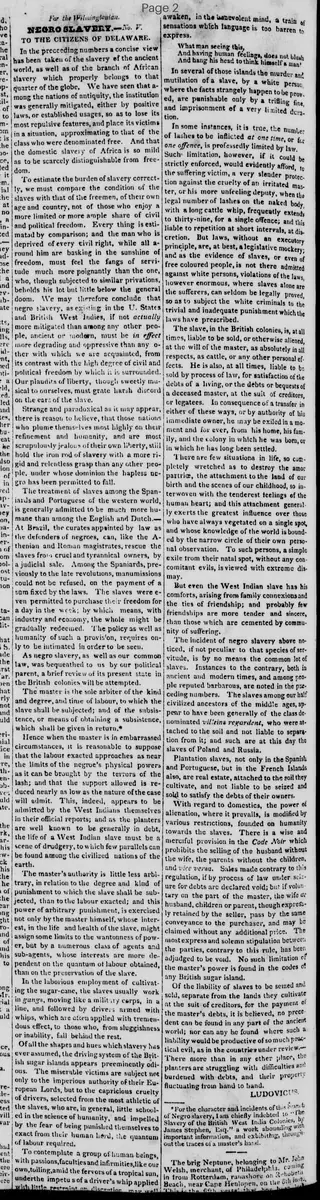
NEGRO SLAVERY--NO. V.
TO THE CITIZENS OF DELAWARE.
In the preceding numbers a concise view has been taken of the slavery of the ancient world, as well as of the branch of African slavery which properly belongs to that quarter of the globe. We have seen that among the nations of antiquity, the institution was generally mitigated, either by positive laws, or established usages, so as to lose its most repulsive features, and place its victims in a situation, approximating to that of the class who were denominated free. And that the domestic slavery of Africa is so mild as to be scarcely distinguishable from freedom.
To estimate the burden of slavery correctly, we must compare the condition of the slaves with that of the freemen, of their own age and country, not of those who enjoy a more limited or more ample share of civil and political freedom. Every thing is estimated by comparison; and the man who is deprived of every civil right, while all around him are basking in the sunshine of freedom, must feel the fangs of servitude much more poignantly than the one, who, though subjected to similar privations, beholds his lot but little below the general doom. We may therefore conclude that negro slavery, as existing in the U. States and British West Indies, if not actually more mitigated than among any other people, ancient or modern, must be in effect more degrading and oppressive than any other with which we are acquainted, from its contrast with the high degree of civil and political freedom by which it is surrounded.
Our plaudits of liberty, though sweetly musical to ourselves, must grate harsh discord on the ears of the slave.
Strange and paradoxical as it may appear, there is reason to believe, that those nations who plume themselves most highly on their refinement and humanity, and are most scrupulously jealous of their own liberty, still hold the iron rod of slavery with a more rigid and relentless grasp than any other people, under whose dominion the hapless negro has been permitted to fall.
The treatment of slaves among the Spaniards and Portuguese of the western world, is generally admitted to be much more humane than among the English and Dutch. At Brazil, the curates appointed by law as the defenders of negroes, can, like the Athenian and Roman magistrates, rescue the slaves from cruel and tyrannical owners, by a judicial sale. Among the Spaniards, previously to the late revolutions, manumissions could not be refused, on the payment of a sum fixed by the laws. The slaves were even permitted to purchase their freedom for a day in the week; by which means, with industry and economy, the whole might be gradually redeemed. The policy as well as humanity of such a provision, requires only to be intimated in order to be seen.
As negro slavery, as well as our common law, was bequeathed to us by our political parent, a brief review of its present state in the British colonies will be attempted.
The master is the sole arbiter of the kind and degree, and time of labour, to which the slave shall be subjected: and of the subsistence, or means of obtaining a subsistence, which shall be given in return.
Hence when the master is in embarrassed circumstances, it is reasonable to suppose that the labour exacted approaches as near the limits of the negro's physical powers as it can be brought by the terrors of the lash; and that the support allowed is reduced nearly as low as the nature of the case will admit. This, indeed, appears to be admitted by the West Indians themselves in their official reports; and as the planters are well known to be generally in debt, the life of a West Indian slave must be a scene of drudgery, to which few parallels can be found among the civilized nations of the earth.
The master's authority is little less arbitrary, in relation to the degree and kind of punishment to which the slave shall be subjected, than to the labour exacted: and this power of arbitrary punishment, is exercised not only by the master himself, whose interest, in the life and health of the slave, might assign some limits to the wantonness of power, but by a numerous class of agents and sub-agents, whose interests are more dependent on the quantum of labour obtained, than on the preservation of the slave.
In the laborious employment of cultivating the sugar-cane, the slaves usually work in gangs, moving like a military corps, in a line, and followed by drivers armed with whips, which are often applied with tremendous effect, to those who, from sluggishness or inability, fall behind the rest.
Of all the shapes and hues which slavery has ever assumed, the driving system of the British sugar islands appears preeminently odious. The miserable victims are subject not only to the imperious authority of their European Lords, but to the capricious cruelty of drivers, selected from the most athletic of the slaves, who are, in general, little schooled in the science of humanity, and impelled by the fear of being punished themselves to exact from their human herd, the quantum of labour required.
To contemplate a group of human beings, with passions, faculties and infirmities, like our own, toiling, amid the fervors of a tropical sun, under the impetus of a driver's whip applied with little restraint or discretion, awaken, in the benevolent mind, a train of sensations which language is too barren to express.
What man seeing this,
And having human feelings, does not blush
And hang his head to think himself a man!
In several of those islands the murder and mutilation of a slave, by a white person, where the facts strangely happen to be proved, are punishable only by a trifling fine, and imprisonment of a very limited duration.
In some instances, it is true, the number of lashes to be inflicted at one time, or for one offence, is professedly limited by law. Such limitation, however, if it could be strictly enforced, would evidently afford, to the suffering victim, a very slender protection against the cruelty of an irritated master, or his more unfeeling deputy, when the legal number of lashes on the naked body, with a long cattle whip, frequently extends to thirty-nine, for a single offence; and this liable to repetition at short intervals, at discretion. But laws, without an executory principle, are, at best, a legislative mockery; and as the evidence of slaves, or even of free coloured people, is not there admitted against white persons, violations of the laws however enormous, where slaves alone are the sufferers, can seldom be legally proved, so as to subject the white criminals to the trivial and inadequate punishment which the laws have prescribed.
The slave, in the British colonies, is, at all times, liable to be sold, or otherwise alienated, at the will of the master, as absolutely in all respects, as cattle, or any other personal effects. He is also, at all times, liable to be sold by process of law, for satisfaction of the debts of a living, or the debts or bequests of a deceased master, at the suit of creditors, or legatees. In consequence of a transfer in either of these ways, or by authority of his immediate owner, he may be exiled in a moment and for ever, from his home, his family, and the colony in which he was born, or in which he has long been settled.
There are few situations in life, so completely wretched as to destroy the amor patriae, the attachment to the land of our birth and the scenes of our childhood, so interwoven with the tenderest feelings of the human heart; and this attachment generally exerts the greatest influence over those who have always vegetated on a single spot and whose knowledge of the world is bounded by the narrow circle of their own personal observation. To such persons, a simple exile from their natal spot, without any concomitant evils, is viewed with extreme dismay.
But even the West Indian slave has his comforts, arising from family connexions and the ties of friendship; and probably few friendships are more tender and sincere, than those which are cemented by community of suffering.
The incident of negro slavery above noticed, if not peculiar to that species of servitude, is by no means the common lot of slaves. Instances to the contrary, both in ancient and modern times, and among people reputed barbarous, are noted in the preceding numbers. The slaves among our half civilized ancestors of the middle ages, appear to have been generally of the class denominated villeins regardant, who were attached to the soil and not liable to separation from it; and such are at this day the slaves of Poland and Russia.
Plantation slaves, not only in the Spanish and Portuguese, but in the French Islands also, are real estate, attached to the soil they cultivate, and not liable to be seized and sold to satisfy the debts of their owners.
With regard to domestics, the power of alienation, where it prevails, is modified by various restrictions, founded on humanity towards the slaves. There is a wise and merciful provision in the Code Noir which prohibits the selling of the husband without the wife, the parents without the children, and vice versa. Sales made contrary to this regulation, if by process of law under seizure for debts are declared void: but if voluntary on the part of the master, the wife or husband, children or parent, though expressly retained by the seller, pass by the same conveyance to the purchaser, and may be claimed without any additional price. The most express and solemn stipulation between the parties, contrary to this rule, has been adjudged to be void. No such limitation of the master's power is found in the codes of any British sugar island.
Of the liability of slaves to be seized and sold, separate from the lands they cultivate at the suit of creditors, for the payment of the master's debts, it is believed, no precedent can be found in any part of the ancient world; nor can any be found where such a liability would be productive of so much practical evil, as in the countries under review. There more than in any other place, the planters are struggling with difficulties and burdened with debts, and their property fluctuating from hand to hand.
LUDOVICUS.
*For the character and incidents of this branch of Negro slavery, I am chiefly indebted to "The Slavery of the British West India Colonies, by James Stephen, Esq" a work abounding with important information, and exhibiting, throughout the traces of a master's hand.
NEGRO SLAVERY--NO. V.
TO THE CITIZENS OF DELAWARE.
In the preceding numbers a concise view has been taken of the slavery of the ancient world, as well as of the branch of African slavery which properly belongs to that quarter of the globe. We have seen that among the nations of antiquity, the institution was generally mitigated, either by positive laws, or established usages, so as to lose its most repulsive features, and place its victims in a situation, approximating to that of the class who were denominated free. And that the domestic slavery of Africa is so mild as to be scarcely distinguishable from freedom.
To estimate the burden of slavery correctly, we must compare the condition of the slaves with that of the freemen, of their own age and country, not of those who enjoy a more limited or more ample share of civil and political freedom. Every thing is estimated by comparison; and the man who is deprived of every civil right, while all around him are basking in the sunshine of freedom, must feel the fangs of servitude much more poignantly than the one, who, though subjected to similar privations, beholds his lot but little below the general doom. We may therefore conclude that negro slavery, as existing in the U. States and British West Indies, if not actually more mitigated than among any other people, ancient or modern, must be in effect more degrading and oppressive than any other with which we are acquainted, from its contrast with the high degree of civil and political freedom by which it is surrounded.
Our plaudits of liberty, though sweetly musical to ourselves, must grate harsh discord on the ears of the slave.
Strange and paradoxical as it may appear, there is reason to believe, that those nations who plume themselves most highly on their refinement and humanity, and are most scrupulously jealous of their own liberty, still hold the iron rod of slavery with a more rigid and relentless grasp than any other people, under whose dominion the hapless negro has been permitted to fall.
The treatment of slaves among the Spaniards and Portuguese of the western world, is generally admitted to be much more humane than among the English and Dutch. At Brazil, the curates appointed by law as the defenders of negroes, can, like the Athenian and Roman magistrates, rescue the slaves from cruel and tyrannical owners, by a judicial sale. Among the Spaniards, previously to the late revolutions, manumissions could not be refused, on the payment of a sum fixed by the laws. The slaves were even permitted to purchase their freedom for a day in the week; by which means, with industry and economy, the whole might be gradually redeemed. The policy as well as humanity of such a provision, requires only to be intimated in order to be seen.
As negro slavery, as well as our common law, was bequeathed to us by our political parent, a brief review of its present state in the British colonies will be attempted.
The master is the sole arbiter of the kind and degree, and time of labour, to which the slave shall be subjected: and of the subsistence, or means of obtaining a subsistence, which shall be given in return.
Hence when the master is in embarrassed circumstances, it is reasonable to suppose that the labour exacted approaches as near the limits of the negro's physical powers as it can be brought by the terrors of the lash; and that the support allowed is reduced nearly as low as the nature of the case will admit. This, indeed, appears to be admitted by the West Indians themselves in their official reports; and as the planters are well known to be generally in debt, the life of a West Indian slave must be a scene of drudgery, to which few parallels can be found among the civilized nations of the earth.
The master's authority is little less arbitrary, in relation to the degree and kind of punishment to which the slave shall be subjected, than to the labour exacted: and this power of arbitrary punishment, is exercised not only by the master himself, whose interest, in the life and health of the slave, might assign some limits to the wantonness of power, but by a numerous class of agents and sub-agents, whose interests are more dependent on the quantum of labour obtained, than on the preservation of the slave.
In the laborious employment of cultivating the sugar-cane, the slaves usually work in gangs, moving like a military corps, in a line, and followed by drivers armed with whips, which are often applied with tremendous effect, to those who, from sluggishness or inability, fall behind the rest.
Of all the shapes and hues which slavery has ever assumed, the driving system of the British sugar islands appears preeminently odious. The miserable victims are subject not only to the imperious authority of their European Lords, but to the capricious cruelty of drivers, selected from the most athletic of the slaves, who are, in general, little schooled in the science of humanity, and impelled by the fear of being punished themselves to exact from their human herd, the quantum of labour required.
To contemplate a group of human beings, with passions, faculties and infirmities, like our own, toiling, amid the fervors of a tropical sun, under the impetus of a driver's whip applied with little restraint or discretion, awaken, in the benevolent mind, a train of sensations which language is too barren to express.
What man seeing this,
And having human feelings, does not blush
And hang his head to think himself a man!
In several of those islands the murder and mutilation of a slave, by a white person, where the facts strangely happen to be proved, are punishable only by a trifling fine, and imprisonment of a very limited duration.
In some instances, it is true, the number of lashes to be inflicted at one time, or for one offence, is professedly limited by law. Such limitation, however, if it could be strictly enforced, would evidently afford, to the suffering victim, a very slender protection against the cruelty of an irritated master, or his more unfeeling deputy, when the legal number of lashes on the naked body, with a long cattle whip, frequently extends to thirty-nine, for a single offence; and this liable to repetition at short intervals, at discretion. But laws, without an executory principle, are, at best, a legislative mockery; and as the evidence of slaves, or even of free coloured people, is not there admitted against white persons, violations of the laws however enormous, where slaves alone are the sufferers, can seldom be legally proved, so as to subject the white criminals to the trivial and inadequate punishment which the laws have prescribed.
The slave, in the British colonies, is, at all times, liable to be sold, or otherwise alienated, at the will of the master, as absolutely in all respects, as cattle, or any other personal effects. He is also, at all times, liable to be sold by process of law, for satisfaction of the debts of a living, or the debts or bequests of a deceased master, at the suit of creditors, or legatees. In consequence of a transfer in either of these ways, or by authority of his immediate owner, he may be exiled in a moment and for ever, from his home, his family, and the colony in which he was born, or in which he has long been settled.
There are few situations in life, so completely wretched as to destroy the amor patriae, the attachment to the land of our birth and the scenes of our childhood, so interwoven with the tenderest feelings of the human heart; and this attachment generally exerts the greatest influence over those who have always vegetated on a single spot and whose knowledge of the world is bounded by the narrow circle of their own personal observation. To such persons, a simple exile from their natal spot, without any concomitant evils, is viewed with extreme dismay.
But even the West Indian slave has his comforts, arising from family connexions and the ties of friendship; and probably few friendships are more tender and sincere, than those which are cemented by community of suffering.
The incident of negro slavery above noticed, if not peculiar to that species of servitude, is by no means the common lot of slaves. Instances to the contrary, both in ancient and modern times, and among people reputed barbarous, are noted in the preceding numbers. The slaves among our half civilized ancestors of the middle ages, appear to have been generally of the class denominated villeins regardant, who were attached to the soil and not liable to separation from it; and such are at this day the slaves of Poland and Russia.
Plantation slaves, not only in the Spanish and Portuguese, but in the French Islands also, are real estate, attached to the soil they cultivate, and not liable to be seized and sold to satisfy the debts of their owners.
With regard to domestics, the power of alienation, where it prevails, is modified by various restrictions, founded on humanity towards the slaves. There is a wise and merciful provision in the Code Noir which prohibits the selling of the husband without the wife, the parents without the children, and vice versa. Sales made contrary to this regulation, if by process of law under seizure for debts are declared void: but if voluntary on the part of the master, the wife or husband, children or parent, though expressly retained by the seller, pass by the same conveyance to the purchaser, and may be claimed without any additional price. The most express and solemn stipulation between the parties, contrary to this rule, has been adjudged to be void. No such limitation of the master's power is found in the codes of any British sugar island.
Of the liability of slaves to be seized and sold, separate from the lands they cultivate at the suit of creditors, for the payment of the master's debts, it is believed, no precedent can be found in any part of the ancient world; nor can any be found where such a liability would be productive of so much practical evil, as in the countries under review. There more than in any other place, the planters are struggling with difficulties and burdened with debts, and their property fluctuating from hand to hand.
LUDOVICUS.
*For the character and incidents of this branch of Negro slavery, I am chiefly indebted to "The Slavery of the British West India Colonies, by James Stephen, Esq" a work abounding with important information, and exhibiting, throughout the traces of a master's hand.
What sub-type of article is it?
Slavery Abolition
Moral Or Religious
What keywords are associated?
Negro Slavery
British West Indies
Slave Treatment
Anti Slavery Critique
West Indian Planters
Slave Drivers
Manumission Rights
What entities or persons were involved?
British West Indies
Spaniards
Portuguese
James Stephen
Ludovicus
Editorial Details
Primary Topic
Critique Of Negro Slavery In The United States And British West Indies
Stance / Tone
Strongly Anti Slavery, Highlighting Oppressiveness And Cruelty
Key Figures
British West Indies
Spaniards
Portuguese
James Stephen
Ludovicus
Key Arguments
Negro Slavery In Us And British West Indies Is More Degrading Due To Contrast With Surrounding Freedoms
Treatment Under British Rule Is Harsher Than In Spanish/Portuguese Colonies
Arbitrary Labor, Punishment, And Sale Of Slaves Exacerbate Suffering
Laws Protecting Slaves Are Ineffective Without Enforcement
Family Separations And Exile Add To The Misery