Thank you for visiting SNEWPapers!
Sign up free
The New York Journal, And Daily Patriotic Register
New York, New York County, New York
What is this article about?
Debates in the Massachusetts Ratifying Convention on January 22-23, 1788, where speakers like R. Jones, Mr. Pierce, Col. Varnum, Mr. Choate, General Thompson, and Rev. Mr. Niles discussed the U.S. Constitution's provisions for checks on power, taxation, representation, and the need for a bill of rights, weighing federal consolidation against state sovereignty.
Clipping
OCR Quality
Full Text
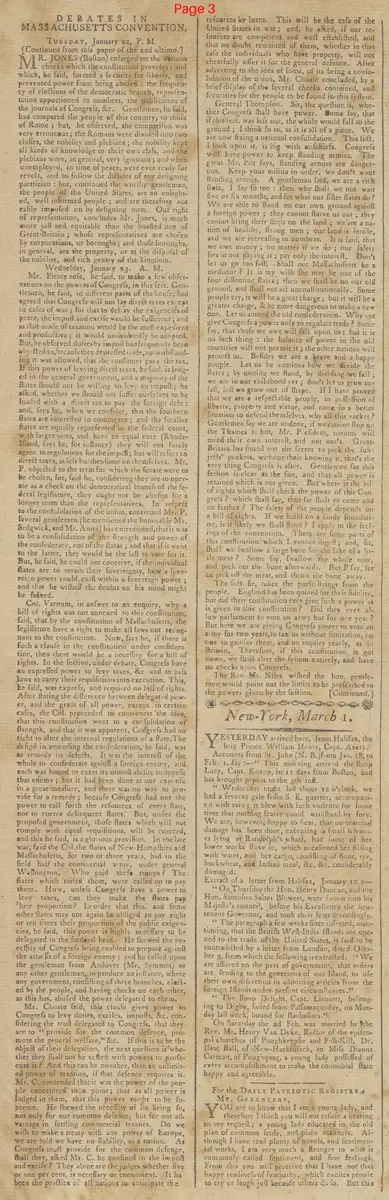
TUESDAY, January 22, P. M.
[Continued from this paper of the 22d ultimo.]
R. JONES (Boston) enlarged on the various checks which the constitution provides; and which, he said, formed a security of liberty, and prevented power from being abused: the frequency of elections of the democratic branch, representation apportioned to numbers, the publication of the journals of Congress, &c. Gentlemen, he said, had compared the people of this country, to those of Rome; but, he observed, the comparison was very erroneous; the Romans were divided into two classes, the nobility and plebeians; the nobility kept all kinds of knowledge in their own class, and the plebeians were, in general, very ignorant; and when unemployed, in time of peace, were ever ready for revolt, and to follow the dictates of any designing patrician: but, continued the worthy gentleman, the people of the United States, are an enlightened, well informed people; and are therefore not easily imposed on by designing men. Our right of representation, concludes Mr. Jones, is much more just and equitable than the boasted one of Great-Britain; whose representatives are chosen by corporations, or boroughs; and those boroughs, in general, are the property, or at the disposal of the nobility, and rich gentry of the kingdom.
Wednesday, January 23. A. M.
Mr. Pierce rose, he said, to make a few observations on the powers of Congress, in this sect. Gentlemen, he said, in different parts of the house, had agreed that Congress will not lay direct taxes except in cases of war; for that to defray the exigencies of peace, the impost and excise would be sufficient; and as that mode of taxation would be the most expedient and productive; it would undoubtedly be adopted. But, he observed duties by impost had frequently been objected to, because they depressed trade, notwithstanding it was allowed, that the consumer pays the tax. If this power of levying direct taxes, he said, is lodged in the general government, and a majority of the states should not be willing to levy an impost; he asked, whether we should not suffer ourselves to be loaded with a direct tax to pay the foreign debt: and, says he, when we consider, that the southern states are interested in commerce; and the smaller states are equally represented in the federal court, with the larger ones, and have an equal vote (Rhode-Island, says he, for instance) they will not surely agree to regulations for the impost; but will resort to direct taxes, as less burdensome on themselves. Mr. P. objected to the term for which the senate were to be chosen, for, said he, considering they are to operate as a check on the democratical branch of the federal legislature, they ought not be chosen for a longer term than the representatives. In respect to the consolidation of the union, continued Mr. P. Several gentlemen (he mentioned the honorable Mr. Sedgwick, and Mr. Ames) have mentioned, that it was to be a consolidation of the strength and power of the confederacy, not of the states; and that if it went to the latter, they would be the last to vote for it. But, he said, he could not conceive, if the individual states are to retain their sovereignty, how a sovereign power could exist within a sovereign power; and that he wished the doubts on his mind might be solved.
Col. Varnum, in answer to an enquiry, why a bill of rights was not annexed to this constitution, said, that by the constitution of Massachusetts, the legislature have a right to make all laws not repugnant to the constitution. Now, says he, if there is such a clause in the constitution under consideration, then there would be a necessity for a bill of rights. In the section, under debate, Congress have an expressed power to levy taxes, &c. and to pass laws to carry their requisitions into execution. This, he said, was express, and required no bill of rights. After stating the difference between delegated power, and the grant of all power, except in certain cases, the Col. proceeded to controvert the idea, that this constitution went to a consolidation of strength, and that it was apparent, Congress had no right to alter the internal regulations of a state. The design in amending the confederation, he said, was to remedy its defects. It was the interest of the whole to confederate against a foreign enemy, and each was bound to exert its utmost ability to oppose that enemy; but it had been done at our expense in a great measure, and there was no way to provide for a remedy; because Congress had not the power to call forth the resources of every state, nor to coerce delinquent states. But, under the proposed government, those states which will not comply with equal requisitions, will be coerced, and this he said, is a glorious provision. In the late war, said the Col. the states of New-Hampshire and Massachusetts, for two or three years, had in the field half the continental army, under general Washington. Who paid the troops? The states which raised them, were called on to pay them. How, unless Congress have a power to levy taxes, can they make the states pay their proportion? In order that this, and some other states may not again be obliged to pay eight or ten times their proportion of the public exigencies, he said, this power is highly necessary to be delegated to the federal head. He shewed the necessity of Congress being enabled to prepare against the attacks of a foreign enemy: and he called upon the gentleman from Andover (Mr. Symmes) or any other gentleman, to produce an instance, where any government, consisting of three branches, elected by the people, and having checks on each other, as this has, abused the power delegated to them.
Mr. Choate said, this clause gives power to Congress to levy duties, excises, imposts, &c. considering the trust delegated to Congress, that they are to "provide for the common defence, promote the general welfare," &c. If this is to be the object of their delegation, the next question is whether they shall not be vested with powers to prosecute it? And this can be no other, than an unlimited power of taxation, if that defence requires it. Mr. C. contended that it was the power of the people concentred to a point; that as all power is lodged in them, that this power ought to be supreme. He shewed the necessity of its being so, not only for our common defence, but for our advantage in settling commercial treaties. Do we wish to make a treaty with any power of Europe, we are told we have no stability, as a nation. As Congress must provide for the common defence, shall they, asked Mr. C. be confined to the impost and excise? They alone are the judges whether five or one per cent. is necessary or convenient. It has been the practice of all nations to anticipate the resources by loans. This will be the case of the United States in war; and, he asked, if our resources are competent and well established, and that no doubt remained of them, whether in that case the individuals who have property, will not cheerfully offer it for the general defence. After adverting to the idea of some, of its being a consolidation of the union, Mr. Choate concluded, by a brief display of the several checks contained, and securities for the people to be found in this system.
General Thompson. Sir, the question is, whether Congress shall have power. Some say, that if this sect. was left out, the whole would fall to the ground; I think so too, as it is all of a piece. We are now fixing a national consolidation. This sect. I look upon it, is big with mischiefs. Congress will have power to keep standing armies. The great Mr. Pitt says, standing armies are dangerous. Keep your militia in order, we don't want standing armies. A gentleman said, we are a rich state, I say so too: then why shall we not wait five or six months, and see what our sister states do? We are able to stand on our own ground against a foreign power; they cannot starve us out; they cannot bring their ships on the land; we are a nation of healthy, strong men; our land is fertile, and we are increasing in numbers. It is said, that we owe money; no matter if we do; our safety lies in not paying it; pay only the interest. Don't let us go too fast. Shall not Massachusetts be a mediator? It is my wish she may be one of the four dissenting states; then we shall be on our old ground, and shall not act unconstitutionally. Some people cry, it will be a great charge; but it will be a greater charge, & be more dangerous to make a new one. Let us amend the old confederation. Why not give Congress a power only to regulate trade? Some say, that those we owe will fall upon us: but it is no such thing: the balance of power in the old countries will not permit it; the other nations will protect us. Besides we are a brave and a happy people. Let us be cautious how we divide the states; by uniting we stand, by dividing we fall; we are in our childhood yet; don't let us grow too fast, lest we grow out of shape. If I have proved that we are a respectable people, in possession of liberty, property and virtue, and none in a better situation to defend themselves, why all this racket? Gentlemen say we are undone, if we cannot sop up the Thames: but, Mr. President, nations will mind their own interest, and not ours. Great-Britain has found out the secret to pick the subjects' pockets, without their knowing it, that's the very thing Congress is after. Gentlemen say this section is clear as the sun, and that all power is retained which is not given. But where is the bill of rights which shall check the power of this Congress? which shall say, thus far shalt ye come and no farther? The safety of the people depends on a bill of rights. If we build on a sandy foundation, is it likely we shall stand? I apply to the feelings of the convention. There are some parts of this constitution which I cannot digest; and, sir, shall we swallow a large bone for the sake of a little meat? Some say, swallow the whole now, and pick out the bone afterwards. But I say, let us pick off the meat, and throw the bone away. The sect. sir, takes the purse strings from the people. England has been quoted for the infidelity, but did their constitution ever give such a power as is given in this constitution? Did they ever allow parliament to vote an army but for one year? But here we are giving Congress power to vote an army for two years, to tax us without limitation, no one to gainsay them, and no inquiry yearly, as in Britain. Therefore, if this constitution is got down, we shall alter the system entirely, and have no checks upon Congress.
The Rev. Mr. Niles wished the hon. gentlemen would point out the limits to be prescribed to the powers given by the section. [Continued.]
What sub-type of article is it?
What themes does it cover?
What keywords are associated?
What entities or persons were involved?
Where did it happen?
Story Details
Key Persons
Location
Massachusetts Convention
Event Date
January 22 And 23
Story Details
Speakers debate the U.S. Constitution's provisions for congressional powers, taxation methods, checks and balances, state sovereignty versus federal consolidation, the need for a bill of rights, and comparisons to Roman, British, and existing confederation systems, with arguments both for and against ratification.