Thank you for visiting SNEWPapers!
Sign up free
Editorial
April 14, 1768
The Virginia Gazette
Williamsburg, Virginia
What is this article about?
Editorial urges American industry in manufacturing necessaries for self-sufficiency and liberty, proposes association to prefer American goods, praises Britain's virtues while warning against separation, and exhorts against sloth, signed by Francis Home.
Clipping
OCR Quality
95%
Excellent
Full Text
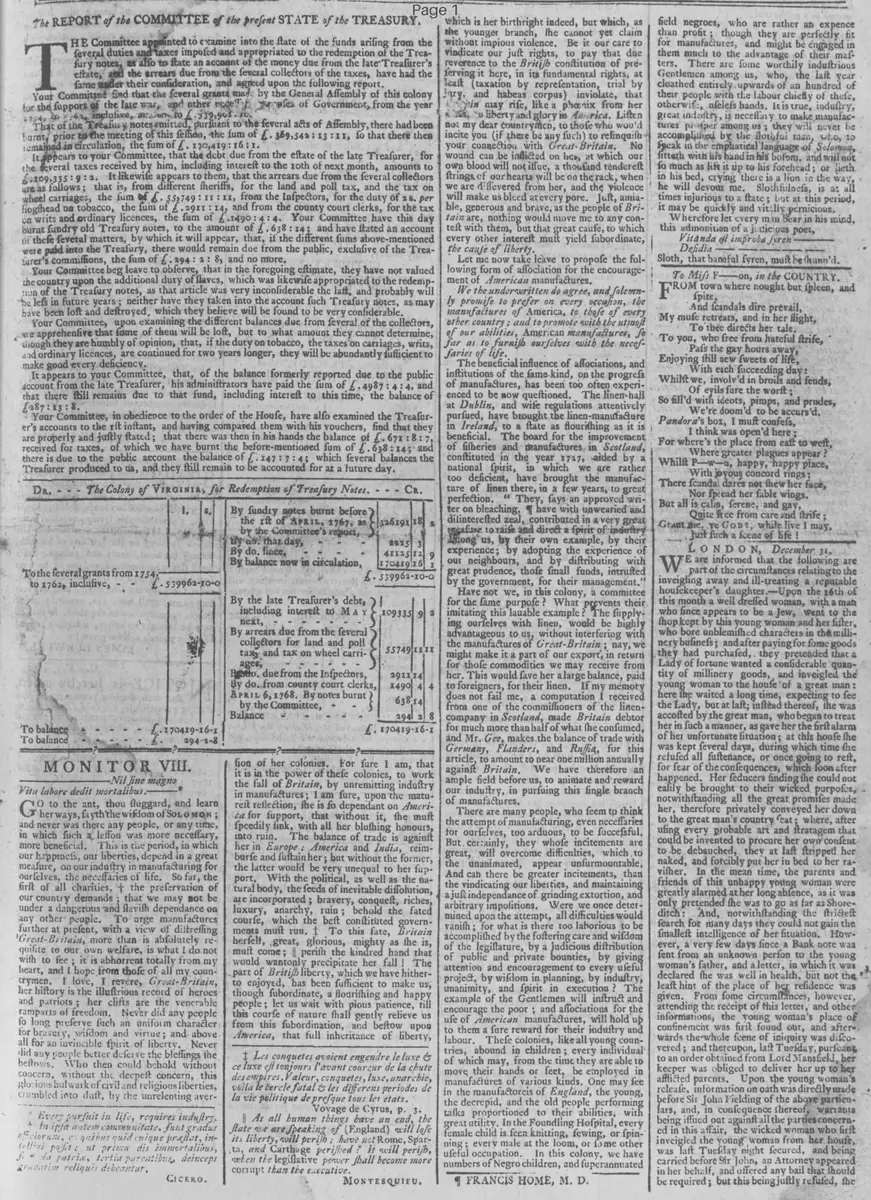
MONITOR VIII.
Nil fine magno
Vita labore dedit mortalibus.
Go to the ant, thou sluggard, and learn wisdom. And never was there any people, or any time, in which such a lesson was more necessary, more beneficial. This is the period, in which our happiness, our liberties, depend in a great measure, on our industry in manufacturing for ourselves, the necessaries of life. So far, the first of all charities, the preservation of our country demands; that we may not be under a dangerous and slavish dependence on any other people. To urge manufactures further at present, with a view of distressing Great-Britain, more than is absolutely requisite to our own welfare, is what I do not wish to see; it is abhorrent totally from my heart, and I hope from those of all my countrymen. I love, I revere, Great-Britain, her history is the illustrious record of heroes and patriots; her cliffs are the venerable ramparts of freedom. Never did any people so long preserve such an uniform character for bravery, wisdom and virtue; and above all for an invincible spirit of liberty. Never did any people better deserve the blessings she bestows. Who then could behold without concern, without the deepest concern, this glorious bulwark of civil and religious liberties, crumbled into dust, by the unrelenting avarice of her colonies. For sure I am, that it is in the power of these colonies, to work the fall of Britain, by unremitting industry in manufactures: I am sure, upon the maturest reflection, she is so dependant on America for support, that without it, she must speedily sink, with all her blushing honours, into ruin. The balance of trade is against her in Europe; America and India, reimburse and sustain her: but without the former, the latter would be very unequal to her support. With the political, as well as the natural body, the seeds of inevitable dissolution, are incorporated: bravery, conquest, riches, luxury, anarchy, ruin: behold the fated course, which the best constituted governments must run. To this fate, Britain herself, great, glorious, mighty as she is, must come: perish the kindred hand that would wantonly precipitate her fall! The part of British liberty, which we have hitherto enjoyed, has been sufficient to make us, though subordinate, a flourishing and happy people: let us wait with pious patience, till this course of nature shall gently relieve us from this subordination, and bestow upon America, that full inheritance of liberty, which is her birthright indeed, but which, as the younger branch, she cannot yet claim without impious violence. Be it our care to vindicate our just rights, to pay that due reverence to the British constitution of preserving it here, in its fundamental rights, at least taxation by representation, trial by jury, and habeas corpus) inviolate, that Britain may rise, like a phoenix from her ashes, to liberty and glory in America. Listen not my dear countrymen, to those who wou'd incite you (if there be any such) to relinquish your connection with Great-Britain. No wound can be inflicted on her, at which our own blood will not issue, a thousand tenderest strings of our hearts will be on the rack, when we are dissevered from her, and the violence will make us bleed at every pore. Just, amiable, generous and brave, as the people of Britain are, nothing would move me to any contest with them, but that great cause, to which every other interest must yield subordinate, the cause of liberty.
Let me now take leave to propose the following form of association for the encouragement of American manufactures.
We the underwritten do agree, and Solemnly promise to prefer on every occasion, the manufactures of America, to those of every other country; and to promote with the utmost of our abilities, American manufactures, so far as to furnish ourselves with the necessaries of life.
The beneficial influence of associations, and institutions of the same kind, on the progress of manufactures, has been too often experienced to be now questioned. The linen-hall at Dublin, and wise regulations attentively pursued, have brought the linen-manufacture in Ireland, to a state as flourishing as it is beneficial. The board for the improvement of fisheries and manufactures in Scotland, constituted in the year 1727, aided by a national spirit, in which we are rather too deficient, have brought the manufacture of linen there, in a few years, to great perfection. They, says an approved writer on bleaching, have with unwearied and disinterested zeal, contributed in a very great measure to raise and direct a spirit of industry among us, by their own example, by their experience; by adopting the experience of our neighbours, and by distributing with great prudence, those small funds, intrusted by the government, for their management.
Have not we, in this colony, a committee for the same purpose? What prevents their imitating this laudable example? The supplying ourselves with linen, would be highly advantageous to us, without interfering with the manufactures of Great-Britain; nay, we might make it a part of our export, in return for those commodities we may receive from her. This would save her a large balance, paid to foreigners, for their linen. If my memory does not fail me, a computation I received from one of the commissioners of the linen-company in Scotland, made Britain debtor for much more than half of what she consumed, and Mr. Gee, makes the balance of trade with Germany, Flanders, and Russia, for this article, to amount to near one million annually against Britain. We have therefore an ample field before us, to animate and reward our industry, in pursuing this single branch of manufactures.
There are many people, who seem to think the attempt of manufacturing, even necessaries for ourselves, too arduous, to be successful. But, certainly, they whose incitements are great, will overcome difficulties, which to the unanimated, appear insurmountable. And can there be greater incitements, than the vindicating our liberties, and maintaining a just independence of grinding extortion, and arbitrary impositions. Were we once determined upon the attempt, all difficulties would vanish: for what is there too laborious to be accomplished by the fostering care and wisdom of the legislature, by a judicious distribution of public and private bounties, by giving attention and encouragement to every useful project, by wisdom in planning, by industry, unanimity, and spirit in execution? The example of the Gentlemen will instruct and encourage the poor; and associations for the use of American manufactures, will hold out to them a sure reward for their industry and labour. These colonies, like all young countries, abound in children: every individual of which may, from the time they are able to move their hands or feet, be employed in manufactures of various kinds. One may see in the manufactories of England, the young, the decrepit, and the old people performing tasks proportioned to their abilities, with great utility. In the Foundling Hospital, every female child is seen knitting, sewing, or pinning; every male at the loom, or some other useful occupation. In this colony, we have numbers of Negro children, and superannuated field negroes, who are rather an expense than profit: though they are perfectly fit for manufactures, and might be engaged in them much to the advantage of their masters. There are some worthily industrious Gentlemen among us, who, the last year cloathed entirely upwards of an hundred of their people with the labour chiefly of these, otherwise useless hands. It is true, industry, great industry, is necessary to make manufactures proper among us: they will never be accomplished by the slothful man, who, to speak in the emphatical language of Solomon, sitteth with his hand in his bosom, and will not so much as lift it up to his forehead; or lieth in his bed, crying there is a lion in the way, he will devour me. Slothfulness, is at all times injurious to a state; but at this period, it may be quickly and vitally pernicious. Wherefore let every man bear in his mind, this admonition of a judicious poet,
Vitanda est improba Siren Desidia.
Sloth, that baneful syren, must be shunn'd.
¶ FRANCIS HOME, M. D.
Nil fine magno
Vita labore dedit mortalibus.
Go to the ant, thou sluggard, and learn wisdom. And never was there any people, or any time, in which such a lesson was more necessary, more beneficial. This is the period, in which our happiness, our liberties, depend in a great measure, on our industry in manufacturing for ourselves, the necessaries of life. So far, the first of all charities, the preservation of our country demands; that we may not be under a dangerous and slavish dependence on any other people. To urge manufactures further at present, with a view of distressing Great-Britain, more than is absolutely requisite to our own welfare, is what I do not wish to see; it is abhorrent totally from my heart, and I hope from those of all my countrymen. I love, I revere, Great-Britain, her history is the illustrious record of heroes and patriots; her cliffs are the venerable ramparts of freedom. Never did any people so long preserve such an uniform character for bravery, wisdom and virtue; and above all for an invincible spirit of liberty. Never did any people better deserve the blessings she bestows. Who then could behold without concern, without the deepest concern, this glorious bulwark of civil and religious liberties, crumbled into dust, by the unrelenting avarice of her colonies. For sure I am, that it is in the power of these colonies, to work the fall of Britain, by unremitting industry in manufactures: I am sure, upon the maturest reflection, she is so dependant on America for support, that without it, she must speedily sink, with all her blushing honours, into ruin. The balance of trade is against her in Europe; America and India, reimburse and sustain her: but without the former, the latter would be very unequal to her support. With the political, as well as the natural body, the seeds of inevitable dissolution, are incorporated: bravery, conquest, riches, luxury, anarchy, ruin: behold the fated course, which the best constituted governments must run. To this fate, Britain herself, great, glorious, mighty as she is, must come: perish the kindred hand that would wantonly precipitate her fall! The part of British liberty, which we have hitherto enjoyed, has been sufficient to make us, though subordinate, a flourishing and happy people: let us wait with pious patience, till this course of nature shall gently relieve us from this subordination, and bestow upon America, that full inheritance of liberty, which is her birthright indeed, but which, as the younger branch, she cannot yet claim without impious violence. Be it our care to vindicate our just rights, to pay that due reverence to the British constitution of preserving it here, in its fundamental rights, at least taxation by representation, trial by jury, and habeas corpus) inviolate, that Britain may rise, like a phoenix from her ashes, to liberty and glory in America. Listen not my dear countrymen, to those who wou'd incite you (if there be any such) to relinquish your connection with Great-Britain. No wound can be inflicted on her, at which our own blood will not issue, a thousand tenderest strings of our hearts will be on the rack, when we are dissevered from her, and the violence will make us bleed at every pore. Just, amiable, generous and brave, as the people of Britain are, nothing would move me to any contest with them, but that great cause, to which every other interest must yield subordinate, the cause of liberty.
Let me now take leave to propose the following form of association for the encouragement of American manufactures.
We the underwritten do agree, and Solemnly promise to prefer on every occasion, the manufactures of America, to those of every other country; and to promote with the utmost of our abilities, American manufactures, so far as to furnish ourselves with the necessaries of life.
The beneficial influence of associations, and institutions of the same kind, on the progress of manufactures, has been too often experienced to be now questioned. The linen-hall at Dublin, and wise regulations attentively pursued, have brought the linen-manufacture in Ireland, to a state as flourishing as it is beneficial. The board for the improvement of fisheries and manufactures in Scotland, constituted in the year 1727, aided by a national spirit, in which we are rather too deficient, have brought the manufacture of linen there, in a few years, to great perfection. They, says an approved writer on bleaching, have with unwearied and disinterested zeal, contributed in a very great measure to raise and direct a spirit of industry among us, by their own example, by their experience; by adopting the experience of our neighbours, and by distributing with great prudence, those small funds, intrusted by the government, for their management.
Have not we, in this colony, a committee for the same purpose? What prevents their imitating this laudable example? The supplying ourselves with linen, would be highly advantageous to us, without interfering with the manufactures of Great-Britain; nay, we might make it a part of our export, in return for those commodities we may receive from her. This would save her a large balance, paid to foreigners, for their linen. If my memory does not fail me, a computation I received from one of the commissioners of the linen-company in Scotland, made Britain debtor for much more than half of what she consumed, and Mr. Gee, makes the balance of trade with Germany, Flanders, and Russia, for this article, to amount to near one million annually against Britain. We have therefore an ample field before us, to animate and reward our industry, in pursuing this single branch of manufactures.
There are many people, who seem to think the attempt of manufacturing, even necessaries for ourselves, too arduous, to be successful. But, certainly, they whose incitements are great, will overcome difficulties, which to the unanimated, appear insurmountable. And can there be greater incitements, than the vindicating our liberties, and maintaining a just independence of grinding extortion, and arbitrary impositions. Were we once determined upon the attempt, all difficulties would vanish: for what is there too laborious to be accomplished by the fostering care and wisdom of the legislature, by a judicious distribution of public and private bounties, by giving attention and encouragement to every useful project, by wisdom in planning, by industry, unanimity, and spirit in execution? The example of the Gentlemen will instruct and encourage the poor; and associations for the use of American manufactures, will hold out to them a sure reward for their industry and labour. These colonies, like all young countries, abound in children: every individual of which may, from the time they are able to move their hands or feet, be employed in manufactures of various kinds. One may see in the manufactories of England, the young, the decrepit, and the old people performing tasks proportioned to their abilities, with great utility. In the Foundling Hospital, every female child is seen knitting, sewing, or pinning; every male at the loom, or some other useful occupation. In this colony, we have numbers of Negro children, and superannuated field negroes, who are rather an expense than profit: though they are perfectly fit for manufactures, and might be engaged in them much to the advantage of their masters. There are some worthily industrious Gentlemen among us, who, the last year cloathed entirely upwards of an hundred of their people with the labour chiefly of these, otherwise useless hands. It is true, industry, great industry, is necessary to make manufactures proper among us: they will never be accomplished by the slothful man, who, to speak in the emphatical language of Solomon, sitteth with his hand in his bosom, and will not so much as lift it up to his forehead; or lieth in his bed, crying there is a lion in the way, he will devour me. Slothfulness, is at all times injurious to a state; but at this period, it may be quickly and vitally pernicious. Wherefore let every man bear in his mind, this admonition of a judicious poet,
Vitanda est improba Siren Desidia.
Sloth, that baneful syren, must be shunn'd.
¶ FRANCIS HOME, M. D.
What sub-type of article is it?
Economic Policy
Trade Or Commerce
Moral Or Religious
What keywords are associated?
American Manufactures
British Loyalty
Industry
Sloth
Linen Manufacture
Trade Balance
Self Sufficiency
Liberty
Associations
Bounties
What entities or persons were involved?
Great Britain
America
Colonies
Francis Home
Solomon
Mr. Gee
Editorial Details
Primary Topic
Encouragement Of American Manufactures For Self Sufficiency And Liberty While Preserving Loyalty To Britain
Stance / Tone
Reverent Towards Britain, Exhortative On Industry And Against Sloth
Key Figures
Great Britain
America
Colonies
Francis Home
Solomon
Mr. Gee
Key Arguments
- happiness and liberties depend on industry in manufacturing necessaries
- preservation of country demands self-sufficiency to avoid dependence
- unremitting industry in manufactures could ruin britain due to trade dependence
- vindicate just rights like taxation by representation, trial by jury, habeas corpus
- propose association to prefer american manufactures for necessaries
- associations and institutions have successfully promoted manufactures in ireland and scotland
- supplying linen would benefit colonies without interfering with british manufactures
- industry overcomes difficulties, supported by legislature, bounties, and unanimity
- employ children, decrepit, old, and negro slaves in manufactures
- shun sloth, which is pernicious especially now