Thank you for visiting SNEWPapers!
Sign up free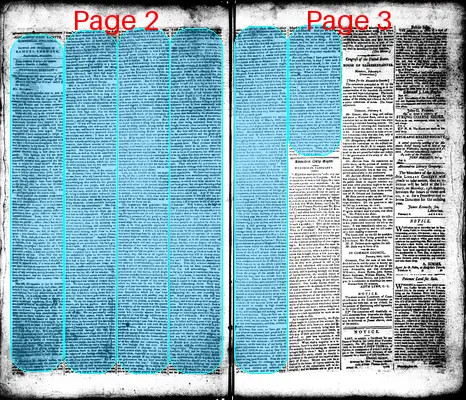
Alexandria Daily Gazette, Commercial & Political
Alexandria, Virginia
What is this article about?
In a congressional speech, Mr. Wheaton opposes Mr. Macon's bill regulating commerce with Britain and France, calling it inconsistent and harmful. He critiques past policies like the embargo and non-intercourse acts, urges choosing between war or peace, and defends patient endurance over rash actions amid national misfortunes.
Merged-components note: Continuation of Mr. Wheaton's speech on Macon's bill across pages 2 and 3, as text flows sequentially from the end of the page 2 component to the start of the page 3 component.
Clippings
1 of 2
OCR Quality
Full Text
COMMERCIAL & POLITICAL:
PRINTED AND PUBLISHED BY SAMUEL SNOWDEN,
Royall street, Alexandria.
Daily Gazette, 6 dollars per annum
Country Gazette, 5 Dollars
WEDNESDAY FEBRUARY 7
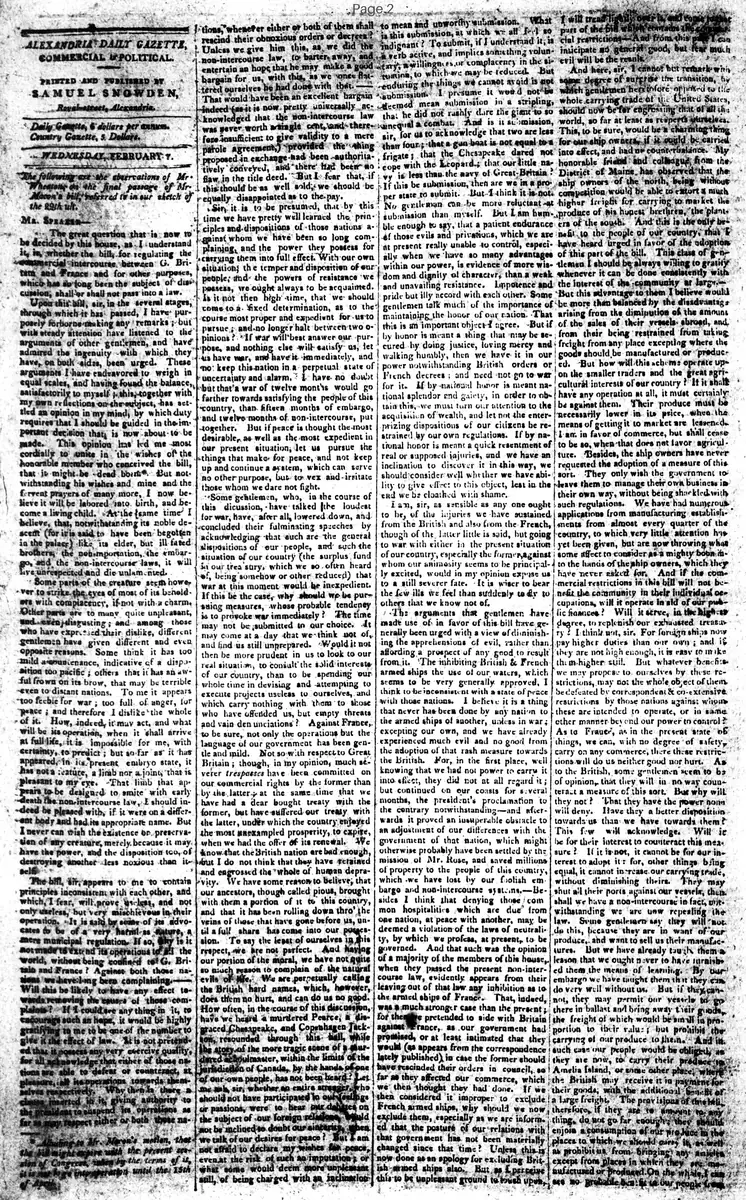
The following are the observations of Mr. Wheaton on the final passage of Mr. Macon's bill, referred to in our sketch of the 29th ult.
Mr. SPEAKER,
The great question that is now to be decided by this house, as I understand it, is whether the bill for regulating the commercial intercourse between G. Britain and France and for other purposes, which has so long been the subject of discussion, shall or shall not pass into a law.
Upon this bill, sir, in the several stages through which it has passed, I have purposely forborne making any remarks; but with steady attention have listened to the arguments of other gentlemen, and have admired the ingenuity with which they have, on both sides, been urged. These arguments I have endeavored to weigh in equal scales, and having found the balance satisfactorily to myself, this, together with my own reflections on the subject, has settled an opinion in my mind, by which duty requires that I should be guided in the important decision that is now about to be made. This opinion has led me most cordially to unite in the wishes of the honorable member who conceived the bill, that it might be deadborn. But notwithstanding his wishes and mine and the fervent prayers of many more, I now believe it will be labored into birth, and become a living child. At the same time I believe, that, notwithstanding its noble descent (for it is said to have been begotten in the palace) like its elder, but ill fated brothers the non-importation, the embargo, and the non-intercourse laws, it will live unrespected and die unlamented.
Some parts of the creature seem however to strike the eyes of most of its beholders with complacence, if not with a charm. Other parts are too many quite unpleasant, and even disgusting; and among those who have expressed their dislike, different gentlemen have given different and even opposite reasons. Some think it has too mild a countenance, indicative of a disposition too pacific; others that it has an awful frown on its brow, that may be terrible even to distant nations. To me it appears too feeble for war; too full of anger, for peace; and therefore I dislike the whole of it. How, indeed, it may act, and what will be its operation when it shall arrive at full life, it is impossible for me, with certainty, to predict; but so far as it has appeared, in its present embryo state, it has not a feature, a limb nor a joint that is pleasant to my eye. That limb that appears to be designed to smite with deadly death the non-intercourse law, I should indeed be pleased with, if it were on a different body and had its appropriate name. But I never can wish the existence or preservation of any creature merely because it may have the power, and the disposition too, of destroying another less noxious than itself.
The bill, Sir, appears to me to contain principles inconsistent with each other, and which, I fear, will prove useless, and not only useless, but very mischievous in their operation. It is said by some of its advocates to be of a very harmless nature, a mere municipal regulation. If so, why is it made to extend its operations to the world, without being confined to G. Britain and France? Against both those nations we have long been complaining. Will this be likely to have any effect towards removing the cause of those complaints? If I could see any thing in it, to encourage such a hope, it would be highly gratifying to me to be one of the number to give it the effect of law. It is not pretended that it possesses any very coercive quality; for all acknowledge that either of those nations are able to defeat or counteract, at pleasure, its operations towards themselves respectively. Why then is there a clause inserted in it giving authority to the President to suspend its operation as to either or both of these nations, when either or both of them shall rescind their obnoxious orders or decrees?
Unless we give him this, as we did the non-intercourse law, to barter away, and surrender ourselves as he had done with that, he had no bargain for us, with this, so we once feared he might make a good one. That would have been an excellent bargain indeed (as it is now pretty universally acknowledged that the non-intercourse law was never worth a single cent, and therefore insufficient to give validity to a mere parole agreement,) provided the thing proposed in exchange had been authoritatively conveyed, and there had been no flaw in the title deed. But I fear that, if this should be as well sold, we should be equally disappointed as to the pay.
Sir, it is to be presumed, that by this time we have pretty well learned the principles and dispositions of those nations against whom we have been so long complaining, and the power they possess for carrying them into full effect. With our own situation; the temper and disposition of our people; and the powers of resistance we possess, we ought always to be acquainted. Is it not then high time, that we should come to a fixed determination, as to the course most proper and expedient for us to pursue; and no longer halt between two opinions? If war will best answer our purpose, and nothing else will satisfy us, let us have war, and have it immediately, and not keep this nation in a perpetual state of uncertainty and alarm. I have no doubt but that a war of twelve months would go farther towards satisfying the people of this country, than fifteen months of embargo, and twelve months of non-intercourse, put together. But if peace is thought the most desirable, as well as the most expedient in our present situation; let us pursue the things that make for peace, and not keep up and continue a system, which can serve no other purpose, but to vex and irritate those whom we dare not fight.
Some gentlemen, who, in the course of this discussion, have talked the loudest for war; have, after all, lowered down, and concluded their fulminating speeches by acknowledging that such are the general dispositions of our people, and such the situation of our country (the surplus fund in our treasury, which we so often heard of, being somehow or other reduced) that war at this moment would be inexpedient. If this be the case, why should we be pursuing measures, whose probable tendency is to provoke war immediately? The time may not be submitted to our choice. It may come at a day that we think not of, and find us still unprepared. Would it not then be more prudent in us to look to our real situation, to consult the solid interests of our country, than to be spending our whole time in devising and attempting to execute projects useless to ourselves, and which carry nothing with them to those who have offended us, but empty threats and vain denunciations? Against France, we be sure, not only the operations but the language of our government has been gentle and mild. Not so with respect to Great Britain; though, in my opinion, much severer trespasses have been committed on our commercial rights by the former than by the latter; at the same time that we have had a dear bought treaty with the former, but have suffered our treaty with the latter, under which the country enjoyed the most unexampled prosperity, to expire, when we had the offer of its renewal. We now hear that the British nation are bad enough, but I do not think that they have retained and engrossed the whole of human depravity. We have some reason to believe, that our ancestors, though called pious, brought with them a portion of it to this country, and that it has been rolling down through the veins of those that have gone before us, until a full share has come into our possession. To say the least of ourselves in this respect, we are not perfect. And having our portion of the moral, we have not quite so much reason to complain of the natural evils of life. We are perpetually calling the British hard names, which, however, does them no hurt, and can do us no good. How often, in the course of this discussion, have we heard a murdered Pierce, disgraced Chesapeake, and Copenhagen Jefferson, resounded through this hall, while the story of the more tragic scene of a murdered gunner, within the limits of this jurisdiction of Canada, by the hands of one of our own people, has not been heard? Let me ask sir, whether an entire stranger who should not have participated in our feelings or passions, were to hear our debates on the subject of our foreign relations would not be inclined to doubt our sincerity when we talk of our desires for peace? But I am not afraid to declare my wishes for peace, even at the risk of such an imputation, or what some would deem more unpleasant still, of being charged with an inclination
is this our submission, at which we all feel so indignant? To submit, if I understand it, is a verb active, and implies something voluntary, a willingness, or complacency in the situation to which we may be reduced. But enduring the things we cannot avoid is not deemed mean submission in a stripling, submission. I presume it would not be that he did not rashly dare the giant to so unequal a combat. And is it submission, sir, for us to acknowledge that two are less than four; that a gun boat is not equal to a frigate; that the Chesapeake dared not cope with the Leopard; that our little navy is less than the navy of Great Britain: If this be submission, then are we in a proper state to submit. But I think it is not. No gentleman can be more reluctant at submission than myself. But I am humble enough to say, that a patient endurance of those evils and privations, which we are at present really unable to control, especially when we have so many advantages within our power, is evidence of more wisdom and dignity of character, than a weak and unavailing resistance. Impotence and pride but ill accord with each other. Some gentlemen talk much of the importance of maintaining the honor of our nation. That this is an important object I agree. But if by honor is meant a thing that may be secured by doing justice, loving mercy and walking humbly, then we have it in our power notwithstanding British orders or French decrees; and need not go to war for it. If by national honor is meant national splendor and gaiety, in order to obtain this, we must turn our attention to the acquisition of wealth, and let not the enterprising dispositions of our citizens be restrained by our own regulations. If by national honor is meant a quick resentment of real or supposed injuries, and we have an inclination to discover it in this way, we should consider well whether we have ability to give effect to this object, lest in the end we be clothed with shame.
I am, sir, as sensible as any one ought to be, of the injuries we have sustained from the British and also from the French, though of the latter little is said, but going to war, with either in the present situation of our country, especially the former against whom our animosity seems to be principally excited, would in my opinion expose us to a still severer fate. It is wiser to bear the ills we feel than suddenly to fly to others that we know not of.
The arguments that gentlemen have made use of in favor of this bill have generally been urged with a view of diminishing the apprehensions of evil, rather than affording a prospect of any good to result from it. The inhibiting British & French armed ships the use of our waters, which seems to be very generally approved, I think to be inconsistent with a state of peace with those nations. I believe it is a thing that never has been done by any nation to the armed ships of another, unless in war; excepting our own, and we have already experienced much evil and no good from the adoption of that rash measure towards the British. For, in the first place, well knowing that we had not power to carry it into effect, they did not at all regard it; but continued on our coasts for several months, the president's proclamation to the contrary notwithstanding—and afterwards it proved an insuperable obstacle to an adjustment of our differences with the government of that nation, which might otherwise probably have been settled by the mission of Mr. Rose, and saved millions of property to the people of this country, which we have lost by our foolish embargo and non-intercourse systems. Besides I think that denying those common hospitalities which are due from one nation, at peace with another, may be deemed a violation of the laws of neutrality, by which we profess, at present, to be governed. And that such was the opinion of a majority of the members of this house, when they passed the present non-intercourse law, evidently appears from their leaving out of that law any inhibition as to the armed ships of France. That, indeed, was a much stronger case than the present; for there we pretended to side with Britain against France, as our government had promised, or at least intimated that they would (as appears from the correspondence lately published) in case the former should have rescinded their orders in council, so far as they affected our commerce, which we then thought they had done. If we then considered it improper to exclude French armed ships, why should we now exclude them, especially as we are informed that the posture of our relations with that government has not been materially changed since that time! Unless this is now done as an apology for excluding British armed ships also. But as I perceive this to be unpleasant ground to touch upon)
I will tread lightly over it and come to that part of the bill which contains commercial restrictions. And from this I anticipate no general good, but fear much evil will be the result.
And here, sir, I cannot but remark with some degree of surprise the transition by which gentlemen heretofore opposed to the whole carrying trade of the United States, should now be for engrossing that of the world, so far at least as respects ourselves. This, to be sure, would be a charming thing for our ship owners if it could be carried into effect, and had no counterbalance. My honorable friend and colleague from the District of Maine, has observed that the ship owners of the north, being without competition would be able to extort a much higher freight on carrying to market the produce of his honest brethren, the planters of the south: And this is the only benefit to the people of our country that I have heard urged in favor of the adoption of this part of the bill. This class of gentlemen I should be always willing to gratify whenever it can be done consistently with the interest of the community at large. But this advantage to them I believe would be more than balanced by the disadvantages arising from the diminution of the amount of the sales of their vessels abroad, and from their being restrained from taking freight from any place excepting where the goods should be manufactured or produced. But how will this scheme operate upon the smaller traders and the great agricultural interests of our country? If it shall have any operation at all, it must certainly be against them. Their produce must be necessarily lower in its price, when the means of getting it to market are lessened. I am in favor of commerce, but shall cease to be so, when that does not favor agriculture. Besides, the ship owners have never requested the adoption of a measure of this sort. They only wish the government to leave them to manage their own business in their own way, without being shackled with such regulations. We have had numerous applications from manufacturing establishments from almost every quarter of the country, to which very little attention has yet been given, but are now throwing what some affect to consider as a mighty boon into the hands of the ship owners, which they have never asked for. And if the commercial restrictions in this bill will not benefit the community in their individual occupations, will it operate in aid of our public revenue? Will it serve, in the highest degree, to replenish our exhausted treasury? I think not, sir. For foreign ships now pay higher duties than our own; and if they are not high enough, it is easy to make them higher still. But whatever benefits we may propose to ourselves by these restrictions, may not the whole object of them be defeated by correspondent & co-extensive restrictions by those nations against whom these are intended to operate, or in some other manner beyond our power to control? As to France, as in the present state of things, we can, with no degree of safety, carry on any commerce, there these restrictions will do us neither good nor hurt. As to the British, some gentlemen seem to be of opinion, that they will in no way counteract a measure of this sort. But why will they not? That they have the power none will deny. Have they a better disposition towards us than we have towards them? This few will acknowledge. Will it be for their interest to counteract this measure? If it is not, it cannot be for our interest to adopt it: or, other things being equal, it cannot increase our carrying trade, without diminishing theirs. They may shut all their ports against our vessels, then shall we have a non-intercourse in fact, without notwithstanding we are now repealing the law. Some gentlemen say they will not do this, because they are in want of our produce, and want to sell us their manufactures. But we have already taught them a lesson that we ought never to have furnished them the means of learning. By our embargo we have taught them that they can do very well without us. But if they cannot, they may permit our vessels to go there in ballast and bring away their goods, the freight of which would be all in proportion to their value; but prohibit the carrying of our produce to them. In such case our people would be obliged as they are now, to carry their produce to Amelia Island, or some other place where the British may receive it in payment for their goods; with the additional expense of a large freight. The provision of this bill therefore if there are to mount to carry thing, do not go far enough to enjoy a consumption of our produce in the places to which we should carry it so as prohibit us from bringing any article except from places in which they are manufactured or produced. On the whole, I see no probable bar by our act
Against this bill in a last, unless we adopt the notions of the Hindoos towards their gods, by tormenting ourselves. Those notions of whose conduct we disapprove, and expect to propitiate with the approbation of the members of this house, because it is in conformity with the views and the wishes of the executive. So far as this may be a reason with some gentlemen to approve of it, exactly so far is it a reason with me to disapprove it. I do not think, however, that such reason ought to be considered as conclusive by either. We ought to refuse the bill, and approve the proceeding. But when we had a new project coming from a source, from whatever source either may come, from which many similar in kind had proceeded before, that have produced no good, but have been followed with much evil, it cannot be strange that it should excite our apprehensions. The people of this country have fortunately or unfortunately been divided into two great rival political parties, each of which have taken their turn to reign. And what can we judge but from what we know? That party has done best for the country, from whose measures they have experienced the greatest good. Sir, I have a high authority for saying, that on the 4th day of March, 1801, our treasury was full, our country in universal prosperity, and at peace with all the world. The sad reverse of all these we now experience. An exhausted treasury, to be replenished only by benevolence, loans, or direct taxation: A depressed commerce, struggling with embarrassments abroad and shackles at home: and, as a necessary consequence, the labor and toils of the husbandman but illy rewarded in the scanty price of his produce: A country full of discontent and complaint, and without a friend on earth. In this state of things, we are naturally led to enquire, what has been the cause of the surprising change? Shall it be charged to misfortune? If we look into those that the world commonly call unfortunate, we shall generally find them to have been unwise; some flaw in their own conduct will be found at the bottom. Will gentlemen say that our present difficulties are not owing to any errors in the conduct of those in the administration, but rather to the wicked machinations of foreign governments, or the uncomplying dispositions of discontented individuals at home? Are these things new? Were they not to be expected, and would it not have been an evidence of more wisdom to have foreseen and guarded against the ill effects of them, than so be running after bugs and butterflies, or, that is far worse, building of gun boats, which have cost the people of this nation more than $10,000,000, and which are now acknowledged to be useless, and worse than useless, a still growing expense on our hands? Has human depravity taken any stronger hold of mankind since the commencement of the nineteenth, than it did in the eighteenth century? Have the Barbary Powers become more barbarous? Have the governments or people of England or France grown worse within the last nine years than they were before? We had sufficient evidence of the ill will of both those nations towards us, when we were under former administrations, and yet they by their prudent conduct averted the ill effects of it. With respect to us the whole world was then tranquilized. A rebellion in the heart of our own country was soothed into peace. Even the savage of the woods had laid down his bow, and his arrows were no longer felt. Then it was that agriculture flourished at home, and commerce brought in from abroad the luxuries of every clime. Our vessels traversed every sea, and our people were respected on every shore. The islands of either India were but as so many sponges to refresh our wearied navigators. But things are not so now. Now the only evidence of our national pride and ambition seems to consist in high sounding words, publishing documents, proclamations, and resolutions and making laws as intellectual as either. Since we find no respect, as a nation, among any other people in the world, we are content to be talking of our own importance, and thus, without a blush, commend ourselves. It is true, that since we have got into our present embarrassed and perplexed situation, many schemes have been contrived and adopted to extricate ourselves, and restore our lost character; all bottomed, however, on the vain idea of our being of more importance to the rest of the world than they think we are; and so they have all proved ineffectual to that relief and exaltation, with the expectation of which we have so long been flattered. First the non-importation, then the embargo, and after that the non-intercourse, have successively been devised and enforced; but all to no purpose, and all now acknowledged to have been the offspring of more folly and delusion. And yet we are going on in the same course, confiding though confounded, always pursuing and always condemning the same things. It seems, indeed, as if we had arrived at that crisis in our affairs, when the sober remonstrances of truth and reason could no longer avail against the misguided impetuosity of public prejudice. But sir, perhaps I have gone too far. I am sensible that in what I have said, I may have exposed myself, in the view of some gentlemen, to the charge of a want of patriotism, if not of being under foreign influence. What is patriotism? Does it consist in empty words and noisy declamations, and not rather in doing and suffering for the general happiness and prosperity of those inhabiting the same country with ourselves? Does it consist in a blind confidence in, and an implicit adherence to those in the administration of the government? If it be true, as some pretend, that this be the sole evidence of patriotism, it must always have been so, through all ages and all countries. But have the friends of the administration always been considered as the exclusive patriots in this country: or do we consider the friends of the administration in England as the exclusive patriots in that country now? Or is the same thing virtue here and vice there? Or as times have changed, have the great principles of right and wrong changed with them? But it is unnecessary to pursue this enquiry any farther. I can profess as strong a love for my country as any gentleman present, and I believe I feel it as ardently. And it is because I love my country, and wish its prosperity, that I cannot agree to the bill now under consideration. Thus, sir, you have what I advised and having made these remarks, I will add no more.
What sub-type of article is it?
What themes does it cover?
What keywords are associated?
What entities or persons were involved?
Where did it happen?
Story Details
Key Persons
Location
Us House Of Representatives
Event Date
Wednesday February 7
Story Details
Mr. Wheaton delivers a speech opposing Mr. Macon's bill on commercial intercourse with Great Britain and France, arguing it is inconsistent, ineffective, and likely to provoke harm without achieving coercion. He critiques past policies like the embargo and non-intercourse acts as failures, contrasts current national distress with prior prosperity, and advocates for either decisive war or genuine peace over irritating half-measures, emphasizing wisdom, patriotism, and endurance of unavoidable ills.