Thank you for visiting SNEWPapers!
Sign up free
Gazette Of The United States
New York, New York County, New York
What is this article about?
An anonymous letter cautions against the speculative rise in US public stocks and Bank of the United States shares, arguing they are overvalued compared to British and Dutch markets due to interest rates and foreign investment limitations, predicting a potential bubble that could harm public credit.
Clipping
OCR Quality
Full Text
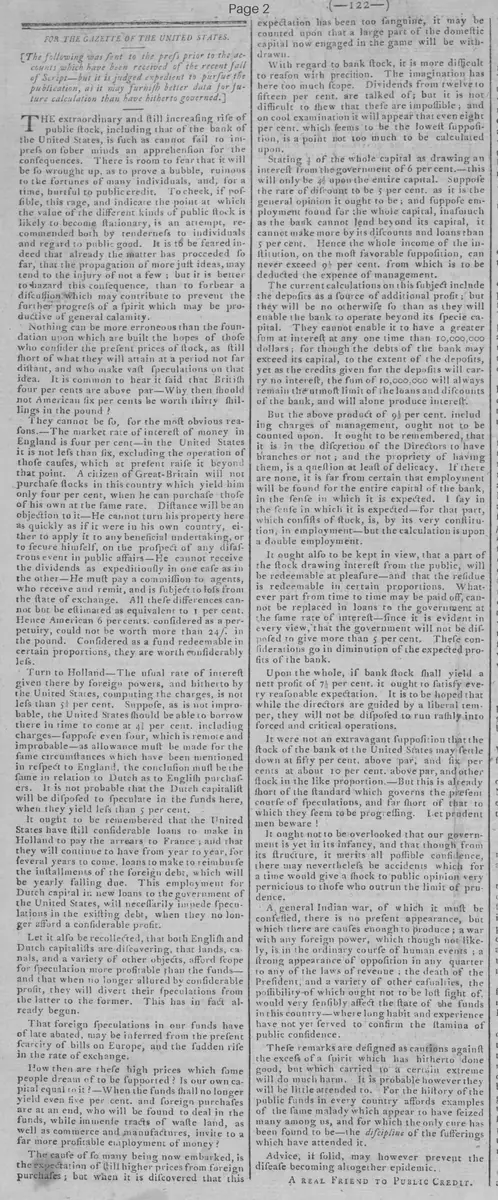
[The following was sent to the press prior to the accounts which have been received of the recent fall of Scrip—but it is judged expedient to pursue the publication, as it may furnish better data for future calculation than have hitherto governed.]
THE extraordinary and still increasing rise of public stock, including that of the bank of the United States, is such as cannot fail to impress on other minds an apprehension for the consequences. There is room to fear that it will be over wrought up, as to prove a bubble, ruinous to the fortunes of many individuals, and, for a time, hurtful to public credit. To check, if possible, this rage, and indicate the point at which the value of the different kinds of public stock is likely to become stationary, is an attempt, recommended both by tenderness to individuals and regard to public good. It is to be feared indeed that already the matter has proceeded too far, that the propagation of more just ideas, may tend to the injury of not a few; but it is better to hazard this consequence, than to forbear a discussion which may contribute to prevent the further progress of a spirit which may be productive of general calamity.
Nothing can be more erroneous than the foundation upon which are built the hopes of those who consider the present prices of stock, as still short of what they will attain at a period not far distant, and who make vast peculations on that idea. It is common to hear it said that British four per cents are above par—Why then should American six per cents be worth thirty shillings in the pound?
They cannot be so, for the most obvious reasons. The market rate of interest of money in England is four per cent—in the United States it is not less than six, excluding the operation of those causes, which at present raise it beyond that point. A citizen of Great-Britain will not purchase stocks in this country which yield him only four per cent, when he can purchase those of his own at the same rate. Distance will be an objection to it—He cannot turn his property here as quickly as if it were in his own country, either to apply it to any beneficial undertaking, or to secure himself, on the prospect of any disastrous event in public affairs—He cannot receive the dividends as expeditiously in one case as in the other—He must pay a commission to agents, who receive and remit, and is subject to loss from the state of exchange. All these differences cannot but be estimated as equivalent to 1 per cent. Hence American 6 percents. considered as a perpetuity, could not be worth more than 24. in the pound. Considered as a fund redeemable in certain proportions, they are worth considerably less.
Turn to Holland—The usual rate of interest given there by foreign powers, and hitherto by the United States, computing the charges, is not less than 5 per cent. Suppose, as is not improbable, the United States should be able to borrow there in time to come at 4 per cent. including charges—suppose even four, which is remote and improbable—as allowance must be made for the same circumstances which have been mentioned in respect to England, the conclusion must be the same in relation to Dutch as to English purchasers. It is not probable that the Dutch capitalist will be disposed to peculate in the funds here, when they yield less than 5 per cent.
It ought to be remembered that the United States have still considerable loans to make in Holland to pay the arrears to France; and that they will continue to have from year to year, for several years to come, loans to make to reimburse the installments of the foreign debt, which will be yearly falling due. This employment for Dutch capital in new loans to the government of the United States, will necessarily impede peculations in the existing debt, when they no longer afford a considerable profit.
Let it also be recollected, that both English and Dutch capitalists are discovering, that lands, canals, and a variety of other objects, afford scope for peculation more profitable than the funds—and that when no longer allured by considerable profit, they will divert their peculations from the latter to the former. This has in fact already begun.
That foreign peculations in our funds have of late abated, may be inferred from the present scarcity of bills on Europe, and the sudden rise in the rate of exchange.
How then are these high prices which some people dream of to be supported? Is our own capital equal to it?—When the funds shall no longer yield even five per cent. and foreign purchases are at an end, who will be found to deal in the funds, while immense tracts of waste land, as well as commerce and manufactures, invite to a far more profitable employment of money?
The cause of so many being now embarked, is the expectation of still higher prices from foreign purchases; but when it is discovered that this expectation has been too sanguine, it may be counted upon that a large part of the domestic capital now engaged in the game will be withdrawn.
With regard to bank stock, it is more difficult to reason with precision. The imagination has here too much scope. Dividends from twelve to fifteen per cent. are talked of; but it is not difficult to show that these are impossible; and on cool examination it will appear that even eight per cent. which seems to be the lowest supposition, is a point not too much to be calculated upon.
Stating ¼ of the whole capital as drawing an interest from the government of 6 per cent.—this will only be 1½ upon the entire capital. Suppose the rate of discount to be 5 per cent. as it is the general opinion it ought to be; and suppose employment found for the whole capital, inasmuch as the bank cannot lend beyond its capital, it cannot make more by its discounts and loans than 5 per cent. Hence the whole income of the institution, on the most favorable supposition, can never exceed 6½ per cent. from which is to be deducted the expense of management.
The current calculations on this subject include the deposits as a source of additional profit; but they will be no otherwise so than as they will enable the bank to operate beyond its specie capital. They cannot enable it to have a greater sum at interest at any one time than 10,000,000 dollars; for though the debts of the bank may exceed its capital, to the extent of the deposits, yet as the credits given for the deposits will carry no interest, the sum of 10,000,000 will always remain the utmost limit of the loans and discounts of the bank, and will alone produce interest.
But the above product of 6½ per cent. including charges of management, ought not to be counted upon. It ought to be remembered, that it is in the discretion of the Directors to have branches or not; and the propriety of having them, is a question at least of delicacy. If there are none, it is far from certain that employment will be found for the entire capital of the bank, in the sense in which it is expected—for that part, which consists of stock, is, by its very constitution, in employment—but the calculation is upon a double employment.
It ought also to be kept in view, that a part of the stock drawing interest from the public, will be redeemable at pleasure—and that the residue is redeemable in certain proportions. Whatever part from time to time may be paid off, cannot be replaced in loans to the government at the same rate of interest—since it is evident in every view, that the government will not be disposed to give more than 5 per cent. These considerations go in diminution of the expected profits of the bank.
Upon the whole, if bank stock shall yield a net profit of 7 per cent. it ought to satisfy every reasonable expectation. It is to be hoped that while the directors are guided by a liberal temper, they will not be disposed to run rashly into forced and critical operations.
It were not an extravagant supposition that the stock of the bank of the United States may settle down at fifty per cent. above par; and six per cents at about 10 per cent. above par, and other stock in the like proportion.—But this is already short of the standard which governs the present course of peculations, and far short of that to which they seem to be progressing. Let prudent men beware!
It ought not to be overlooked that our government is yet in its infancy, and that though from its structure, it merits all possible confidence, there may nevertheless be accidents which for a time would give a shock to public opinion very pernicious to those who outrun the limit of prudence.
A general Indian war, of which it must be confessed, there is no present appearance, but which there are causes enough to produce; a war with any foreign power, which though not likely, is in the ordinary course of human events; a strong appearance of opposition in any quarter to any of the laws of revenue; the death of the President, and a variety of other casualties, the possibility of which ought not to be lost sight of, would very sensibly affect the state of the funds in this country—where long habit and experience have not yet served to confirm the stamina of public confidence.
These remarks are designed as cautions against the excess of a spirit which has hitherto done good, but which carried to a certain extreme will do much harm. It is probable however they will be little attended to. For the history of the public funds in every country affords examples of the same malady which appear to have seized many among us, and for which the only cure has been found to be—the discipline of the sufferings which have attended it.
Advice, if solid, may however prevent the disease becoming altogether epidemic.
A Real Friend to Public Credit.
What sub-type of article is it?
What themes does it cover?
What keywords are associated?
What entities or persons were involved?
Letter to Editor Details
Author
A Real Friend To Public Credit
Recipient
Gazette Of The United States
Main Argument
the rising prices of us public stocks and bank of the united states shares are overvalued and risk forming a ruinous bubble; foreign investors will not sustain high prices due to better domestic options, and domestic capital will shift to more profitable ventures like land and commerce.
Notable Details