Thank you for visiting SNEWPapers!
Sign up free
Literary
January 4, 1868
The Shasta Courier
Shasta, Shasta County, California
What is this article about?
Eulogistic prose tribute to a heroic statesman and warrior, compared to Cicero and Leonidas, buried humbly on Lone Mountain in California. Laments the lack of a monument despite his sacrifices for freedom in Oregon and California, quoting his defiant stand and calling for a befitting memorial.
Clipping
OCR Quality
98%
Excellent
Full Text
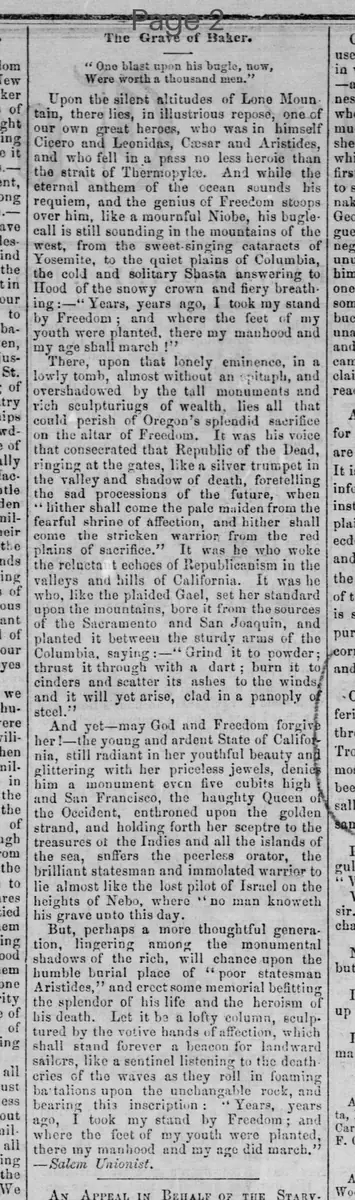
"Opo blast upon his bugle, now,
Were worth a thousand men."
Upon the silent altitudes of Lone Mountain, there lies, in illustrious repose, one of our own great heroes, who was in himself Cicero and Leonidas, Caesar and Aristides, and who fell in a pass no less heroic than the strait of Thermopylae. And while the eternal anthem of the ocean sounds his requiem, and the genius of Freedom stoops over him, like a mournful Niobe, his bugle-call is still sounding in the mountains of the west, from the sweet-singing cataracts of Yosemite, to the quiet plains of Columbia, the cold and solitary Shasta answering to Hood of the snowy crown and fiery breathing:—"Years, years ago, I took my stand by Freedom; and where the feet of my youth were planted, there my manhood and my age shall march !'
There, upon that lonely eminence, in a lowly tomb, almost without an epitaph, and overshadowed by the tall monuments and rich sculpturings of wealth, lies all that could perish of Oregon's splendid sacrifice on the altar of Freedom. It was his voice that consecrated that Republic of the Dead, ringing at the gates, like a silver trumpet in the valley and shadow of death, foretelling the sad processions of the future, when "hither shall come the pale maiden from the fearful shrine of affection, and hither shall come the stricken warrior from the red plains of sacrifice." It was he who woke the reluctant echoes of Republicanism in the valleys and hills of California. It was he who, like the plaided Gael, set her standard upon the mountains, bore it from the sources of the Sacramento and San Joaquin, and planted it between the sturdy arms of the Columbia, saying:—"Grind it to powder; thrust it through with a dart; burn it to cinders and scatter its ashes to the winds, and it will yet arise, clad in a panoply of steel."
And yet—may God and Freedom forgive her!—the young and ardent State of California, still radiant in her youthful beauty and glittering with her priceless jewels, denies him a monument even five cubits high and San Francisco, the haughty Queen of the Occident, enthroned upon the golden strand, and holding forth her sceptre to the treasures of the Indies and all the islands of the sea, suffers the peerless orator, the brilliant statesman and immolated warrior to lie almost like the lost pilot of Israel on the heights of Nebo, where no man knoweth his grave unto this day.
But, perhaps a more thoughtful generation, lingering among the monumental shadows of the rich, will chance upon the humble burial place of "poor statesman Aristides," and erect some memorial befitting the splendor of his life and the heroism of his death. Let it be a lofty column, sculptured by the votive hands of affection, which shall stand forever a beacon for landward sailors, like a sentinel listening to the death cries of the waves as they roll in foaming battalions upon the unchangeable rock, and bearing this inscription: "Years, years ago, I took my stand by Freedom; and where the feet of my youth were planted, there my manhood and my age did march."
—Salem Unionist.
Were worth a thousand men."
Upon the silent altitudes of Lone Mountain, there lies, in illustrious repose, one of our own great heroes, who was in himself Cicero and Leonidas, Caesar and Aristides, and who fell in a pass no less heroic than the strait of Thermopylae. And while the eternal anthem of the ocean sounds his requiem, and the genius of Freedom stoops over him, like a mournful Niobe, his bugle-call is still sounding in the mountains of the west, from the sweet-singing cataracts of Yosemite, to the quiet plains of Columbia, the cold and solitary Shasta answering to Hood of the snowy crown and fiery breathing:—"Years, years ago, I took my stand by Freedom; and where the feet of my youth were planted, there my manhood and my age shall march !'
There, upon that lonely eminence, in a lowly tomb, almost without an epitaph, and overshadowed by the tall monuments and rich sculpturings of wealth, lies all that could perish of Oregon's splendid sacrifice on the altar of Freedom. It was his voice that consecrated that Republic of the Dead, ringing at the gates, like a silver trumpet in the valley and shadow of death, foretelling the sad processions of the future, when "hither shall come the pale maiden from the fearful shrine of affection, and hither shall come the stricken warrior from the red plains of sacrifice." It was he who woke the reluctant echoes of Republicanism in the valleys and hills of California. It was he who, like the plaided Gael, set her standard upon the mountains, bore it from the sources of the Sacramento and San Joaquin, and planted it between the sturdy arms of the Columbia, saying:—"Grind it to powder; thrust it through with a dart; burn it to cinders and scatter its ashes to the winds, and it will yet arise, clad in a panoply of steel."
And yet—may God and Freedom forgive her!—the young and ardent State of California, still radiant in her youthful beauty and glittering with her priceless jewels, denies him a monument even five cubits high and San Francisco, the haughty Queen of the Occident, enthroned upon the golden strand, and holding forth her sceptre to the treasures of the Indies and all the islands of the sea, suffers the peerless orator, the brilliant statesman and immolated warrior to lie almost like the lost pilot of Israel on the heights of Nebo, where no man knoweth his grave unto this day.
But, perhaps a more thoughtful generation, lingering among the monumental shadows of the rich, will chance upon the humble burial place of "poor statesman Aristides," and erect some memorial befitting the splendor of his life and the heroism of his death. Let it be a lofty column, sculptured by the votive hands of affection, which shall stand forever a beacon for landward sailors, like a sentinel listening to the death cries of the waves as they roll in foaming battalions upon the unchangeable rock, and bearing this inscription: "Years, years ago, I took my stand by Freedom; and where the feet of my youth were planted, there my manhood and my age did march."
—Salem Unionist.
What sub-type of article is it?
Essay
What themes does it cover?
Liberty Freedom
Patriotism
Political
What keywords are associated?
Freedom
Hero
Monument
Lone Mountain
California
Oregon
Republicanism
Eulogy
Statesman
What entities or persons were involved?
Salem Unionist
Literary Details
Author
Salem Unionist
Subject
Tribute To Oregon's Hero Sacrificed For Freedom, Buried On Lone Mountain
Form / Style
Eulogistic Prose With Poetic Quotations
Key Lines
"Opo Blast Upon His Bugle, Now, Were Worth A Thousand Men."
"Years, Years Ago, I Took My Stand By Freedom; And Where The Feet Of My Youth Were Planted, There My Manhood And My Age Shall March !'
"Grind It To Powder; Thrust It Through With A Dart; Burn It To Cinders And Scatter Its Ashes To The Winds, And It Will Yet Arise, Clad In A Panoply Of Steel."
"Hither Shall Come The Pale Maiden From The Fearful Shrine Of Affection, And Hither Shall Come The Stricken Warrior From The Red Plains Of Sacrifice."
"Years, Years Ago, I Took My Stand By Freedom; And Where The Feet Of My Youth Were Planted, There My Manhood And My Age Did March."