Thank you for visiting SNEWPapers!
Sign up free
Literary
August 4, 1847
Ypsilanti Sentinel
Ypsilanti, Washtenaw County, Michigan
What is this article about?
A young bachelor, Alfred Couvraud, disillusioned with single life, places a marriage advertisement specifying a wife with modest income. Two ladies, Madame Souville and the widow Lucy, respond mischievously, summoning him. Their banter leads to mutual interest, chance encounters, and Alfred's eventual marriage to Lucy, proving advertisements can work.
Clipping
OCR Quality
97%
Excellent
Full Text
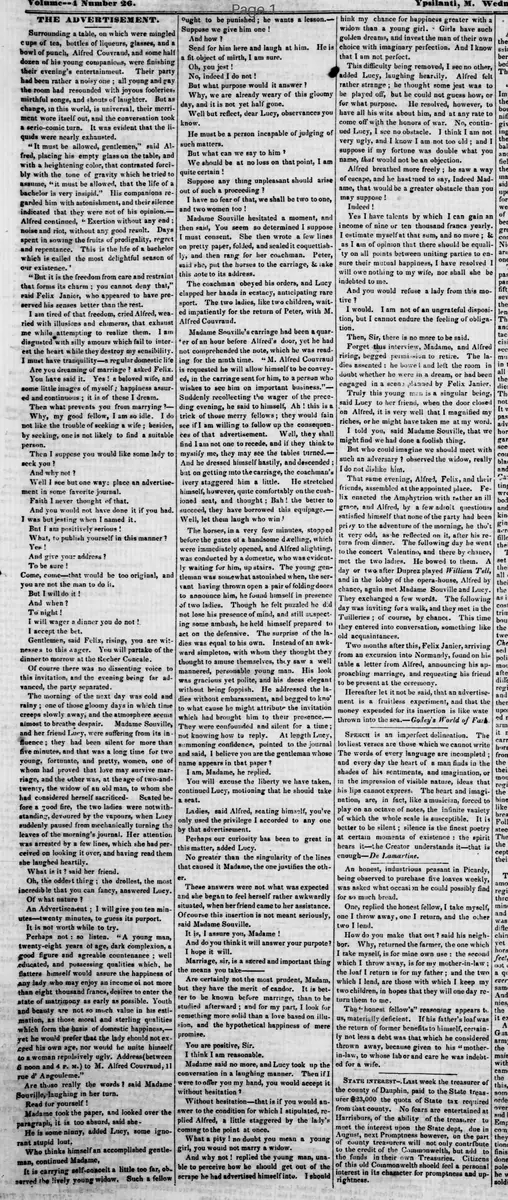
THE ADVERTISEMENT.
Surrounding a table, on which were mingled cups of tea, bottles of liqueurs, glasses, and a bowl of punch, Alfred Couvraud, and some half dozen of his young companions, were finishing their evening's entertainment. Their party had been rather a noisy one; all young and gay the room had resounded with joyous fooleries, mirthful songs, and shouts of laughter. But as change, in this world, is universal. their merriment wore itself out, and the conversation took a serio-comic turn. It was evident that the liquors were nearly exhausted.
"It must be allowed, gentlemen," said Alfred, placing his empty glass on the table, and with a heightening color, that contrasted forcibly with the tone of gravity which he tried to assume, "it must be allowed, that the life of a bachelor is very insipid." His companions regarded him with astonishment, and their silence indicated that they were not of his opinion.
Alfred continued, "Exertion without any end; noise and riot, without any good result. Days spent in sowing the fruits of prodigality, regret and repentance. This is the life of a bachelor which is called the most delightful season of our existence."
"But it is the freedom from care and restraint that forms its charm: you cannot deny that," said Felix Janier, who appeared to have preserved his senses better than the rest.
"I am tired of that freedom," cried Alfred, wearied with illusions and chimeras, that exhaust me while attempting to realize them. I am disgusted with silly amours which fail to interest the heart while they destroy my sensibility. I must have tranquility—a regular domestic life"
"Are you dreaming of marriage?" asked Felix.
"You have said it. Yes! a beloved wife, and some little images of myself; happiness assured and continuous: it is of these I dream."
"Then what prevents you from marrying?"
"Why, my good fellow, I am so idle. I do not like the trouble of seeking a wife; besides, by seeking, one is not likely to find a suitable person."
"Then I suppose you would like some lady to seek you?"
"And why not?"
"Well I see but one way: place an advertisement in some favorite journal."
"Faith! I never thought of that."
"And you would not have done it if you had."
"I was but jesting when I named it."
"But I am positively serious!"
"What, to publish yourself in this manner!"
"Yes!"
"And give your address?"
"To be sure!"
"Come, come—that would be too original, and you are not the man to do it."
"But I will do it!"
"And when?"
"To night!"
"I will wager a dinner you do not!"
"I accept the bet."
"Gentlemen," said Felix, rising, "you are witnesses to this wager. You will partake of the dinner to morrow at the Rocher de Cancale."
Of course there was no dissenting voice to this invitation, and the evening being far advanced, the party separated.
The morning of the next day was cold and rainy; one of those gloomy days in which time creeps slowly away, and the atmosphere seems almost to breathe despair. Madame Souville, and her friend Lucy, were suffering from its influence: they had been silent for more than five minutes, and that was a long time for two young, fortunate, and pretty, women, one of whom had proved that love may survive marriage, and the other was, at the age of two-and-twenty, the widow of an old man, to whom she had considered herself sacrificed. Seated before a good fire, the two ladies were nevertheless, devoured by the vapours, when Lucy suddenly paused from mechanically turning the leaves of the morning's journal. Her attention was arrested by a few lines, which she had perceived on looking it over, and having read them she laughed heartily.
"What is it?" said her friend.
"Oh, the oddest thing; the drollest, the most incredible that you can fancy," answered Lucy.
"Of what nature?"
"An Advertisement; I will give you ten minutes—twenty minutes, to guess its purport."
"It is not worth while to try."
"Perhaps not: so listen. 'A young man, twenty-eight years of age, dark complexion, a good figure and agreeable countenance; well educated, and possessing qualities which, he flatters himself would assure the happiness of any lady who may enjoy an income of not more than eight thousand francs, desires to enter the state of matrimony as early as possible. Youth and beauty are not so much value in his estimation, as those moral and sterling qualities which form the basis of domestic happiness,—yet he would prefer that the lady should not exceed his own age, nor would he unite himself to a woman repulsively ugly. Address (between 6 noon and 4 P. M.) to M. Alfred Couvraud, 11 rue d'Angouleme.'"
"Are those really the words?" said Madame Souville, laughing in her turn.
"Read for yourself!"
Madame took the paper, and looked over the paragraph, "it is too absurd," said she—
"He is some ninny," added Lucy, "some ignorant stupid lout,
Who thinks himself an accomplished gentleman," continued Madame,
"It is carrying self-conceit a little too far," observed the lively young widow, "Such a fellow ought to be punished; he wants a lesson."
"Suppose we give him one!"
"And how?"
"Send for him here and laugh at him. He is a fit object of mirth, I am sure."
"Oh, you jest!"
"No, indeed I do not!"
"But what purpose would it answer?"
"Why, we are already weary of this gloomy day, and it is not yet half gone."
"Well but reflect, dear Lucy, observances you know."
"He must be a person incapable of judging of such matters."
"But what can we say to him?"
"We should be at no loss on that point, I am quite certain!"
"Suppose any thing unpleasant should arise out of such a proceeding?"
"I have no fear of that, we shall be two to one, and two women too!"
Madame Souville hesitated a moment, and then said, "You seem so determined I suppose I must consent." She then wrote a few lines on pretty paper, folded, and sealed it coquettishly, and then rang for her coachman. "Peter," said she, "put the horses to the carriage, & take this note to its address."
The coachman obeyed his orders, and Lucy clapped her hands in ecstasy, anticipating rare sport. The two ladies, like two children, waited impatiently for the return of Peter, with M. Alfred Couvraud.
Madame Souville's carriage had been a quarter of an hour before Alfred's door, yet he had not comprehended the note, which he was reading for the ninth time. "M. Alfred Couvraud is requested he will allow himself to be conveyed, in the carriage sent for him, to a person who wishes to see him on important business."—Suddenly recollecting the wager of the preceding evening, he said to himself, "Ah! this is a trick of those merry fellows; they would fain see if I am willing to follow up the consequences of that advertisement. Well, they shall find I am not one to recede, and if they think to mystify me, they may see the tables turned."
And he dressed himself hastily, and descended: but on getting into the carriage, the coachman's livery staggered him a little. He stretched himself, however, quite comfortably on the cushioned seat, and thought: "Bah! the better to succeed, they have borrowed this equipage.—Well, let them laugh who win!"
The horses, in a very few minutes, stopped before the gates of a handsome dwelling, which were immediately opened, and Alfred alighting, was conducted by a domestic, who was evidently waiting for him, up stairs. The young gentleman was somewhat astonished when, the servant having thrown open a pair of folding doors to announce him, he found himself in presence of two ladies. Though he felt puzzled he did not lose his presence of mind, and still suspecting some ambush, he held himself prepared to act on the defensive. The surprise of the ladies was equal to his own. Instead of an awkward simpleton, with whom they thought to amuse themselves, they saw a well mannered, personable young man. His look was gracious yet polite, and his dress elegant without being foppish. He addressed the ladies without embarrassment, and begged to know to what cause he might attribute the invitation which had brought him to their presence.—
They were confounded and silent for a time; not knowing how to reply. At length Lucy, summoning confidence, pointed to the journal and said, "I believe you are the gentleman whose name appears in that paper?"
"I am, Madame," he replied.
"You will excuse the liberty we have taken," continued Lucy, motioning that he should take a seat.
"Ladies," said Alfred, seating himself, "you've only used the privilege I accorded to any one by that advertisement."
"Perhaps our curiosity has been too great in this matter," added Lucy.
"No greater than the singularity of the lines that caused it Madame, the one justifies the other."
These answers were not what was expected and she began to feel herself rather awkwardly situated, when her friend came to her assistance.
"Of course this insertion is not meant seriously," said Madame Souville.
"It is, I assure you, Madame"
"And do you think it will answer your purpose?"
"I hope it will."
"Marriage, sir, is a sacred and important thing the means you take Are certainly not the most prudent, Madam, but they have the merit of candor. It is better to be known before marriage, than to be studied afterward; and for my part, I look for something more solid than a love based on illusion, and the hypothetical happiness of mere promise."
"You are positive, Sir."
"I think I am reasonable."
Madame said no more, and Lucy took up the conversation in a laughing manner. "Then if I were to offer you my hand, you would accept it without hesitation?"
"Without hesitation—that is if you would answer to the condition for which I stipulated," replied Alfred, a little staggered by the lady's coming to the point at once.
"What a pity! no doubt you mean a young girl, you would not marry a widow."
"And why not!" replied the young man, unable to perceive how he should get out of the scrape he had advertised himself into. "I should think my chance of happiness greater with a widow than a young girl. Girls have such golden dreams, and invest the man of their own choice with imaginary perfection. And I know that I am not perfect."
This difficulty being removed, I see no other, added Lucy, laughing heartily. Alfred felt rather strange; he thought some jest was to be played off, but he could not guess how, or for what purpose. He resolved, however, to have all his wits about him, and at any rate to come off with the honors of war. "No, continued Lucy, I see no obstacle. I think I am not very ugly, and I know I am not too old; and I suppose if my fortune was double what you name, that would not be an objection."
Alfred breathed more freely; he saw a way of escape, and he hastened to say, "Indeed Madame, that would be a greater obstacle than you may suppose!"
"Indeed!"
"Yes I have talents by which I can gain an income of nine or ten thousand francs yearly. I estimate myself at that sum, and no more; & as I am of opinion that there should be equality on all points between uniting parties to ensure their mutual happiness, I have resolved I will owe nothing to my wife, nor shall she be indebted to me."
"And you would refuse a lady from this motive?"
"I would. I am not of an ungrateful disposition, but I cannot endure the feeling of obligation."
"Then, Sir, there is no more to be said. Forget this interview," Madame, and Alfred rising, begged permission to retire. The ladies assented: he bowed and left the room in doubt whether he were in a dream, or had been engaged in a scene planned by Felix Janier.
"Truly this young man is a singular being," said Lucy to her friend, when the door closed on Alfred, "it is very well that I magnified my riches, or he might have taken me at my word."
"I told you," said Madame Souville, "that we might find we had done a foolish thing."
"But who could imagine we should meet with such an adversary?" observed the widow, "really I do not dislike him."
That same evening, Alfred, Felix, and their friends, assembled at the appointed place. Felix enacted the Amphitryon with rather an ill grace, and Alfred, by a few adroit questions, satisfied himself that none of the party had been privy to the adventure of the morning, he thought it very odd, as he reflected on it, after his return from dinner. The following day he went to the concert Valentino, and there by chance, met the two ladies. He bowed to them. A day or two after Duprez played William Tell, and in the lobby of the opera-house, Alfred by chance, again met Madame Souville and Lucy. They exchanged a few words. The following day was inviting for a walk, and they met in the Tuilleries; of course, by chance. This time they entered into conversation, something like old acquaintances.
Two months after this, Felix Janier, arriving from an excursion into Normandy, found on his table a letter from Alfred, announcing his approaching marriage, and requesting his friend to be present at the ceremony.
Hereafter let it not be said, that an advertisement is a fruitless experiment, and that the money expended for its insertion is like water thrown into the sea.
Surrounding a table, on which were mingled cups of tea, bottles of liqueurs, glasses, and a bowl of punch, Alfred Couvraud, and some half dozen of his young companions, were finishing their evening's entertainment. Their party had been rather a noisy one; all young and gay the room had resounded with joyous fooleries, mirthful songs, and shouts of laughter. But as change, in this world, is universal. their merriment wore itself out, and the conversation took a serio-comic turn. It was evident that the liquors were nearly exhausted.
"It must be allowed, gentlemen," said Alfred, placing his empty glass on the table, and with a heightening color, that contrasted forcibly with the tone of gravity which he tried to assume, "it must be allowed, that the life of a bachelor is very insipid." His companions regarded him with astonishment, and their silence indicated that they were not of his opinion.
Alfred continued, "Exertion without any end; noise and riot, without any good result. Days spent in sowing the fruits of prodigality, regret and repentance. This is the life of a bachelor which is called the most delightful season of our existence."
"But it is the freedom from care and restraint that forms its charm: you cannot deny that," said Felix Janier, who appeared to have preserved his senses better than the rest.
"I am tired of that freedom," cried Alfred, wearied with illusions and chimeras, that exhaust me while attempting to realize them. I am disgusted with silly amours which fail to interest the heart while they destroy my sensibility. I must have tranquility—a regular domestic life"
"Are you dreaming of marriage?" asked Felix.
"You have said it. Yes! a beloved wife, and some little images of myself; happiness assured and continuous: it is of these I dream."
"Then what prevents you from marrying?"
"Why, my good fellow, I am so idle. I do not like the trouble of seeking a wife; besides, by seeking, one is not likely to find a suitable person."
"Then I suppose you would like some lady to seek you?"
"And why not?"
"Well I see but one way: place an advertisement in some favorite journal."
"Faith! I never thought of that."
"And you would not have done it if you had."
"I was but jesting when I named it."
"But I am positively serious!"
"What, to publish yourself in this manner!"
"Yes!"
"And give your address?"
"To be sure!"
"Come, come—that would be too original, and you are not the man to do it."
"But I will do it!"
"And when?"
"To night!"
"I will wager a dinner you do not!"
"I accept the bet."
"Gentlemen," said Felix, rising, "you are witnesses to this wager. You will partake of the dinner to morrow at the Rocher de Cancale."
Of course there was no dissenting voice to this invitation, and the evening being far advanced, the party separated.
The morning of the next day was cold and rainy; one of those gloomy days in which time creeps slowly away, and the atmosphere seems almost to breathe despair. Madame Souville, and her friend Lucy, were suffering from its influence: they had been silent for more than five minutes, and that was a long time for two young, fortunate, and pretty, women, one of whom had proved that love may survive marriage, and the other was, at the age of two-and-twenty, the widow of an old man, to whom she had considered herself sacrificed. Seated before a good fire, the two ladies were nevertheless, devoured by the vapours, when Lucy suddenly paused from mechanically turning the leaves of the morning's journal. Her attention was arrested by a few lines, which she had perceived on looking it over, and having read them she laughed heartily.
"What is it?" said her friend.
"Oh, the oddest thing; the drollest, the most incredible that you can fancy," answered Lucy.
"Of what nature?"
"An Advertisement; I will give you ten minutes—twenty minutes, to guess its purport."
"It is not worth while to try."
"Perhaps not: so listen. 'A young man, twenty-eight years of age, dark complexion, a good figure and agreeable countenance; well educated, and possessing qualities which, he flatters himself would assure the happiness of any lady who may enjoy an income of not more than eight thousand francs, desires to enter the state of matrimony as early as possible. Youth and beauty are not so much value in his estimation, as those moral and sterling qualities which form the basis of domestic happiness,—yet he would prefer that the lady should not exceed his own age, nor would he unite himself to a woman repulsively ugly. Address (between 6 noon and 4 P. M.) to M. Alfred Couvraud, 11 rue d'Angouleme.'"
"Are those really the words?" said Madame Souville, laughing in her turn.
"Read for yourself!"
Madame took the paper, and looked over the paragraph, "it is too absurd," said she—
"He is some ninny," added Lucy, "some ignorant stupid lout,
Who thinks himself an accomplished gentleman," continued Madame,
"It is carrying self-conceit a little too far," observed the lively young widow, "Such a fellow ought to be punished; he wants a lesson."
"Suppose we give him one!"
"And how?"
"Send for him here and laugh at him. He is a fit object of mirth, I am sure."
"Oh, you jest!"
"No, indeed I do not!"
"But what purpose would it answer?"
"Why, we are already weary of this gloomy day, and it is not yet half gone."
"Well but reflect, dear Lucy, observances you know."
"He must be a person incapable of judging of such matters."
"But what can we say to him?"
"We should be at no loss on that point, I am quite certain!"
"Suppose any thing unpleasant should arise out of such a proceeding?"
"I have no fear of that, we shall be two to one, and two women too!"
Madame Souville hesitated a moment, and then said, "You seem so determined I suppose I must consent." She then wrote a few lines on pretty paper, folded, and sealed it coquettishly, and then rang for her coachman. "Peter," said she, "put the horses to the carriage, & take this note to its address."
The coachman obeyed his orders, and Lucy clapped her hands in ecstasy, anticipating rare sport. The two ladies, like two children, waited impatiently for the return of Peter, with M. Alfred Couvraud.
Madame Souville's carriage had been a quarter of an hour before Alfred's door, yet he had not comprehended the note, which he was reading for the ninth time. "M. Alfred Couvraud is requested he will allow himself to be conveyed, in the carriage sent for him, to a person who wishes to see him on important business."—Suddenly recollecting the wager of the preceding evening, he said to himself, "Ah! this is a trick of those merry fellows; they would fain see if I am willing to follow up the consequences of that advertisement. Well, they shall find I am not one to recede, and if they think to mystify me, they may see the tables turned."
And he dressed himself hastily, and descended: but on getting into the carriage, the coachman's livery staggered him a little. He stretched himself, however, quite comfortably on the cushioned seat, and thought: "Bah! the better to succeed, they have borrowed this equipage.—Well, let them laugh who win!"
The horses, in a very few minutes, stopped before the gates of a handsome dwelling, which were immediately opened, and Alfred alighting, was conducted by a domestic, who was evidently waiting for him, up stairs. The young gentleman was somewhat astonished when, the servant having thrown open a pair of folding doors to announce him, he found himself in presence of two ladies. Though he felt puzzled he did not lose his presence of mind, and still suspecting some ambush, he held himself prepared to act on the defensive. The surprise of the ladies was equal to his own. Instead of an awkward simpleton, with whom they thought to amuse themselves, they saw a well mannered, personable young man. His look was gracious yet polite, and his dress elegant without being foppish. He addressed the ladies without embarrassment, and begged to know to what cause he might attribute the invitation which had brought him to their presence.—
They were confounded and silent for a time; not knowing how to reply. At length Lucy, summoning confidence, pointed to the journal and said, "I believe you are the gentleman whose name appears in that paper?"
"I am, Madame," he replied.
"You will excuse the liberty we have taken," continued Lucy, motioning that he should take a seat.
"Ladies," said Alfred, seating himself, "you've only used the privilege I accorded to any one by that advertisement."
"Perhaps our curiosity has been too great in this matter," added Lucy.
"No greater than the singularity of the lines that caused it Madame, the one justifies the other."
These answers were not what was expected and she began to feel herself rather awkwardly situated, when her friend came to her assistance.
"Of course this insertion is not meant seriously," said Madame Souville.
"It is, I assure you, Madame"
"And do you think it will answer your purpose?"
"I hope it will."
"Marriage, sir, is a sacred and important thing the means you take Are certainly not the most prudent, Madam, but they have the merit of candor. It is better to be known before marriage, than to be studied afterward; and for my part, I look for something more solid than a love based on illusion, and the hypothetical happiness of mere promise."
"You are positive, Sir."
"I think I am reasonable."
Madame said no more, and Lucy took up the conversation in a laughing manner. "Then if I were to offer you my hand, you would accept it without hesitation?"
"Without hesitation—that is if you would answer to the condition for which I stipulated," replied Alfred, a little staggered by the lady's coming to the point at once.
"What a pity! no doubt you mean a young girl, you would not marry a widow."
"And why not!" replied the young man, unable to perceive how he should get out of the scrape he had advertised himself into. "I should think my chance of happiness greater with a widow than a young girl. Girls have such golden dreams, and invest the man of their own choice with imaginary perfection. And I know that I am not perfect."
This difficulty being removed, I see no other, added Lucy, laughing heartily. Alfred felt rather strange; he thought some jest was to be played off, but he could not guess how, or for what purpose. He resolved, however, to have all his wits about him, and at any rate to come off with the honors of war. "No, continued Lucy, I see no obstacle. I think I am not very ugly, and I know I am not too old; and I suppose if my fortune was double what you name, that would not be an objection."
Alfred breathed more freely; he saw a way of escape, and he hastened to say, "Indeed Madame, that would be a greater obstacle than you may suppose!"
"Indeed!"
"Yes I have talents by which I can gain an income of nine or ten thousand francs yearly. I estimate myself at that sum, and no more; & as I am of opinion that there should be equality on all points between uniting parties to ensure their mutual happiness, I have resolved I will owe nothing to my wife, nor shall she be indebted to me."
"And you would refuse a lady from this motive?"
"I would. I am not of an ungrateful disposition, but I cannot endure the feeling of obligation."
"Then, Sir, there is no more to be said. Forget this interview," Madame, and Alfred rising, begged permission to retire. The ladies assented: he bowed and left the room in doubt whether he were in a dream, or had been engaged in a scene planned by Felix Janier.
"Truly this young man is a singular being," said Lucy to her friend, when the door closed on Alfred, "it is very well that I magnified my riches, or he might have taken me at my word."
"I told you," said Madame Souville, "that we might find we had done a foolish thing."
"But who could imagine we should meet with such an adversary?" observed the widow, "really I do not dislike him."
That same evening, Alfred, Felix, and their friends, assembled at the appointed place. Felix enacted the Amphitryon with rather an ill grace, and Alfred, by a few adroit questions, satisfied himself that none of the party had been privy to the adventure of the morning, he thought it very odd, as he reflected on it, after his return from dinner. The following day he went to the concert Valentino, and there by chance, met the two ladies. He bowed to them. A day or two after Duprez played William Tell, and in the lobby of the opera-house, Alfred by chance, again met Madame Souville and Lucy. They exchanged a few words. The following day was inviting for a walk, and they met in the Tuilleries; of course, by chance. This time they entered into conversation, something like old acquaintances.
Two months after this, Felix Janier, arriving from an excursion into Normandy, found on his table a letter from Alfred, announcing his approaching marriage, and requesting his friend to be present at the ceremony.
Hereafter let it not be said, that an advertisement is a fruitless experiment, and that the money expended for its insertion is like water thrown into the sea.
What sub-type of article is it?
Prose Fiction
What themes does it cover?
Love Romance
Social Manners
What keywords are associated?
Marriage Advertisement
Bachelor Life
Romantic Pursuit
Social Comedy
French Society
Literary Details
Title
The Advertisement.
Key Lines
'A Young Man, Twenty Eight Years Of Age, Dark Complexion, A Good Figure And Agreeable Countenance; Well Educated, And Possessing Qualities Which, He Flatters Himself Would Assure The Happiness Of Any Lady Who May Enjoy An Income Of Not More Than Eight Thousand Francs, Desires To Enter The State Of Matrimony As Early As Possible. Youth And Beauty Are Not So Much Value In His Estimation, As Those Moral And Sterling Qualities Which Form The Basis Of Domestic Happiness,—Yet He Would Prefer That The Lady Should Not Exceed His Own Age, Nor Would He Unite Himself To A Woman Repulsively Ugly. Address (Between 6 Noon And 4 P. M.) To M. Alfred Couvraud, 11 Rue D'angouleme.'
"It Is Better To Be Known Before Marriage, Than To Be Studied Afterward; And For My Part, I Look For Something More Solid Than A Love Based On Illusion, And The Hypothetical Happiness Of Mere Promise."
Hereafter Let It Not Be Said, That An Advertisement Is A Fruitless Experiment, And That The Money Expended For Its Insertion Is Like Water Thrown Into The Sea.