Thank you for visiting SNEWPapers!
Sign up free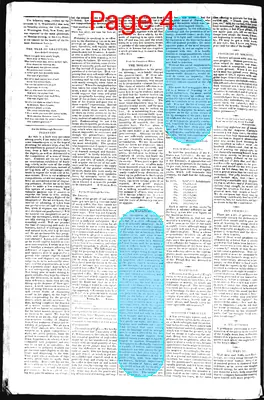
Editorial
January 24, 1821
The Hillsborough Recorder
Hillsboro, Orange County, North Carolina
What is this article about?
This editorial praises the circulation of newspapers for providing cheap, rapid, and effective knowledge dissemination. It argues newspapers serve as a basis for political education, promote moral improvement, facilitate public discourse, reduce crime through exposure, and act as a 'University of the People' by offering practical lessons over formal college education.
Clipping
OCR Quality
95%
Excellent
Full Text
NEWSPAPERS.
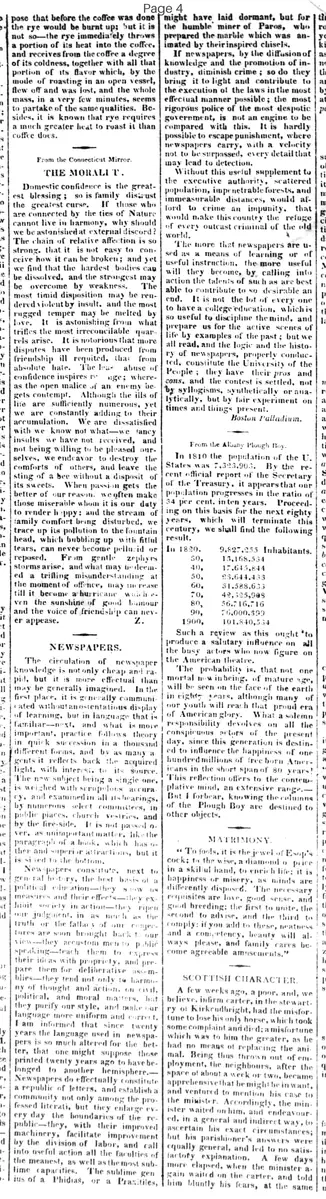
The circulation of newspaper knowledge is not only cheap and rapid, but it is more effectual than may be generally imagined. In the first place, it is generally communicated without an ostentatious display of learning, but in language that is familiar—next, and what is more important, practice follows theory in quick succession in a thousand different forms, and by as many agents it reflects back the acquired light, with interest, to its source. The new subject being a single one, is weighed with scrupulous accuracy, and examined in all its bearings, by numerous select committees, in public places, church vestries, and by the fire-side. It is not passed over, as unimportant matter, with the paragraph of a book, which has other and superior attractions, but it is sifted to the bottom. Newspapers constitute, next to general history, the best basis of a political education—they show measures and their effects—they exhibit sovereignty in action—they ripen our judgment, in as much as the truth or the fallacy of our conjectures are soon brought back to our view—they accustom men to public speaking—teach them to express their ideas with propriety, and prepare them for deliberative assemblies—they tend not only to harmony of thought and action, on civil, political, and moral matters, but they purify our style, and shake our language more uniform and correct. I am informed that since twenty years the language used in newspapers is so much altered for the better, that one might suppose those printed twenty years ago to have belonged to another hemisphere.—Newspapers do effectually constitute a republic of letters, and establish a community not only among the professed literati, but they enlarge every day the boundaries of the republic—they, with their improved machinery, facilitate improvement by the division of labor, and call into useful action all the faculties of the meanest, as well as the most sublime capacities. The sublime genius of a Phidias, or a Praxiteles, might have laid dormant, but for the humble miner of Paros, who prepared the marble which was animated by their inspired chisels. If newspapers, by the diffusion of knowledge and the promotion of industry, diminish crime; so do they bring it to light and contribute to the execution of the laws in the most effectual manner possible: the most rigorous police of the most despotic government, is not an engine to be compared with this. It is hardly possible to escape punishment, where newspapers carry, with a velocity not to be surpassed, every detail that may lead to detection. Without this useful supplement to the executive authority, scattered population, impenetrable forests, and immeasurable distances, would afford to crime an impunity, that would make this country the refuge of every outcast criminal of the old world. The more that newspapers are used as a means of learning or of useful instruction, the more useful will they become, by calling into action the talents of such as are best able to contribute to so desirable an end. It is not the lot of every one to have a college education, which is so useful to discipline the mind, and prepare us for the active scenes of life by examples of the past; but we all read, and the logic and the history of newspapers, properly conducted, constitute the University of the People; they have their pros and cons, and the contest is settled, not by syllogisms, synthetically or analytically, but by fair experiment on times and things present.
Boston Palladium.
The circulation of newspaper knowledge is not only cheap and rapid, but it is more effectual than may be generally imagined. In the first place, it is generally communicated without an ostentatious display of learning, but in language that is familiar—next, and what is more important, practice follows theory in quick succession in a thousand different forms, and by as many agents it reflects back the acquired light, with interest, to its source. The new subject being a single one, is weighed with scrupulous accuracy, and examined in all its bearings, by numerous select committees, in public places, church vestries, and by the fire-side. It is not passed over, as unimportant matter, with the paragraph of a book, which has other and superior attractions, but it is sifted to the bottom. Newspapers constitute, next to general history, the best basis of a political education—they show measures and their effects—they exhibit sovereignty in action—they ripen our judgment, in as much as the truth or the fallacy of our conjectures are soon brought back to our view—they accustom men to public speaking—teach them to express their ideas with propriety, and prepare them for deliberative assemblies—they tend not only to harmony of thought and action, on civil, political, and moral matters, but they purify our style, and shake our language more uniform and correct. I am informed that since twenty years the language used in newspapers is so much altered for the better, that one might suppose those printed twenty years ago to have belonged to another hemisphere.—Newspapers do effectually constitute a republic of letters, and establish a community not only among the professed literati, but they enlarge every day the boundaries of the republic—they, with their improved machinery, facilitate improvement by the division of labor, and call into useful action all the faculties of the meanest, as well as the most sublime capacities. The sublime genius of a Phidias, or a Praxiteles, might have laid dormant, but for the humble miner of Paros, who prepared the marble which was animated by their inspired chisels. If newspapers, by the diffusion of knowledge and the promotion of industry, diminish crime; so do they bring it to light and contribute to the execution of the laws in the most effectual manner possible: the most rigorous police of the most despotic government, is not an engine to be compared with this. It is hardly possible to escape punishment, where newspapers carry, with a velocity not to be surpassed, every detail that may lead to detection. Without this useful supplement to the executive authority, scattered population, impenetrable forests, and immeasurable distances, would afford to crime an impunity, that would make this country the refuge of every outcast criminal of the old world. The more that newspapers are used as a means of learning or of useful instruction, the more useful will they become, by calling into action the talents of such as are best able to contribute to so desirable an end. It is not the lot of every one to have a college education, which is so useful to discipline the mind, and prepare us for the active scenes of life by examples of the past; but we all read, and the logic and the history of newspapers, properly conducted, constitute the University of the People; they have their pros and cons, and the contest is settled, not by syllogisms, synthetically or analytically, but by fair experiment on times and things present.
Boston Palladium.
What sub-type of article is it?
Education
Moral Or Religious
Crime Or Punishment
What keywords are associated?
Newspaper Circulation
Political Education
Moral Improvement
Crime Detection
Public Discourse
Republic Of Letters
University Of The People
What entities or persons were involved?
Boston Palladium
Editorial Details
Primary Topic
Benefits Of Newspapers For Political Education And Societal Improvement
Stance / Tone
Strongly Positive Endorsement
Key Figures
Boston Palladium
Key Arguments
Newspaper Knowledge Is Cheap, Rapid, And Effectual In Familiar Language
Practice Follows Theory Quickly Through Various Agents
Newspapers Provide Scrupulous Examination Of Subjects In Public And Private Settings
Best Basis For Political Education After General History, Showing Measures And Effects
Ripen Judgment By Testing Conjectures, Accustom To Public Speaking And Proper Expression
Promote Harmony In Civil, Political, Moral Matters; Purify Style And Language
Constitute A Republic Of Letters, Enlarging Community And Facilitating Improvement
Diminish Crime Through Knowledge Diffusion And Bring It To Light For Punishment
Serve As University Of The People With Practical Logic And History