Thank you for visiting SNEWPapers!
Sign up free
Rutland Herald
Rutland, Rutland County, Vermont
What is this article about?
In the U.S. House on February 15, 1836, Mr. Briggs presented an abolition memorial, prompting a heated debate. Mr. Wise criticized Mr. Pinckney's resolution as a betrayal of Southern interests, leading to disorder. After explanations, the House voted 111-92 to allow Wise to proceed.
Clipping
OCR Quality
Full Text
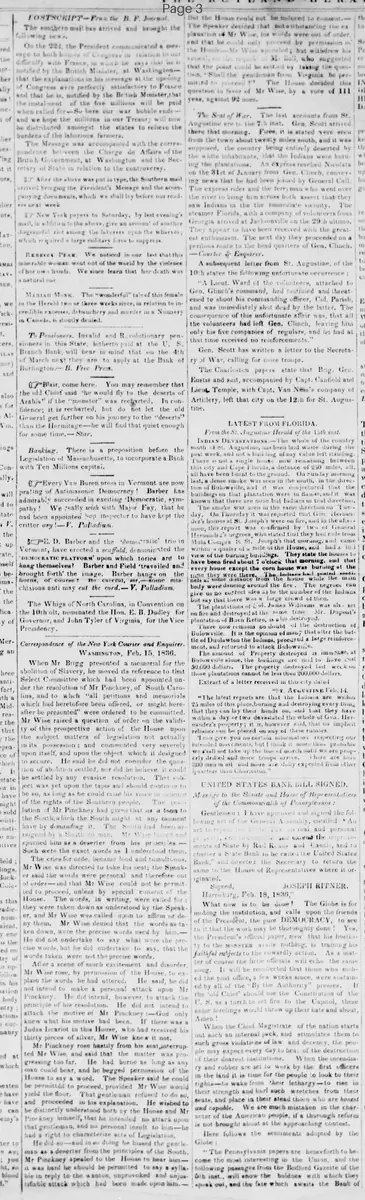
Washington, Feb. 15, 1836.
When Mr. Briggs presented a memorial for the abolition of Slavery, he moved its reference to that Select Committee which had been appointed under the resolution of Mr. Pinckney, of South Carolina, and to which "all petitions and memorials which had heretofore been offered, or might hereafter be presented" were ordered to be committed.
Mr. Wise raised a question of order on the validity of this prospective action of the House upon the subject matters of legislation not actually in its possession: and commented very severely upon itself, and upon the object which it designed to secure. He said he did not consider the question of abolition settled, nor did he believe it could be settled by any evasive resolution. That subject was yet upon the tapis and should continue to be so, as long as he could raise his voice in defence of the rights of the Southern people. The resolution of Mr. Pinckney had given that as a boon to the South, which the South might at any moment have by demanding it. The South had been betrayed by a Southern man. Mr. Wise had spurned him as a deserter from his party; yes—Such were the exact words as I understood them.
The cries for order became loud and tumultuous. Mr. Wise was directed to take his seat: the Speaker said the words were personal and therefore out of order—and that Mr. Wise could not be permitted to proceed, unless by special consent of the House. The words, in writing, were called for: they were taken down as understood by the Speaker, and Mr. Wise was called upon to affirm or deny them. Mr. Wise denied that the words as taken down, were the precise words used by him. He did not undertake to say what were the precise words, but he did undertake to say, that the words taken were not the precise words.
After a scene of much excitement and disorder Mr. Wise rose, by permission of the House, to explain the word he had uttered. He said, he did not intend to make a personal attack upon Mr. Pinckney. He did intend, however to attack the principle of his resolution. He did not intend to attack the motive of Mr. Pinckney:—God only knew what his motive had been. If there was a Judas Iscariot in this House, who had received his thirty pieces of silver, Mr. Wise knew it not.
Mr. Pinckney rose hastily from his seat, interrupted Mr. Wise, and said that the matter was progressing too far. He had borne as long as any man could bear, and he begged permission of the House to say a word. The Speaker said he could be permitted to proceed, provided Mr. Wise would yield the floor. That gentleman refused to do so, and proceeded in his explanation. He wished to be distinctly understood both by the House and Mr. Pinckney himself, that he intended no attack upon that gentleman, and no personal insult to him—he had a right to characterize acts of Legislation. He did so—and in so doing he hissed the gentleman as a deserter from the principles of the South.
Mr. Pinckney appealed to the House to hear him—it was hard he should be permitted to say a syllable in reply to the wanton, unprovoked and unjustifiable attack which had been made upon him.—
But the House could not be induced to consent. The Speaker decided that notwithstanding the explanation of Mr. Wise, his words were out of order and that he could only proceed by permission of the House—Mr. Wise appealed: but withdrew his motion, Mr. Bell, who suggested that the point could be settled by taking the question—Shall the gentleman from Virginia be permitted to proceed? The House decided this question in favor of Mr. Wise, by a vote of 111 yeas, against 92 nays.
What sub-type of article is it?
What keywords are associated?
What entities or persons were involved?
Where did it happen?
Domestic News Details
Primary Location
Washington
Event Date
1836 02 15
Key Persons
Outcome
the house voted 111 yeas to 92 nays to permit mr. wise to proceed.
Event Details
Mr. Briggs presented a memorial for the abolition of slavery and moved its reference to a select committee appointed under Mr. Pinckney's resolution. Mr. Wise raised a question of order, criticized the resolution as a betrayal of Southern interests, and called Mr. Pinckney a deserter, leading to disorder. After explanations and denials, the House allowed Wise to continue.