Thank you for visiting SNEWPapers!
Sign up free
The Pacific Commercial Advertiser
Honolulu, Honolulu County, Hawaii
What is this article about?
Professor Maggiorani's experiment showed that exposing hen eggs to powerful magnets during artificial incubation led to higher rates of developmental arrest, chick mortality, and abnormalities compared to a control group without magnetic influence.
Clipping
OCR Quality
Full Text
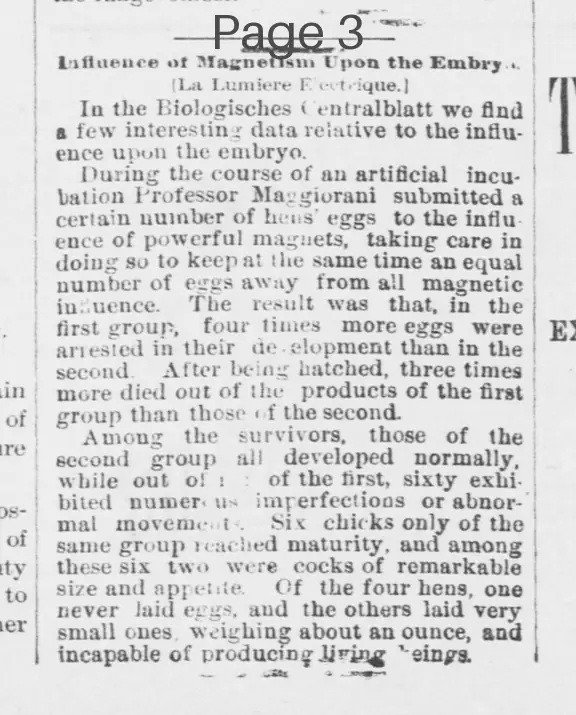
In the Biologisches Centralblatt we find a few interesting data relative to the influence upon the embryo.
During the course of an artificial incubation Professor Maggiorani submitted a certain number of hens eggs to the influence of powerful magnets, taking care in doing so to keep at the same time an equal number of eggs away from all magnetic influence. The result was that, in the first group, four times more eggs were arrested in their development than in the second. After being hatched, three times more died out of the products of the first group than those of the second.
Among the survivors, those of the second group all developed normally, while out of the first, sixty exhibited numerous imperfections or abnormal movement. Six chicks only of the same group reached maturity, and among these six two were cocks of remarkable size and appetite. Of the four hens, one never laid eggs, and the others laid very small ones weighing about an ounce, and incapable of producing living beings.
What sub-type of article is it?
What themes does it cover?
What keywords are associated?
What entities or persons were involved?
Story Details
Key Persons
Story Details
Professor Maggiorani conducted an artificial incubation experiment on hen eggs, exposing one group to powerful magnets and keeping another as a control. The magnet-exposed group showed four times more developmental arrests, three times more post-hatch deaths, and survivors had imperfections or abnormal movements. Only six reached maturity, with two large cocks and four hens that laid small, non-viable eggs.