Thank you for visiting SNEWPapers!
Sign up free
Literary
July 22, 1904
The Cairo Bulletin
Cairo, Alexander County County, Illinois
What is this article about?
In this chapter of the pirate romance, Dickory Charter aids the marooned Mander family on their island when a merchant brig arrives. Lucilla, dressed as a sailor boy, spots the boat. The family, fearing pirates, hides but is joyfully rescued after Dickory and Mander greet the crew, secure cloth for clothes, and prepare to sail to Jamaica.
Clipping
OCR Quality
95%
Excellent
Full Text
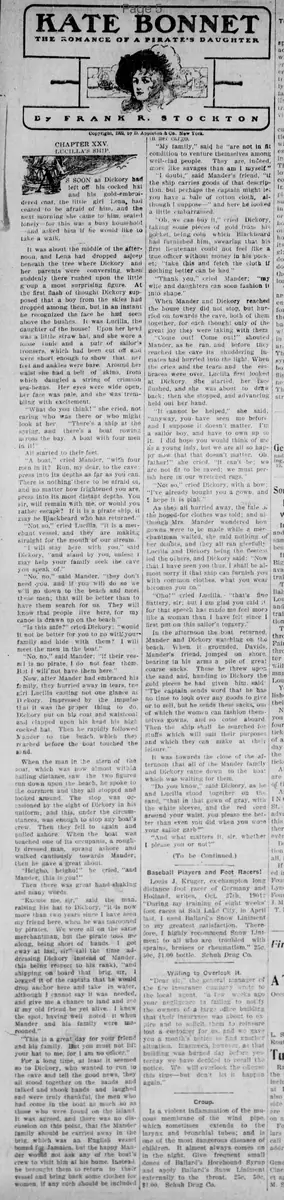
KATE BONNET
THE ROMANCE OF A PIRATE'S DAUGHTER
FRANK R. STOCKTON
Copyright, 1904, by D. Appleton & Co., New York.
CHAPTER XXV.
LUCILLA'S SHIP.
"My family," said he, "are not in a condition to venture themselves among well-clad people. They are, indeed, more like savages than am I myself."
As soon as Dickory had left off his cocked hat and his gold-embroidered coat, the little girl Lena had ceased to be afraid of him, and the next morning she came to him, seated lonely—for this was a busy household—and asked him if he would like to take a walk.
It was about the middle of the afternoon, and Lena had dropped asleep beneath the tree where Dickory and her parents were conversing, when suddenly there rushed upon the little group a most surprising figure. At the first flash of thought Dickory supposed that a boy from the skies had dropped among them, but in an instant he recognized the face he had seen above the bushes. It was Lucilla, the daughter of the house! Upon her head was a little straw hat, and she wore a loose tunic and a pair of sailor's trousers, which had been cut off and were short enough to show that her feet and ankles were bare. Around her waist she had a belt of skins, from which dangled a string of crimson sea-beans. Her eyes were wide open, her face was pale, and she was trembling with excitement.
"What do you think!" she cried, not caring who was there or who might look at her. "There's a ship at the spring, and there's a boat rowing across the bay. A boat with four men in it!"
All started to their feet.
"A boat," cried Mander, "with four men in it? Run, my dear, to the cave; press into its depths as far as you can. There is nothing there to be afraid of, and no matter how frightened you are, press into its most distant depths. You, sir, will remain with me, or would you rather escape? If it is a pirate ship, it may be Blackbeard who has returned."
"Not so," cried Lucilla. "It is a merchant vessel, and they are making straight for the mouth of our stream. I will stay here with you." said Dickory, "and stand by you, unless I may help your family seek the cave you speak of."
"No, no," said Mander, "they don't need you, and if you will do so we'll go down to the beach and meet these men; that will be better than to have them search for us. They will know that people live here, for my canoe is drawn up on the beach."
"Is this safe?" cried Dickory; "would it not be better for you to go with your family and hide with them? I will meet the men in the boat."
"No, no," said Mander; "if their vessel is no pirate, I do not fear them. But I will not have them here."
Now, after Mander had embraced his family, they hurried away in tears, the girl Lucilla casting not one glance at Dickory. Impressed by the impulse that it was the proper thing to do, Dickory put on his coat and waistcoat and clapped upon his head his high cocked hat. Then he rapidly followed Mander to the beach, which they reached before the boat touched the sand.
When the man in the stern of the boat, which was now almost within hailing distance, saw the two figures run down upon the beach, he spoke to the oarsmen and they all stopped and looked around. The stop was occasioned by the sight of Dickory in his uniform; and this, under the circumstances, was enough to stop any boat's crew. Then they fell to again and pulled ashore. When the boat was beached one of its occupants, a roughly dressed man, sprang ashore and walked cautiously towards Mander, then he gave a great shout.
"Heigho, heigho!" he cried. "and Mander, this is you!"
Then there was great hand-shaking and many words.
"Excuse me, sir," said the man, raising his hat to Dickory. "it is now more than two years since I have seen my friend here, when he was marooned by pirates. We were all on the same merchantman, but the pirate took me along, being short of hands. I got away at last, sir" (all the time addressing Dickory instead of Mander, this being respect to his rank). "and shipping on board that brig, sir, I begged it of the captain that he would drop anchor here and take in water, although I cannot say it was needed, and give me a chance to land and see if my old friend be yet alive. I knew the spot, having well noted it when Mander and his family were marooned."
"This is a great day for your friend and his family. But you must not lift your hat to me, for I am no officer."
For a long time, at least it seemed so to Dickory, who wanted to run to the cave and tell the good news, they all stood together on the sands and talked and shook hands and laughed and were truly thankful, the men who had come in the boat as much so as those who were found on the island.
It was agreed, and there was no discussion on this point, that the Mander family should be carried away in the brig, which was an English vessel bound for Jamaica, but the happy Mander would not ask any of the boat's crew to visit him at his home. Instead he besought them to return to their vessel and bring back some clothes for women, if any such should be included in her cargo.
I doubt, said Mander's friend, "if the ship carries goods of that description, but perhaps the captain might let you have a bale of cotton cloth, although I suppose—" and here he looked a little embarrassed.
"Oh, we can buy it," cried Dickory, taking some pieces of gold from his pocket, being coin which Blackbeard had furnished him, swearing that his first lieutenant could not feel like a true officer without money in his pocket; "take this and fetch the cloth if nothing better can be had."
"Thank you," cried Mander; "my wife and daughters can soon fashion it into shape."
When Mander and Dickory reached the house they did not stop, but hurried on towards the cave, both of them together, for each thought only of the great joy they were taking with them.
"Come out! Come out!" shouted Mander, as he ran, and before they reached the cave its shuddering inmates had hurried into the light. When the cries and the tears and the embraces were over, Lucilla first looked at Dickory. She started, her face flushed, and she was about to draw back; then she stopped, and advancing held out her hand.
"It cannot be helped," she said, "anyway, you have seen me before and I suppose it doesn't matter. I'm a sailor boy, and have to own up to it. I did hope you would think of me as a young lady, but we are all so happy now that that doesn't matter. Oh, father!" she cried, "it can't be: we are not fit to be saved: we must perish here in our wretched rags."
"Not so," cried Dickory, with a bow; "I've already bought you a gown, and I hope it is pink."
As they all hurried away, the tale of the hoped-for clothes was told: and although Mrs. Mander wondered how gowns were to be made while a merchantman waited, she said nothing of her doubts, and they all ran gleefully, Lucilla and Dickory being the fleetest led the others, and Dickory said: "Now that I have seen you thus, I shall be almost sorry if that ship can furnish you with common clothes. what you wear becomes you so."
"Oho!" cried Lucilla, "that's fine flattery, sir: but I am glad you said it for that speech has made me feel more like a woman than I have felt since I first put on this sailor's toggery."
In the afternoon the boat returned Mander and Dickory watching on the beach. When it grounded, Davids, Mander's friend, jumped on shore bearing in his arms a pile of great coarse sacks. These he threw upon the sand and, handing to Dickory the gold pieces he had given him, said:
"The captain sends word that he has no time to look over any goods to give or to sell, but he sends these sacks, out of which the women can fashion themselves gowns, and so come aboard Then the ship shall be searched for stuffs which will suit their purposes and which they can make at their leisure."
It was towards the close of the afternoon that all of the Mander family and Dickory came down to the boat which was waiting for them.
"Do you know," said Dickory, as he and Lucilla stood together on the sand, "that in that gown of gray, with the white sleeves, and the red cord around your waist, you please me better than even you did when you wore your sailor garb?"
"And what matters it, sir, whether I please you or not?"
(To be Continued.)
THE ROMANCE OF A PIRATE'S DAUGHTER
FRANK R. STOCKTON
Copyright, 1904, by D. Appleton & Co., New York.
CHAPTER XXV.
LUCILLA'S SHIP.
"My family," said he, "are not in a condition to venture themselves among well-clad people. They are, indeed, more like savages than am I myself."
As soon as Dickory had left off his cocked hat and his gold-embroidered coat, the little girl Lena had ceased to be afraid of him, and the next morning she came to him, seated lonely—for this was a busy household—and asked him if he would like to take a walk.
It was about the middle of the afternoon, and Lena had dropped asleep beneath the tree where Dickory and her parents were conversing, when suddenly there rushed upon the little group a most surprising figure. At the first flash of thought Dickory supposed that a boy from the skies had dropped among them, but in an instant he recognized the face he had seen above the bushes. It was Lucilla, the daughter of the house! Upon her head was a little straw hat, and she wore a loose tunic and a pair of sailor's trousers, which had been cut off and were short enough to show that her feet and ankles were bare. Around her waist she had a belt of skins, from which dangled a string of crimson sea-beans. Her eyes were wide open, her face was pale, and she was trembling with excitement.
"What do you think!" she cried, not caring who was there or who might look at her. "There's a ship at the spring, and there's a boat rowing across the bay. A boat with four men in it!"
All started to their feet.
"A boat," cried Mander, "with four men in it? Run, my dear, to the cave; press into its depths as far as you can. There is nothing there to be afraid of, and no matter how frightened you are, press into its most distant depths. You, sir, will remain with me, or would you rather escape? If it is a pirate ship, it may be Blackbeard who has returned."
"Not so," cried Lucilla. "It is a merchant vessel, and they are making straight for the mouth of our stream. I will stay here with you." said Dickory, "and stand by you, unless I may help your family seek the cave you speak of."
"No, no," said Mander, "they don't need you, and if you will do so we'll go down to the beach and meet these men; that will be better than to have them search for us. They will know that people live here, for my canoe is drawn up on the beach."
"Is this safe?" cried Dickory; "would it not be better for you to go with your family and hide with them? I will meet the men in the boat."
"No, no," said Mander; "if their vessel is no pirate, I do not fear them. But I will not have them here."
Now, after Mander had embraced his family, they hurried away in tears, the girl Lucilla casting not one glance at Dickory. Impressed by the impulse that it was the proper thing to do, Dickory put on his coat and waistcoat and clapped upon his head his high cocked hat. Then he rapidly followed Mander to the beach, which they reached before the boat touched the sand.
When the man in the stern of the boat, which was now almost within hailing distance, saw the two figures run down upon the beach, he spoke to the oarsmen and they all stopped and looked around. The stop was occasioned by the sight of Dickory in his uniform; and this, under the circumstances, was enough to stop any boat's crew. Then they fell to again and pulled ashore. When the boat was beached one of its occupants, a roughly dressed man, sprang ashore and walked cautiously towards Mander, then he gave a great shout.
"Heigho, heigho!" he cried. "and Mander, this is you!"
Then there was great hand-shaking and many words.
"Excuse me, sir," said the man, raising his hat to Dickory. "it is now more than two years since I have seen my friend here, when he was marooned by pirates. We were all on the same merchantman, but the pirate took me along, being short of hands. I got away at last, sir" (all the time addressing Dickory instead of Mander, this being respect to his rank). "and shipping on board that brig, sir, I begged it of the captain that he would drop anchor here and take in water, although I cannot say it was needed, and give me a chance to land and see if my old friend be yet alive. I knew the spot, having well noted it when Mander and his family were marooned."
"This is a great day for your friend and his family. But you must not lift your hat to me, for I am no officer."
For a long time, at least it seemed so to Dickory, who wanted to run to the cave and tell the good news, they all stood together on the sands and talked and shook hands and laughed and were truly thankful, the men who had come in the boat as much so as those who were found on the island.
It was agreed, and there was no discussion on this point, that the Mander family should be carried away in the brig, which was an English vessel bound for Jamaica, but the happy Mander would not ask any of the boat's crew to visit him at his home. Instead he besought them to return to their vessel and bring back some clothes for women, if any such should be included in her cargo.
I doubt, said Mander's friend, "if the ship carries goods of that description, but perhaps the captain might let you have a bale of cotton cloth, although I suppose—" and here he looked a little embarrassed.
"Oh, we can buy it," cried Dickory, taking some pieces of gold from his pocket, being coin which Blackbeard had furnished him, swearing that his first lieutenant could not feel like a true officer without money in his pocket; "take this and fetch the cloth if nothing better can be had."
"Thank you," cried Mander; "my wife and daughters can soon fashion it into shape."
When Mander and Dickory reached the house they did not stop, but hurried on towards the cave, both of them together, for each thought only of the great joy they were taking with them.
"Come out! Come out!" shouted Mander, as he ran, and before they reached the cave its shuddering inmates had hurried into the light. When the cries and the tears and the embraces were over, Lucilla first looked at Dickory. She started, her face flushed, and she was about to draw back; then she stopped, and advancing held out her hand.
"It cannot be helped," she said, "anyway, you have seen me before and I suppose it doesn't matter. I'm a sailor boy, and have to own up to it. I did hope you would think of me as a young lady, but we are all so happy now that that doesn't matter. Oh, father!" she cried, "it can't be: we are not fit to be saved: we must perish here in our wretched rags."
"Not so," cried Dickory, with a bow; "I've already bought you a gown, and I hope it is pink."
As they all hurried away, the tale of the hoped-for clothes was told: and although Mrs. Mander wondered how gowns were to be made while a merchantman waited, she said nothing of her doubts, and they all ran gleefully, Lucilla and Dickory being the fleetest led the others, and Dickory said: "Now that I have seen you thus, I shall be almost sorry if that ship can furnish you with common clothes. what you wear becomes you so."
"Oho!" cried Lucilla, "that's fine flattery, sir: but I am glad you said it for that speech has made me feel more like a woman than I have felt since I first put on this sailor's toggery."
In the afternoon the boat returned Mander and Dickory watching on the beach. When it grounded, Davids, Mander's friend, jumped on shore bearing in his arms a pile of great coarse sacks. These he threw upon the sand and, handing to Dickory the gold pieces he had given him, said:
"The captain sends word that he has no time to look over any goods to give or to sell, but he sends these sacks, out of which the women can fashion themselves gowns, and so come aboard Then the ship shall be searched for stuffs which will suit their purposes and which they can make at their leisure."
It was towards the close of the afternoon that all of the Mander family and Dickory came down to the boat which was waiting for them.
"Do you know," said Dickory, as he and Lucilla stood together on the sand, "that in that gown of gray, with the white sleeves, and the red cord around your waist, you please me better than even you did when you wore your sailor garb?"
"And what matters it, sir, whether I please you or not?"
(To be Continued.)
What sub-type of article is it?
Prose Fiction
What themes does it cover?
Liberty Freedom
Commerce Trade
What keywords are associated?
Pirate Romance
Marooned Family
Merchant Ship
Rescue
Lucilla
Dickory
Sailor Garb
Blackbeard
What entities or persons were involved?
Frank R. Stockton
Literary Details
Title
Chapter Xxv. Lucilla's Ship.
Author
Frank R. Stockton
Key Lines
"What Do You Think!" She Cried, Not Caring Who Was There Or Who Might Look At Her. "There's A Ship At The Spring, And There's A Boat Rowing Across The Bay. A Boat With Four Men In It!"
"It Cannot Be Helped," She Said, "Anyway, You Have Seen Me Before And I Suppose It Doesn't Matter. I'm A Sailor Boy, And Have To Own Up To It. I Did Hope You Would Think Of Me As A Young Lady, But We Are All So Happy Now That That Doesn't Matter.
"Not So," Cried Dickory, With A Bow; "I've Already Bought You A Gown, And I Hope It Is Pink."
"Oho!" Cried Lucilla, "That's Fine Flattery, Sir: But I Am Glad You Said It For That Speech Has Made Me Feel More Like A Woman Than I Have Felt Since I First Put On This Sailor's Toggery."
"Do You Know," Said Dickory, As He And Lucilla Stood Together On The Sand, "That In That Gown Of Gray, With The White Sleeves, And The Red Cord Around Your Waist, You Please Me Better Than Even You Did When You Wore Your Sailor Garb?"