Thank you for visiting SNEWPapers!
Sign up free
Letter to Editor
March 22, 1814
Alexandria Gazette, Commercial And Political
Alexandria, Virginia
What is this article about?
An anonymous gentleman in Washington criticizes two public exhibitions: Wertmuller's lascivious painting of Danae, attended by women, and Ogilvie's morally questionable orations on education, death, suicide, and dueling. He laments the hypocrisy amid religious calls for repentance, and critiques Ogilvie's literary analysis of Cato.
Clipping
OCR Quality
88%
Good
Full Text
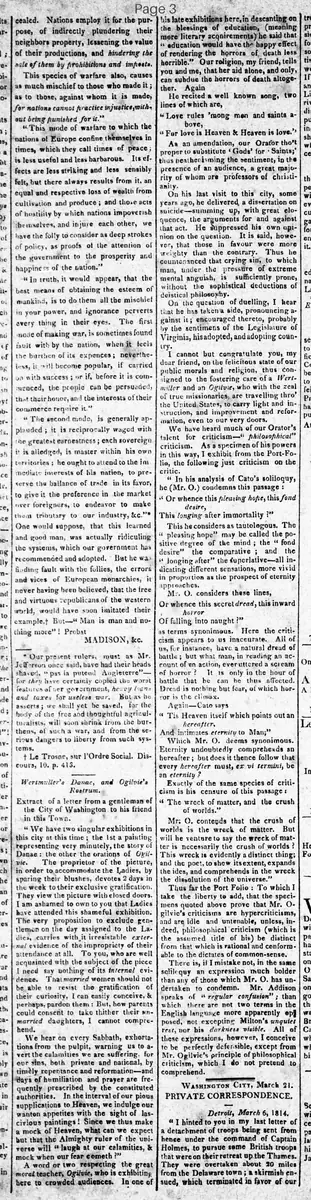
Wertmuller's Danae, and Ogilvie's Orations.
Extract of a letter from a gentleman of the City of Washington to his friend in this Town.
"We have two singular exhibitions in this city at this time; the 1st a painting representing very minutely, the story of Danae: the other the orations of Ogilvie. The proprietor of the picture, in order to accommodate the Ladies, by sparing their blushes, devotes 2 days in the week to their exclusive gratification. They view the picture with closed doors. I am ashamed to own to you that Ladies have attended this shameful exhibition. The very proposition to exclude gentlemen on the day assigned to the Ladies, carries with it irresistible external evidence of the impropriety of their attendance at all. To you, who are well acquainted with the subject of the piece I need say nothing of its internal evidence. That married women should not be able to resist the gratification of their curiosity, I can easily conceive, & perhaps pardon them: But, how parents could consent to take thither their unmarried daughters, I cannot comprehend.
We hear on every Sabbath, exhortations from the pulpit, warning us to avert the calamities we are suffering for our sins, both private and national, by timely repentance and reformation—and days of humiliation and prayer are frequently prescribed by the constituted authorities. In the interval of our pious supplications to Heaven, we indulge our wanton appetites with the sight of lascivious paintings! Since we thus make a mock of Heaven, what can we expect but that the Almighty ruler of the universe will "laugh at our calamities, & mock when our fear cometh?"
A word or two respecting the great moral teacher, Ogilvie, who is exhibiting here to crowded audiences. In one of his late exhibitions here, in descanting on the blessings of education, (meaning more literary acquirements) he said that "education would have the happy effect of rendering the horrors of death less horrible." Our religion, my friend, tells you and me, that her aid alone, and only, can subdue the horrors of death altogether.
Again he recited a well known song, two lines of which are, "Love rules 'mong men and saints above, "For love is Heaven & Heaven is love.'" As an amendation, our Orator thought proper to substitute 'Gods' for 'Saints;' thus heathenizing the sentiment, in the presence of an audience, a great majority of whom are professors of christianity.
On his last visit to this city, some years ago, he delivered a dissertation on suicide—summing up, with great eloquence, the arguments for and against that act. He suppressed his own opinion on the question. It is said, however, that those in favour were more weighty than the contrary. Thus he countenanced that crying sin, to which man, under the pressure of extreme mental anguish, is sufficiently prone, without the sophistical deductions of deistical philosophy.
On the question of duelling, I hear that he has taken a side, pronouncing against it; encouraged thereto, probably by the sentiments of the Legislature of Virginia, his adopted, and adopting country.
I cannot but congratulate you, my dear friend, on the felicitous state of our public morals and religion, thus consigned to the fostering Care of a Wertmuller and an Ogilvie, who with the zeal of true missionaries, are travelling thro' the United States, to carry light and instruction, and improvement and reformation, even to our very doors.
We have heard much of our Orator's talent for criticism—"philosophical" criticism. As a specimen of his powers in this way, I exhibit from the Port-Folio, the following just criticism on the critic.
"In his analysis of Cato's soliloquy, he (Mr. O.) condemns this passage :
"Or whence this pleasing hope, this fond desire,
This longing after immortality?"
This he considers as tautological. The "pleasing hope" may be called the positive degree of the mind; the "fond desire" the comparative; and the "longing after" the superlative—all indicating different sensations, more vivid in proportion as the prospect of eternity approaches.
Mr. O. considers these lines,
"Or whence this secret dread, this inward horror
Of falling into naught?"
as terms synonymous. Here the criticism appears to us inaccurate. All of us, for instance, have a natural dread of battle; but what man, in reading an account of an action, ever uttered a scream of horror? It is only in the hour of battle that he can be thus affected. Dread is nothing but fear, of which horror is the climax.
Again—Cato says
"'Tis Heaven itself which points out an hereafter,
And intimates eternity to Man:"
Which Mr. O. deems synonymous. Eternity undoubtedly comprehends an hereafter; but does it thence follow that every hereafter must, ex vi termini, be an eternity?
Exactly of the same species of criticism is his censure of this passage:
"The wreck of matter, and the crush of worlds."
Mr. O. contends that the crush of worlds is the wreck of matter. But will he venture to say the wreck of matter is necessarily the crush of worlds? This wreck is evidently a distinct thing and the poet, to show its extent, expands the idea, and comprehends in the wreck the dissolution of the universe."
Thus far the Port Folio: To which I take the liberty to add, that the specimens quoted above prove that Mr. Ogilvie's criticisms are hypercriticisms, and are idle and untenable, unless, indeed, 'philosophical' criticism (which is the assumed title of his) be distinct from that which is rational and conformable to the dictates of common-sense.
There is, if I mistake not, in the same soliloquy an expression much bolder than any of those which Mr. O. has undertaken to condemn. Mr. Addison speaks of "regular confusion"; than which there are not two terms in the English language more apparently opposed, not excepting Milton's "unquiet rest," nor his "darkness visible." All of these expressions, however, I conceive to be perfectly defensible, except from Mr. Ogilvie's principle of philosophical criticism, which I do not pretend to comprehend."
Extract of a letter from a gentleman of the City of Washington to his friend in this Town.
"We have two singular exhibitions in this city at this time; the 1st a painting representing very minutely, the story of Danae: the other the orations of Ogilvie. The proprietor of the picture, in order to accommodate the Ladies, by sparing their blushes, devotes 2 days in the week to their exclusive gratification. They view the picture with closed doors. I am ashamed to own to you that Ladies have attended this shameful exhibition. The very proposition to exclude gentlemen on the day assigned to the Ladies, carries with it irresistible external evidence of the impropriety of their attendance at all. To you, who are well acquainted with the subject of the piece I need say nothing of its internal evidence. That married women should not be able to resist the gratification of their curiosity, I can easily conceive, & perhaps pardon them: But, how parents could consent to take thither their unmarried daughters, I cannot comprehend.
We hear on every Sabbath, exhortations from the pulpit, warning us to avert the calamities we are suffering for our sins, both private and national, by timely repentance and reformation—and days of humiliation and prayer are frequently prescribed by the constituted authorities. In the interval of our pious supplications to Heaven, we indulge our wanton appetites with the sight of lascivious paintings! Since we thus make a mock of Heaven, what can we expect but that the Almighty ruler of the universe will "laugh at our calamities, & mock when our fear cometh?"
A word or two respecting the great moral teacher, Ogilvie, who is exhibiting here to crowded audiences. In one of his late exhibitions here, in descanting on the blessings of education, (meaning more literary acquirements) he said that "education would have the happy effect of rendering the horrors of death less horrible." Our religion, my friend, tells you and me, that her aid alone, and only, can subdue the horrors of death altogether.
Again he recited a well known song, two lines of which are, "Love rules 'mong men and saints above, "For love is Heaven & Heaven is love.'" As an amendation, our Orator thought proper to substitute 'Gods' for 'Saints;' thus heathenizing the sentiment, in the presence of an audience, a great majority of whom are professors of christianity.
On his last visit to this city, some years ago, he delivered a dissertation on suicide—summing up, with great eloquence, the arguments for and against that act. He suppressed his own opinion on the question. It is said, however, that those in favour were more weighty than the contrary. Thus he countenanced that crying sin, to which man, under the pressure of extreme mental anguish, is sufficiently prone, without the sophistical deductions of deistical philosophy.
On the question of duelling, I hear that he has taken a side, pronouncing against it; encouraged thereto, probably by the sentiments of the Legislature of Virginia, his adopted, and adopting country.
I cannot but congratulate you, my dear friend, on the felicitous state of our public morals and religion, thus consigned to the fostering Care of a Wertmuller and an Ogilvie, who with the zeal of true missionaries, are travelling thro' the United States, to carry light and instruction, and improvement and reformation, even to our very doors.
We have heard much of our Orator's talent for criticism—"philosophical" criticism. As a specimen of his powers in this way, I exhibit from the Port-Folio, the following just criticism on the critic.
"In his analysis of Cato's soliloquy, he (Mr. O.) condemns this passage :
"Or whence this pleasing hope, this fond desire,
This longing after immortality?"
This he considers as tautological. The "pleasing hope" may be called the positive degree of the mind; the "fond desire" the comparative; and the "longing after" the superlative—all indicating different sensations, more vivid in proportion as the prospect of eternity approaches.
Mr. O. considers these lines,
"Or whence this secret dread, this inward horror
Of falling into naught?"
as terms synonymous. Here the criticism appears to us inaccurate. All of us, for instance, have a natural dread of battle; but what man, in reading an account of an action, ever uttered a scream of horror? It is only in the hour of battle that he can be thus affected. Dread is nothing but fear, of which horror is the climax.
Again—Cato says
"'Tis Heaven itself which points out an hereafter,
And intimates eternity to Man:"
Which Mr. O. deems synonymous. Eternity undoubtedly comprehends an hereafter; but does it thence follow that every hereafter must, ex vi termini, be an eternity?
Exactly of the same species of criticism is his censure of this passage:
"The wreck of matter, and the crush of worlds."
Mr. O. contends that the crush of worlds is the wreck of matter. But will he venture to say the wreck of matter is necessarily the crush of worlds? This wreck is evidently a distinct thing and the poet, to show its extent, expands the idea, and comprehends in the wreck the dissolution of the universe."
Thus far the Port Folio: To which I take the liberty to add, that the specimens quoted above prove that Mr. Ogilvie's criticisms are hypercriticisms, and are idle and untenable, unless, indeed, 'philosophical' criticism (which is the assumed title of his) be distinct from that which is rational and conformable to the dictates of common-sense.
There is, if I mistake not, in the same soliloquy an expression much bolder than any of those which Mr. O. has undertaken to condemn. Mr. Addison speaks of "regular confusion"; than which there are not two terms in the English language more apparently opposed, not excepting Milton's "unquiet rest," nor his "darkness visible." All of these expressions, however, I conceive to be perfectly defensible, except from Mr. Ogilvie's principle of philosophical criticism, which I do not pretend to comprehend."
What sub-type of article is it?
Ethical Moral
Religious
Social Critique
What themes does it cover?
Morality
Religion
Social Issues
What keywords are associated?
Danae Painting
Ogilvie Orations
Public Morals
Lascivious Art
Religious Hypocrisy
Suicide Debate
Dueling Opposition
Literary Criticism
What entities or persons were involved?
A Gentleman Of The City Of Washington
His Friend In This Town
Letter to Editor Details
Author
A Gentleman Of The City Of Washington
Recipient
His Friend In This Town
Main Argument
the public exhibitions of wertmuller's lascivious danae painting and ogilvie's morally flawed orations exemplify hypocrisy and moral decay, contradicting religious calls for repentance and exposing flaws in ogilvie's teachings and criticisms.
Notable Details
Critique Of Women's Attendance At Danae Painting
Reference To Proverbs On Divine Mockery
Ogilvie's Views On Education And Death
Substitution Of 'Gods' For 'Saints' In Song
Discussion Of Suicide And Dueling
Excerpt From Port Folio Criticizing Ogilvie's Analysis Of Cato's Soliloquy
Mention Of 'Regular Confusion' In Addison