Thank you for visiting SNEWPapers!
Sign up free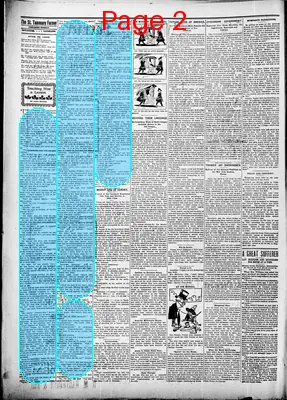
Literary
February 18, 1905
St. Tammany Farmer
Covington, Saint Tammany County, Louisiana
What is this article about?
In this humorous short story, Eva ends her engagement to the frivolous Bertie Pilkinghame, but at a dance, after he feigns interest in another woman and gets rejected, she reconsiders and they reconcile, resuming their relationship.
Clipping
OCR Quality
98%
Excellent
Full Text
"Then, I suppose, our engagement is to be at an end?" said Bertie.
"Certainly," Eva replied, coldly. "It seems a pity," he said; "it was pleasant enough while it lasted."
"I have been thinking over it for some time," she went on, "and I have come to the conclusion that I could never marry one who was so—so heartlessly frivolous. So I have decided that we had better part. I think you must agree with me."
"O, quite, quite!" he said, walking to the window. "If you say so, of course. I'm helpless. A fellow can't be engaged all by himself. What is the other man's name?"
"What other man?" she asked quickly.
"The sympathetic man with the jolly outlook."
She flushed and said with warmth, "There is no other man!"
"No?" he said, surprised. "I could understand and forgive your throwing me over for somebody else—that's natural; but to say, Go away and break your heart; I don't like your outlook, well—it's a little—er—unusual, isn't it?"
"It is best for both of us," she said. She was finding it very difficult.
"O, quite, quite!" he replied. "I'm not saying you're wrong. You will burn all of my letters, of course? I shouldn't like them to be lying about and get into the newspapers."
"Yes," she said.
"Or, if you want to publish them in book form, wait until you hear of my death. I don't suppose it will be delayed much longer now."
"Yes," she replied faintly. There was a pause. "Well," he said, "I suppose I'd better say goodby."
"Goodby," she said.
"We can still be friends, of course and all that?"
"Of course!"
"All right; and I'll come to you whenever I'm in trouble or anything."
He had got one glove on and was blowing into the other and making it stand out straight. "By the way," he said, "I suppose we keep this a secret?"
"I must tell mother."
"Of course; but we needn't let the world know until we've got more used to it."
"No," she said. He was at the door, but stopped again. "See you at the Farboroughs dance to-night?" he asked. "I may be there," she said. "Right!" he replied, and passed out of the room and her life.
She doubted whether she ought to go to Farboroughs, but she had promised to be there, and did not like to disappoint the duchess. She would go for a short time. She went. He was already there. He was taking one of the Noreham girls towards the ballroom, and he bowed and smiled cheerfully to her as he passed. She particularly disliked the Noreham girls. It felt strange not to have him at her side at once, securing all the dunces he could. She was not quite sure whether she liked the new sensation or not.
About half an hour after her arrival he happened to be standing near her, uttering pleasant nonsense to Lady Enid, the daughter of the house. He seemed to be enjoying himself. A man walked off with Lady Enid, and Bertie looked around the room. His eye fell upon Eva, and he came up, smiling. "Ah, my dear Miss Rowen, how do you do? Great crowd. Just come?"
"No," she said; "I've been here some time."
"No—really? Curious that I haven't seen you; but there are so many people, aren't there? May I have a dance?"
They danced the waltz that was just beginning. He soon found out that she had been to the academy and was a great admirer of Wagner. So was he—clever beggar, he thought him. Wondered how the fellow ever remembered what the violins were doing while he was jotting down airs for the drum; though some of the things they did in "The Toreador" were nearly as tricky. Had she read many novels lately? Jolly waltz they were playing! "Blue Danube," wasn't it! Yes. Found the fellow! Hope she wasn't hurt. No, he hadn't got a pin. Why not simply tear it all off? So sorry! Sit out the rest? Certainly. So they retired to a quiet corner of the conservatory.
There he laboriously began the same kind of a conversation, and she, having up till now answered chiefly in monosyllables, said, "Don't be foolish, Mr. Pilkinghame!"
"I'm sorry, Miss Bowen," he said, "but the fact is, I'm not quite sure at what degree of acquaintance we have arrived."
"I don't think you can expect me to define it," she said.
"Well," said Bertie, reproachfully, "you arranged this picnic; you should know more about it than I do."
"I don't think we need be quite so distant; it sounds rather idiotic."
"Very well," said Bertie, huffed; "was quite up to the level of my usual conversation in first introductions, though."
"Oh, I didn't mean that!" she said, hastily. "I mean, as we've known each other so many years—"
"I see. Well, I'm glad you put it in that way, because I have something rather—rather delicate to ask you, something I couldn't ask a complete stranger."
"What is it?" she said. In a low voice, not quite knowing whether she hoped or feared. He hesitated.
"The fact is, I should rather like you to return me the ring I once gave you—er—you may perhaps remember."
"Oh, certainly!" she said. She had forgotten all about it; it was still on her finger. She handed it to him. "I am sorry; of course, I meant to return it to you this afternoon. How foolish of me!"
She would have liked at least one more attack upon her sense of duty. Not that she would have yielded, of course.
"No," said Bertie. "It was rather strange of me to ask for it. But the fact is, I want it just now for a special reason."
He held it between his thumb and forefinger and looked at it tenderly. She saw that the attack was coming, and rejoiced.
"What reason?" she said, almost in a whisper.
"Well," he said, "as we are on such friendly terms, I don't mind confiding it to you. You see that tall girl in blue over there, under that scrubby green stuff?"
"Maude Noreham!" said Eva, startled.
"Yes. Fact is, I've got the next dance with her, and it struck me that she's such a ripping girl that I've decided to ask her to marry me, and on occasions like this it is always useful, I find, to have the ring ready, you know."
"O!" said Eva. She could think of nothing more to say. "As you are a sort of a sister, you know," he went on dreamily. "I don't mind telling you how passionately I love her. It is so nice to have somebody to confide in, in a case like this—somebody sympathetic. You know Maude?"
"Yes," said Eva, in a choking voice.
"Isn't she a dear girl? Isn't she perfect? Did you ever see such hair, such eyes, such an outlook? And her disposition is so sweet!"
"I think you've—you've made a very good choice."
Eva was making a heroic effort to see things in the common-sense light; to a sister all this should be interesting, nothing more.
"I'm glad you are pleased," he said. "I value your opinion more highly than that of any other friend I've got. So you advise me to do it?"
"O, yes!" she said, with hollow cheerfulness.
"Thank you, thank you so much!" he said, shaking her hand earnestly and looking into her eyes. "Isn't that the next dance beginning?"
Eva had a headache. She determined to go home, and looked around for her mother, but was claimed for the next dance by an elderly gentleman who would take no refusal. And she was fortunate to have got rid of a man who could see anything in that horsey Noreham creature.
Her next partner, a cheerful young man, said, "Have you heard the news about Maude Noreham?"
Her heart sank, in spite of all her determination. "About—about her engagement?" she asked, faintly.
"Yes," said her partner. "Lucky beggar, isn't he?"
She didn't know what reply she made, nor what they talked about for the rest of that dance. She only knew that, in order to do this so suddenly, Bertie and that—that person must have had an understanding for months before...must have simply been waiting for the opportunity...must have—oh, the villainous treachery of it all!
"Mother, I really think we had better go now," she began, when her eye fell on a familiar figure. Bertie was standing at the table. Though munching a sandwich, he looked the picture of hopeless misery.
"Nonsense, nonsense!" said the duke; "I couldn't allow such a thing; the next is my dance with Mrs. Rowen." And they went away and left her helpless and alone.
Bertie came slowly toward her, mournfully rubbing crumbs off his gloves. His step was heavy; it seemed as if the light had gone out of his life.
"I think the next is our dance, Miss Rowen," he said, offering his arm.
What was she to do? She took it and they walked toward the ballroom in silence.
"Do you want to dance this?" he asked, in hollow tones.
"I do not feel," said Bertie, "as if I should ever want to dance again."
He took her to the conservatory and they sat down in the same corner as before. He groaned and put his head on his hands. She waited, with some surprise. "Oh for a little sympathy!" he moaned.
"I should have thought you expected congratulations."
She spoke with a touch of bitterness.
"Congratulations!" he exclaimed, savagely. "Congratulations! Listen! I can come to you in my trouble, can I not?"
She said nothing.
"Did I tell you how I loved Maude?"
"Yes," she said.
"Yes," he went on. "I thought I had mentioned it to somebody. Well—"
He paused. She waited.
"Well," he said, raising his head wearily, "I asked her if she would marry me."
He paused again. "Was there anything unreasonable in that?" he exclaimed, fiercely.
"What—what did she say?" faltered Eva.
"Say!" he replied; and then went on, in a monotonous wail of anguish: "She said, 'No, dear boy, but I'm suited. Didn't I tell you before?' Just as if I were an errand boy applying for a situation!"
"I believe you're pleased," he said, reproachfully.
"That's the way with sisters—they always object to people their brothers choose."
"You can choose anybody you like," she said.
He took his programme from his pocket, and said reflectively, "I don't think I'll make another shot to-night, though! Let's see who I've got." He ran his eye down the list and ticked off two or three names. "What do you say to Miss Vanning? But I don't think I know her quite well enough to suggest it. There's Enid Stafford, of course. I think I love her very much. Isn't she a charming girl?"
"Yes," said Eva.
"Do you happen to know," he said, anxiously, "whether she has a nice outlook?"
Eva did not reply; she was still fanning herself.
"It's worse than choosing a motor-car," he sighed. "Why can't one hire an expert to choose a wife? And yet I must, I must."
"Why in such a hurry?" asked Eva. "I should take a day or two to look round."
"But it's so uncomfortable to feel oneself hanging about loose and liable to be snapped up at any moment. Other men, when they meet some sudden and terrible disaster, fly to drink. Drink is so vulgar; I fly to matrimony."
"And have you had a disaster?" she asked, with sisterly interest, still fanning herself.
"Disaster!" he said dolefully. "Listen! For three months I had been engaged to the perfectest, beautifulest, sweetest darling in the whole world—er—you don't mind my confiding to you my personal affairs like this?"
"Did she die?" asked Eva, with sympathy. "Please don't brush my nose with the feathers?"
No, she didn't exactly die. She drew herself erect, with a flashing eye, looking magnificent—pardon an unhappy man's reminiscences, won't you?—and she said, 'Go! Out into blank, dismal, dreary darkness.' Now, why? Because I was a murderer? Not a bit of it. Because I was unkind to my aged parents? No. Because I was already married? Not even that. You won't believe it, but it was simply and solely because there was something gone groggy in my outlook."
"I think I hear the next dance beginning," said Eva, rising.
"Yes? By the way, just put this ring on, will you? I shall lose it if I keep it in my pocket."
So she put it on.
"This is our dance?" said Bertie.
"I think so," she replied.
"And all the rest?"
"If you like."
"Including extras?"
"Including the extras. And I hope," she added, "that I've taught you a lesson, dear."
"You've taught me a lesson?" he said, puzzled. And then, repentantly, "Ah. O! Yes. Of course! I am very sorry—I will never do it again."
-London Sketch.
"Certainly," Eva replied, coldly. "It seems a pity," he said; "it was pleasant enough while it lasted."
"I have been thinking over it for some time," she went on, "and I have come to the conclusion that I could never marry one who was so—so heartlessly frivolous. So I have decided that we had better part. I think you must agree with me."
"O, quite, quite!" he said, walking to the window. "If you say so, of course. I'm helpless. A fellow can't be engaged all by himself. What is the other man's name?"
"What other man?" she asked quickly.
"The sympathetic man with the jolly outlook."
She flushed and said with warmth, "There is no other man!"
"No?" he said, surprised. "I could understand and forgive your throwing me over for somebody else—that's natural; but to say, Go away and break your heart; I don't like your outlook, well—it's a little—er—unusual, isn't it?"
"It is best for both of us," she said. She was finding it very difficult.
"O, quite, quite!" he replied. "I'm not saying you're wrong. You will burn all of my letters, of course? I shouldn't like them to be lying about and get into the newspapers."
"Yes," she said.
"Or, if you want to publish them in book form, wait until you hear of my death. I don't suppose it will be delayed much longer now."
"Yes," she replied faintly. There was a pause. "Well," he said, "I suppose I'd better say goodby."
"Goodby," she said.
"We can still be friends, of course and all that?"
"Of course!"
"All right; and I'll come to you whenever I'm in trouble or anything."
He had got one glove on and was blowing into the other and making it stand out straight. "By the way," he said, "I suppose we keep this a secret?"
"I must tell mother."
"Of course; but we needn't let the world know until we've got more used to it."
"No," she said. He was at the door, but stopped again. "See you at the Farboroughs dance to-night?" he asked. "I may be there," she said. "Right!" he replied, and passed out of the room and her life.
She doubted whether she ought to go to Farboroughs, but she had promised to be there, and did not like to disappoint the duchess. She would go for a short time. She went. He was already there. He was taking one of the Noreham girls towards the ballroom, and he bowed and smiled cheerfully to her as he passed. She particularly disliked the Noreham girls. It felt strange not to have him at her side at once, securing all the dunces he could. She was not quite sure whether she liked the new sensation or not.
About half an hour after her arrival he happened to be standing near her, uttering pleasant nonsense to Lady Enid, the daughter of the house. He seemed to be enjoying himself. A man walked off with Lady Enid, and Bertie looked around the room. His eye fell upon Eva, and he came up, smiling. "Ah, my dear Miss Rowen, how do you do? Great crowd. Just come?"
"No," she said; "I've been here some time."
"No—really? Curious that I haven't seen you; but there are so many people, aren't there? May I have a dance?"
They danced the waltz that was just beginning. He soon found out that she had been to the academy and was a great admirer of Wagner. So was he—clever beggar, he thought him. Wondered how the fellow ever remembered what the violins were doing while he was jotting down airs for the drum; though some of the things they did in "The Toreador" were nearly as tricky. Had she read many novels lately? Jolly waltz they were playing! "Blue Danube," wasn't it! Yes. Found the fellow! Hope she wasn't hurt. No, he hadn't got a pin. Why not simply tear it all off? So sorry! Sit out the rest? Certainly. So they retired to a quiet corner of the conservatory.
There he laboriously began the same kind of a conversation, and she, having up till now answered chiefly in monosyllables, said, "Don't be foolish, Mr. Pilkinghame!"
"I'm sorry, Miss Bowen," he said, "but the fact is, I'm not quite sure at what degree of acquaintance we have arrived."
"I don't think you can expect me to define it," she said.
"Well," said Bertie, reproachfully, "you arranged this picnic; you should know more about it than I do."
"I don't think we need be quite so distant; it sounds rather idiotic."
"Very well," said Bertie, huffed; "was quite up to the level of my usual conversation in first introductions, though."
"Oh, I didn't mean that!" she said, hastily. "I mean, as we've known each other so many years—"
"I see. Well, I'm glad you put it in that way, because I have something rather—rather delicate to ask you, something I couldn't ask a complete stranger."
"What is it?" she said. In a low voice, not quite knowing whether she hoped or feared. He hesitated.
"The fact is, I should rather like you to return me the ring I once gave you—er—you may perhaps remember."
"Oh, certainly!" she said. She had forgotten all about it; it was still on her finger. She handed it to him. "I am sorry; of course, I meant to return it to you this afternoon. How foolish of me!"
She would have liked at least one more attack upon her sense of duty. Not that she would have yielded, of course.
"No," said Bertie. "It was rather strange of me to ask for it. But the fact is, I want it just now for a special reason."
He held it between his thumb and forefinger and looked at it tenderly. She saw that the attack was coming, and rejoiced.
"What reason?" she said, almost in a whisper.
"Well," he said, "as we are on such friendly terms, I don't mind confiding it to you. You see that tall girl in blue over there, under that scrubby green stuff?"
"Maude Noreham!" said Eva, startled.
"Yes. Fact is, I've got the next dance with her, and it struck me that she's such a ripping girl that I've decided to ask her to marry me, and on occasions like this it is always useful, I find, to have the ring ready, you know."
"O!" said Eva. She could think of nothing more to say. "As you are a sort of a sister, you know," he went on dreamily. "I don't mind telling you how passionately I love her. It is so nice to have somebody to confide in, in a case like this—somebody sympathetic. You know Maude?"
"Yes," said Eva, in a choking voice.
"Isn't she a dear girl? Isn't she perfect? Did you ever see such hair, such eyes, such an outlook? And her disposition is so sweet!"
"I think you've—you've made a very good choice."
Eva was making a heroic effort to see things in the common-sense light; to a sister all this should be interesting, nothing more.
"I'm glad you are pleased," he said. "I value your opinion more highly than that of any other friend I've got. So you advise me to do it?"
"O, yes!" she said, with hollow cheerfulness.
"Thank you, thank you so much!" he said, shaking her hand earnestly and looking into her eyes. "Isn't that the next dance beginning?"
Eva had a headache. She determined to go home, and looked around for her mother, but was claimed for the next dance by an elderly gentleman who would take no refusal. And she was fortunate to have got rid of a man who could see anything in that horsey Noreham creature.
Her next partner, a cheerful young man, said, "Have you heard the news about Maude Noreham?"
Her heart sank, in spite of all her determination. "About—about her engagement?" she asked, faintly.
"Yes," said her partner. "Lucky beggar, isn't he?"
She didn't know what reply she made, nor what they talked about for the rest of that dance. She only knew that, in order to do this so suddenly, Bertie and that—that person must have had an understanding for months before...must have simply been waiting for the opportunity...must have—oh, the villainous treachery of it all!
"Mother, I really think we had better go now," she began, when her eye fell on a familiar figure. Bertie was standing at the table. Though munching a sandwich, he looked the picture of hopeless misery.
"Nonsense, nonsense!" said the duke; "I couldn't allow such a thing; the next is my dance with Mrs. Rowen." And they went away and left her helpless and alone.
Bertie came slowly toward her, mournfully rubbing crumbs off his gloves. His step was heavy; it seemed as if the light had gone out of his life.
"I think the next is our dance, Miss Rowen," he said, offering his arm.
What was she to do? She took it and they walked toward the ballroom in silence.
"Do you want to dance this?" he asked, in hollow tones.
"I do not feel," said Bertie, "as if I should ever want to dance again."
He took her to the conservatory and they sat down in the same corner as before. He groaned and put his head on his hands. She waited, with some surprise. "Oh for a little sympathy!" he moaned.
"I should have thought you expected congratulations."
She spoke with a touch of bitterness.
"Congratulations!" he exclaimed, savagely. "Congratulations! Listen! I can come to you in my trouble, can I not?"
She said nothing.
"Did I tell you how I loved Maude?"
"Yes," she said.
"Yes," he went on. "I thought I had mentioned it to somebody. Well—"
He paused. She waited.
"Well," he said, raising his head wearily, "I asked her if she would marry me."
He paused again. "Was there anything unreasonable in that?" he exclaimed, fiercely.
"What—what did she say?" faltered Eva.
"Say!" he replied; and then went on, in a monotonous wail of anguish: "She said, 'No, dear boy, but I'm suited. Didn't I tell you before?' Just as if I were an errand boy applying for a situation!"
"I believe you're pleased," he said, reproachfully.
"That's the way with sisters—they always object to people their brothers choose."
"You can choose anybody you like," she said.
He took his programme from his pocket, and said reflectively, "I don't think I'll make another shot to-night, though! Let's see who I've got." He ran his eye down the list and ticked off two or three names. "What do you say to Miss Vanning? But I don't think I know her quite well enough to suggest it. There's Enid Stafford, of course. I think I love her very much. Isn't she a charming girl?"
"Yes," said Eva.
"Do you happen to know," he said, anxiously, "whether she has a nice outlook?"
Eva did not reply; she was still fanning herself.
"It's worse than choosing a motor-car," he sighed. "Why can't one hire an expert to choose a wife? And yet I must, I must."
"Why in such a hurry?" asked Eva. "I should take a day or two to look round."
"But it's so uncomfortable to feel oneself hanging about loose and liable to be snapped up at any moment. Other men, when they meet some sudden and terrible disaster, fly to drink. Drink is so vulgar; I fly to matrimony."
"And have you had a disaster?" she asked, with sisterly interest, still fanning herself.
"Disaster!" he said dolefully. "Listen! For three months I had been engaged to the perfectest, beautifulest, sweetest darling in the whole world—er—you don't mind my confiding to you my personal affairs like this?"
"Did she die?" asked Eva, with sympathy. "Please don't brush my nose with the feathers?"
No, she didn't exactly die. She drew herself erect, with a flashing eye, looking magnificent—pardon an unhappy man's reminiscences, won't you?—and she said, 'Go! Out into blank, dismal, dreary darkness.' Now, why? Because I was a murderer? Not a bit of it. Because I was unkind to my aged parents? No. Because I was already married? Not even that. You won't believe it, but it was simply and solely because there was something gone groggy in my outlook."
"I think I hear the next dance beginning," said Eva, rising.
"Yes? By the way, just put this ring on, will you? I shall lose it if I keep it in my pocket."
So she put it on.
"This is our dance?" said Bertie.
"I think so," she replied.
"And all the rest?"
"If you like."
"Including extras?"
"Including the extras. And I hope," she added, "that I've taught you a lesson, dear."
"You've taught me a lesson?" he said, puzzled. And then, repentantly, "Ah. O! Yes. Of course! I am very sorry—I will never do it again."
-London Sketch.
What sub-type of article is it?
Prose Fiction
Dialogue
Satire
What themes does it cover?
Love Romance
Social Manners
What keywords are associated?
Engagement
Breakup
Reconciliation
Dance
Frivolity
Satirical Romance
Social Satire
What entities or persons were involved?
London Sketch.
Literary Details
Author
London Sketch.
Key Lines
"The Sympathetic Man With The Jolly Outlook."
"I Could Understand And Forgive Your Throwing Me Over For Somebody Else—That's Natural; But To Say, Go Away And Break Your Heart; I Don't Like Your Outlook, Well—It's A Little—Er—Unusual, Isn't It?"
"Fact Is, I've Got The Next Dance With Her, And It Struck Me That She's Such A Ripping Girl That I've Decided To Ask Her To Marry Me, And On Occasions Like This It Is Always Useful, I Find, To Have The Ring Ready, You Know."
"She Said, 'No, Dear Boy, But I'm Suited. Didn't I Tell You Before?' Just As If I Were An Errand Boy Applying For A Situation!"
"And I Hope," She Added, "That I've Taught You A Lesson, Dear."