Thank you for visiting SNEWPapers!
Sign up free
Editorial
May 29, 1952
The Herald
Savannah, Chatham County, Georgia
What is this article about?
Julius J. Adams defends General Dwight D. Eisenhower's decision not to actively campaign for the Republican presidential nomination while still allowing him to state views on national issues. He distinguishes campaigning from expressing opinions, critiques political promises on civil rights, and notes party differences in the South.
Clipping
OCR Quality
98%
Excellent
Full Text
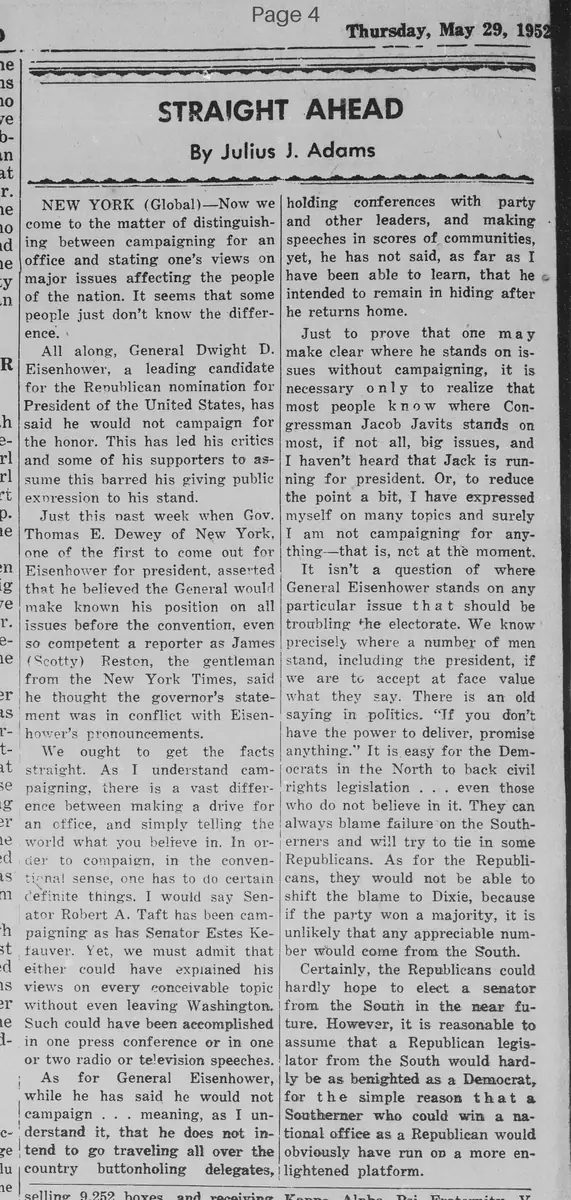
Thursday, May 29, 1952
STRAIGHT AHEAD
By Julius J. Adams
NEW YORK (Global)--Now we come to the matter of distinguishing between campaigning for an office and stating one's views on major issues affecting the people of the nation. It seems that some people just don't know the difference.
All along, General Dwight D. Eisenhower, a leading candidate for the Republican nomination for President of the United States, has said he would not campaign for the honor. This has led his critics and some of his supporters to assume this barred his giving public expression to his stand.
Just this past week when Gov. Thomas E. Dewey of New York, one of the first to come out for Eisenhower for president, asserted that he believed the General would make known his position on all issues before the convention, even so competent a reporter as James (Scotty) Reston, the gentleman from the New York Times, said he thought the governor's statement was in conflict with Eisenhower's pronouncements.
We ought to get the facts straight. As I understand campaigning, there is a vast difference between making a drive for an office, and simply telling the world what you believe in. In order to campaign, in the conventional sense, one has to do certain definite things. I would say Senator Robert A. Taft has been campaigning as has Senator Estes Kefauver. Yet, we must admit that either could have explained his views on every conceivable topic without even leaving Washington. Such could have been accomplished in one press conference or in one or two radio or television speeches.
As for General Eisenhower, while he has said he would not campaign . . . meaning, as I understand it, that he does not intend to go traveling all over the country buttonholing delegates, holding conferences with party and other leaders, and making speeches in scores of communities, yet, he has not said, as far as I have been able to learn, that he intended to remain in hiding after he returns home.
Just to prove that one may make clear where he stands on issues without campaigning, it is necessary only to realize that most people know where Congressman Jacob Javits stands on most, if not all, big issues, and I haven't heard that Jack is running for president. Or, to reduce the point a bit, I have expressed myself on many topics and surely I am not campaigning for anything--that is, not at the moment.
It isn't a question of where General Eisenhower stands on any particular issue that should be troubling the electorate. We know precisely where a number of men stand, including the president, if we are to accept at face value what they say. There is an old saying in politics. "If you don't have the power to deliver, promise anything." It is easy for the Democrats in the North to back civil rights legislation . . . even those who do not believe in it. They can always blame failure on the Southerners and will try to tie in some Republicans. As for the Republicans, they would not be able to shift the blame to Dixie, because if the party won a majority, it is unlikely that any appreciable number would come from the South. Certainly, the Republicans could hardly hope to elect a senator from the South in the near future. However, it is reasonable to assume that a Republican legislator from the South would hardly be as benighted as a Democrat, for the simple reason that a Southerner who could win a national office as a Republican would obviously have run on a more enlightened platform.
STRAIGHT AHEAD
By Julius J. Adams
NEW YORK (Global)--Now we come to the matter of distinguishing between campaigning for an office and stating one's views on major issues affecting the people of the nation. It seems that some people just don't know the difference.
All along, General Dwight D. Eisenhower, a leading candidate for the Republican nomination for President of the United States, has said he would not campaign for the honor. This has led his critics and some of his supporters to assume this barred his giving public expression to his stand.
Just this past week when Gov. Thomas E. Dewey of New York, one of the first to come out for Eisenhower for president, asserted that he believed the General would make known his position on all issues before the convention, even so competent a reporter as James (Scotty) Reston, the gentleman from the New York Times, said he thought the governor's statement was in conflict with Eisenhower's pronouncements.
We ought to get the facts straight. As I understand campaigning, there is a vast difference between making a drive for an office, and simply telling the world what you believe in. In order to campaign, in the conventional sense, one has to do certain definite things. I would say Senator Robert A. Taft has been campaigning as has Senator Estes Kefauver. Yet, we must admit that either could have explained his views on every conceivable topic without even leaving Washington. Such could have been accomplished in one press conference or in one or two radio or television speeches.
As for General Eisenhower, while he has said he would not campaign . . . meaning, as I understand it, that he does not intend to go traveling all over the country buttonholing delegates, holding conferences with party and other leaders, and making speeches in scores of communities, yet, he has not said, as far as I have been able to learn, that he intended to remain in hiding after he returns home.
Just to prove that one may make clear where he stands on issues without campaigning, it is necessary only to realize that most people know where Congressman Jacob Javits stands on most, if not all, big issues, and I haven't heard that Jack is running for president. Or, to reduce the point a bit, I have expressed myself on many topics and surely I am not campaigning for anything--that is, not at the moment.
It isn't a question of where General Eisenhower stands on any particular issue that should be troubling the electorate. We know precisely where a number of men stand, including the president, if we are to accept at face value what they say. There is an old saying in politics. "If you don't have the power to deliver, promise anything." It is easy for the Democrats in the North to back civil rights legislation . . . even those who do not believe in it. They can always blame failure on the Southerners and will try to tie in some Republicans. As for the Republicans, they would not be able to shift the blame to Dixie, because if the party won a majority, it is unlikely that any appreciable number would come from the South. Certainly, the Republicans could hardly hope to elect a senator from the South in the near future. However, it is reasonable to assume that a Republican legislator from the South would hardly be as benighted as a Democrat, for the simple reason that a Southerner who could win a national office as a Republican would obviously have run on a more enlightened platform.
What sub-type of article is it?
Partisan Politics
Social Reform
What keywords are associated?
Eisenhower Candidacy
Political Campaigning
Civil Rights Legislation
Republican Nomination
Party Politics
Southern Democrats
What entities or persons were involved?
Dwight D. Eisenhower
Thomas E. Dewey
James Reston
Robert A. Taft
Estes Kefauver
Jacob Javits
Editorial Details
Primary Topic
Eisenhower's Non Campaigning Approach To Stating Views On Issues
Stance / Tone
Supportive Of Eisenhower, Critical Of Political Maneuvering On Civil Rights
Key Figures
Dwight D. Eisenhower
Thomas E. Dewey
James Reston
Robert A. Taft
Estes Kefauver
Jacob Javits
Key Arguments
Distinction Between Active Campaigning And Expressing Views On Issues
Eisenhower Will State Positions Without Traditional Campaigning
Critics Misunderstand Eisenhower's Stance
Examples Of Non Candidates Expressing Views Like Javits
Politicians Promise Freely Without Power To Deliver
Democrats In North Support Civil Rights But Blame South For Failures
Republicans Less Likely To Win Southern Seats, Leading To More Enlightened Platforms