Thank you for visiting SNEWPapers!
Sign up free
Story
April 20, 1882
The Cheyenne Daily Leader
Cheyenne, Laramie County, Wyoming
What is this article about?
Ethnographic account of California Native Americans' traditional life in 1849, including dress, grooming, child-rearing, navigation, and hunting skills, contrasted with subjection by gold-diggers.
Clipping
OCR Quality
95%
Excellent
Full Text
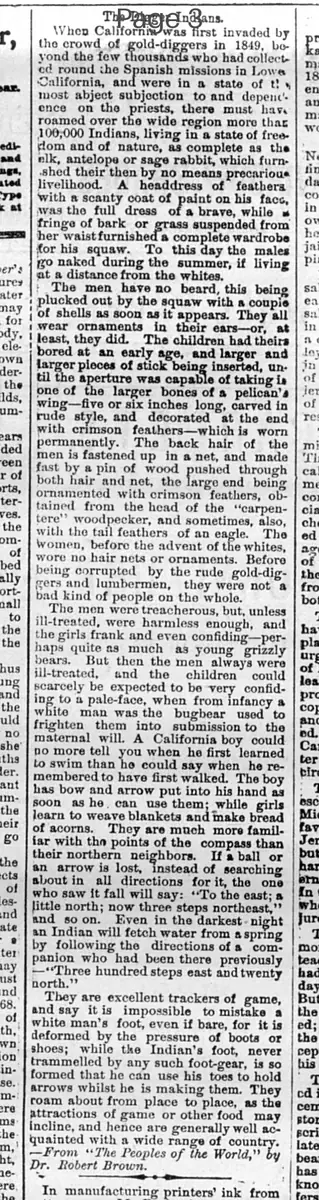
When California was first invaded by the crowd of gold-diggers in 1849, beyond the few thousands who had collected round the Spanish missions in Lower California, and were in a state of the most abject subjection to and dependence on the priests, there must have roamed over the wide region more than 100,000 Indians, living in a state of freedom and of nature, as complete as the elk, antelope or sage rabbit, which furnished their then by no means precarious livelihood.
A headdress of feathers with a scanty coat of paint on his face, was the full dress of a brave, while fringe of bark or grass suspended from her waist furnished a complete wardrobe for his squaw. To this day the males go naked during the summer, if living at a distance from the whites. The men have no beard, this being plucked out by the squaw with a couple of shells as soon as it appears. They all wear ornaments in their ears—or, at least, they did. The children had their ears bored at an early age, and larger and larger pieces of stick being inserted, until the aperture was capable of taking in one of the larger bones of a pelican's wing—five or six inches long, carved in rude style, and decorated at the end with crimson feathers—which is worn permanently. The back hair of the men is fastened up in a net, and made fast by a pin of wood pushed through both hair and net, the large end being ornamented with crimson feathers, obtained from the head of the "carpenter" woodpecker, and sometimes, also, with the tail feathers of an eagle. The women, before the advent of the whites, wore no hair nets or ornaments.
Before being corrupted by the rude gold-diggers and lumbermen, they were not a bad kind of people on the whole. The men were treacherous, but, unless ill-treated, were harmless enough, and the girls frank and even confiding—perhaps quite as much as young grizzly bears. But then the men always were ill-treated, and the children could scarcely be expected to be very confiding to a pale-face, when from infancy a white man was the bugbear used to frighten them into submission to the maternal will.
A California boy could no more tell you when he first learned to swim than he could say when he remembered to have first walked. The boy has bow and arrow put into his hand as soon as he can use them; while girls learn to weave blankets and make bread of acorns. They are much more familiar with the points of the compass than their northern neighbors. If ball or an arrow is lost, instead of searching about in all directions for it, the one who saw it fall will say: "To the east; a little north; now three steps northeast," and so on. Even in the darkest night an Indian will fetch water from a spring by following the directions of a companion who had been there previously—"Three hundred steps east and twenty north."
They are excellent trackers of game, and say it is impossible to mistake a white man's foot, even if bare, for it is deformed by the pressure of boots or shoes; while the Indian's foot, never trammelled by any such foot-gear, is so formed that he can use his toes to hold arrows whilst he is making them. They roam about from place to place, as the attractions of game or other food may incline, and hence are generally well acquainted with a wide range of country.
—From "The Peoples of the World," by Dr. Robert Brown.
A headdress of feathers with a scanty coat of paint on his face, was the full dress of a brave, while fringe of bark or grass suspended from her waist furnished a complete wardrobe for his squaw. To this day the males go naked during the summer, if living at a distance from the whites. The men have no beard, this being plucked out by the squaw with a couple of shells as soon as it appears. They all wear ornaments in their ears—or, at least, they did. The children had their ears bored at an early age, and larger and larger pieces of stick being inserted, until the aperture was capable of taking in one of the larger bones of a pelican's wing—five or six inches long, carved in rude style, and decorated at the end with crimson feathers—which is worn permanently. The back hair of the men is fastened up in a net, and made fast by a pin of wood pushed through both hair and net, the large end being ornamented with crimson feathers, obtained from the head of the "carpenter" woodpecker, and sometimes, also, with the tail feathers of an eagle. The women, before the advent of the whites, wore no hair nets or ornaments.
Before being corrupted by the rude gold-diggers and lumbermen, they were not a bad kind of people on the whole. The men were treacherous, but, unless ill-treated, were harmless enough, and the girls frank and even confiding—perhaps quite as much as young grizzly bears. But then the men always were ill-treated, and the children could scarcely be expected to be very confiding to a pale-face, when from infancy a white man was the bugbear used to frighten them into submission to the maternal will.
A California boy could no more tell you when he first learned to swim than he could say when he remembered to have first walked. The boy has bow and arrow put into his hand as soon as he can use them; while girls learn to weave blankets and make bread of acorns. They are much more familiar with the points of the compass than their northern neighbors. If ball or an arrow is lost, instead of searching about in all directions for it, the one who saw it fall will say: "To the east; a little north; now three steps northeast," and so on. Even in the darkest night an Indian will fetch water from a spring by following the directions of a companion who had been there previously—"Three hundred steps east and twenty north."
They are excellent trackers of game, and say it is impossible to mistake a white man's foot, even if bare, for it is deformed by the pressure of boots or shoes; while the Indian's foot, never trammelled by any such foot-gear, is so formed that he can use his toes to hold arrows whilst he is making them. They roam about from place to place, as the attractions of game or other food may incline, and hence are generally well acquainted with a wide range of country.
—From "The Peoples of the World," by Dr. Robert Brown.
What sub-type of article is it?
Curiosity
Historical Event
What themes does it cover?
Social Manners
Nature
Misfortune
What keywords are associated?
California Indians
Gold Rush Invasion
Native Customs
Indian Dress
Tracking Skills
Where did it happen?
California
Story Details
Location
California
Event Date
1849
Story Details
Description of California Indians' pre-gold rush lifestyle, customs, dress, and interactions with white invaders, noting their natural freedom, tracking skills, and subjugation.