Thank you for visiting SNEWPapers!
Sign up free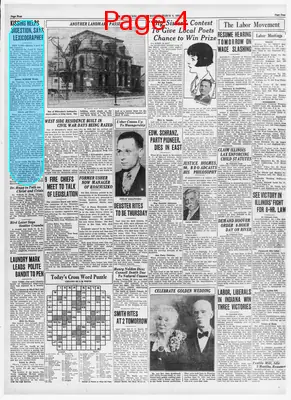
Story
March 9, 1931
The Milwaukee Leader
Milwaukee, Milwaukee County, Wisconsin
What is this article about?
Dr. Frank H. Vizetelly, a dictionary editor, claims kissing promotes digestion via beneficial microbes and shares poetic definitions and historical kissing customs from ancient to feudal times.
Clipping
OCR Quality
98%
Excellent
Full Text
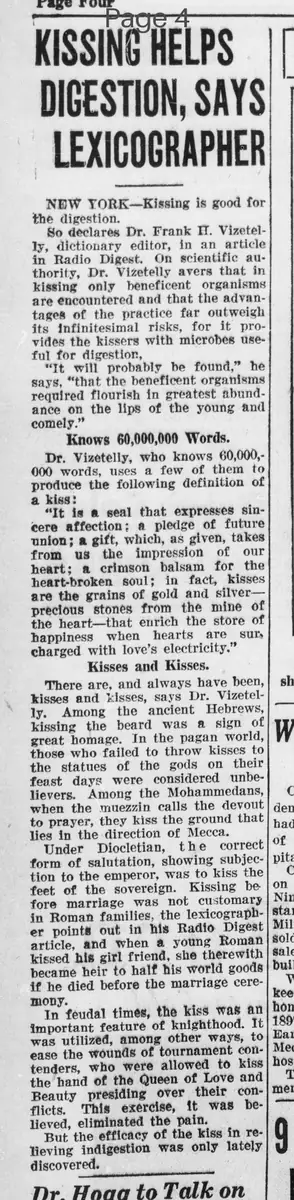
KISSING HELPS DIGESTION, SAYS LEXICOGRAPHER
NEW YORK—Kissing is good for the digestion.
So declares Dr. Frank H. Vizetelly, dictionary editor, in an article in Radio Digest. On scientific authority, Dr. Vizetelly avers that in kissing only beneficent organisms are encountered and that the advantages of the practice far outweigh its infinitesimal risks, for it provides the kissers with microbes useful for digestion.
"It will probably be found," he says, that the beneficent organisms required flourish in greatest abundance on the lips of the young and comely."
Knows 60,000,000 Words.
Dr. Vizetelly, who knows 60,000,000 words, uses a few of them to produce the following definition of a kiss:
"It is a seal that expresses sincere affection; a pledge of future union; a gift, which, as given, takes from us the impression of our heart; a crimson balsam for the heart-broken soul: in fact, kisses are the grains of gold and silver—precious stones from the mine of the heart—that enrich the store of happiness when hearts are surcharged with love's electricity."
Kisses and Kisses.
There are, and always have been, kisses and Kisses, says Dr. Vizetelly. Among the ancient Hebrews, kissing the beard was a sign of great homage. In the pagan world, those who failed to throw kisses to the statues of the gods on their feast days were considered unbelievers. Among the Mohammedans, when the muezzin calls the devout to prayer, they kiss the ground that lies in the direction of Mecca.
Under Diocletian, the correct form of salutation, showing subjection to the emperor, was to kiss the feet of the sovereign. Kissing before marriage was not customary in Roman families, the lexicographer points out in his Radio Digest article, and when a young Roman kissed his girl friend, she therewith became heir to half his world goods if he died before the marriage ceremony.
In feudal times, the kiss was an important feature of knighthood. It was utilized, among other ways, to ease the wounds of tournament contenders, who were allowed to kiss the hand of the Queen of Love and Beauty presiding over their conflicts. This exercise, it was believed, eliminated the pain.
But the efficacy of the kiss in relieving indigestion was only lately discovered.
NEW YORK—Kissing is good for the digestion.
So declares Dr. Frank H. Vizetelly, dictionary editor, in an article in Radio Digest. On scientific authority, Dr. Vizetelly avers that in kissing only beneficent organisms are encountered and that the advantages of the practice far outweigh its infinitesimal risks, for it provides the kissers with microbes useful for digestion.
"It will probably be found," he says, that the beneficent organisms required flourish in greatest abundance on the lips of the young and comely."
Knows 60,000,000 Words.
Dr. Vizetelly, who knows 60,000,000 words, uses a few of them to produce the following definition of a kiss:
"It is a seal that expresses sincere affection; a pledge of future union; a gift, which, as given, takes from us the impression of our heart; a crimson balsam for the heart-broken soul: in fact, kisses are the grains of gold and silver—precious stones from the mine of the heart—that enrich the store of happiness when hearts are surcharged with love's electricity."
Kisses and Kisses.
There are, and always have been, kisses and Kisses, says Dr. Vizetelly. Among the ancient Hebrews, kissing the beard was a sign of great homage. In the pagan world, those who failed to throw kisses to the statues of the gods on their feast days were considered unbelievers. Among the Mohammedans, when the muezzin calls the devout to prayer, they kiss the ground that lies in the direction of Mecca.
Under Diocletian, the correct form of salutation, showing subjection to the emperor, was to kiss the feet of the sovereign. Kissing before marriage was not customary in Roman families, the lexicographer points out in his Radio Digest article, and when a young Roman kissed his girl friend, she therewith became heir to half his world goods if he died before the marriage ceremony.
In feudal times, the kiss was an important feature of knighthood. It was utilized, among other ways, to ease the wounds of tournament contenders, who were allowed to kiss the hand of the Queen of Love and Beauty presiding over their conflicts. This exercise, it was believed, eliminated the pain.
But the efficacy of the kiss in relieving indigestion was only lately discovered.
What sub-type of article is it?
Curiosity
Historical Event
What themes does it cover?
Social Manners
What keywords are associated?
Kissing
Digestion
Historical Customs
Lexicographer
Microbes
What entities or persons were involved?
Dr. Frank H. Vizetelly
Where did it happen?
New York
Story Details
Key Persons
Dr. Frank H. Vizetelly
Location
New York
Story Details
Dr. Frank H. Vizetelly declares kissing aids digestion by transferring beneficial microbes, especially from young and comely lips. He defines kissing poetically and describes historical customs among Hebrews, pagans, Mohammedans, Romans, and in feudal times.