Thank you for visiting SNEWPapers!
Sign up free
The Democratic Pioneer
Upper Sandusky, Wyandot County, Ohio
What is this article about?
In Dusseldorf, poet Ferdinand Freiligrath is acquitted by jury on sedition charges for his revolutionary poem 'Dead to the Living,' marking the first public trial under Prussia's new constitution amid celebrations by crowds and Burgher Guard.
Clipping
OCR Quality
Full Text
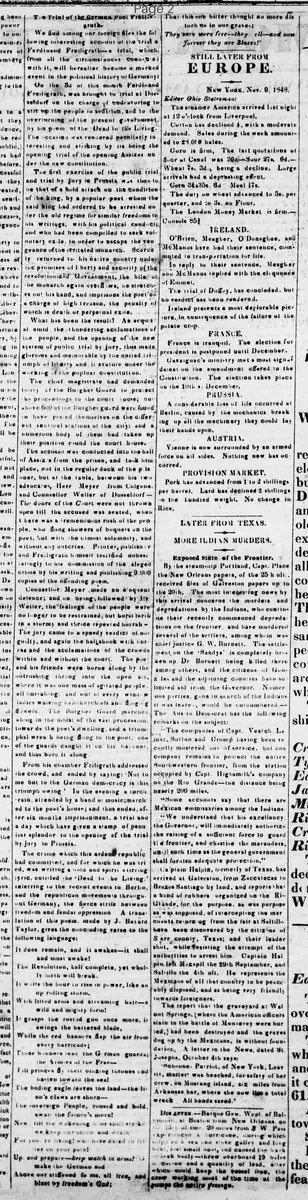
The chief magistrate had demanded thirty of the Burger Guard to protect his proceedings in the court house; but above two hundred of the Burgher Guard were found to have posted themselves on the different sentinel stations of the court; and a numerous body of them had taken up their position round the court house. The accused was conducted into the hall of Assizes from the prison, and took his place, put in the regular dock of the prisoner, but at the table, between his two advocates, Herr Meyer from Cologne, and Counsellor Weller of Dusseldorf. The doors of the Court were not thrown open till the accused was seated, when there was a tremendous rush of the people, who flung showers of bouquets on the poet, but with the utmost solemnity, and without any outcries. Printer, publisher and Freiligrath himself testified unhesitatingly to his commission of the alleged crime by his writing and publishing 9,000 copies of the offending poem. Counsellor Meyer made an eloquent defence; and on being followed by Herr Weller, the feelings of the people were no longer to be restrained, but burst forth in a stormy and thrice repeated hurrah. The jury came to a speedy verdict of not guilty, and again the Burghers with torches and the acclamations of the crowds within and without the court. The poet and his friends were borne along by the outrushing throng into the open air, where it was one mass of agitated people, all hurrahing, and out of every window ladies waving handkerchiefs and flinging flowers. The Burgher Guard marched along in the midst of the vast procession, towards the poet's dwelling, and a triumphal wreath being flung to the poet, one of the guards caught it on his bayonet, and thus bore it along. From his chamber Freiligrath addressed the crowd, and ended by saying: 'Not to me but to the German democracy is this triumph owing!' In the evening a torch fete, attended by a band of music, marched to the poet's house; and thus ended, after six months imprisonment, a trial and a day which have given a stamp of peculiar splendor to the opening of the trial by jury in Prussia.
The crime which this ardent republican had committed, and for which he was tried, was writing a bold and spirit stirring lyric, entitled the 'Dead to the Living,' referring to the recent events in Berlin, and the republican movements throughout Germany, the fierce strife between freedom and feudal oppression. A translation of this poem, made by J. Bazard Taylor, gives the concluding verse in the following language:
It does remain, and it awakes—it shall and must awake!
The Revolution, half complete, yet wholly forth will break.
It waits the hour to rise in power, like an up rolling storm.
With hurtled arm and streaming hair—a wild and mighty form!
It grasps the rusted gun once more, it swings the battered blade,
While the red banners flap the air from every barricade;
Those banners lead the German guards; the Armies of the Free
fill princes fly their blazing touch and hasten toward the sea!
The boding eagle leaves the land—the lion's claws are torn—
The sovereign People, roused and bold, await the future's morn!
Now, till the wakening hour strikes we keep our moan and wrath
For you, ye living! we have dared to falter on your path!
Up, and prepare—keep watch in arms! make the German sod
Above our stiffened forms, all free, and blest by freedom's God;
That this one bitter thought no more disturb us in our grave;
They once were free—they fell—and now forever they are slaves!
What sub-type of article is it?
What keywords are associated?
What entities or persons were involved?
Where did it happen?
Foreign News Details
Primary Location
Dusseldorf, Prussia
Event Date
3d Of This Month
Key Persons
Outcome
acquittal of ferdinand freiligrath
Event Details
Ferdinand Freiligrath was tried at Dusseldorf for sedition due to his poem 'Dead to the Living' inciting overthrow of the government. As the first jury trial under the new Prussian constitution, it highlighted tensions with the king who had previously exiled him. Despite admitting to writing and publishing 9,000 copies, eloquent defenses led to a not guilty verdict amid public celebrations, including hurrahs, flowers, torches, and a procession with the Burgher Guard.