Thank you for visiting SNEWPapers!
Sign up free
Kentucky Gazette
Lexington, Fayette County, Kentucky
What is this article about?
Mr. Finnerty arrives in Lincoln for imprisonment after libel conviction, faces harsh conditions affecting his health; supporters in London hold meeting chaired by Sir F. Burdett to defend press freedom and raise subscription aid.
Merged-components note: These two components are sequential in reading order and cover the same topic: the case and support for Mr. Finnerty, forming a coherent foreign news story.
Clipping
OCR Quality
Full Text
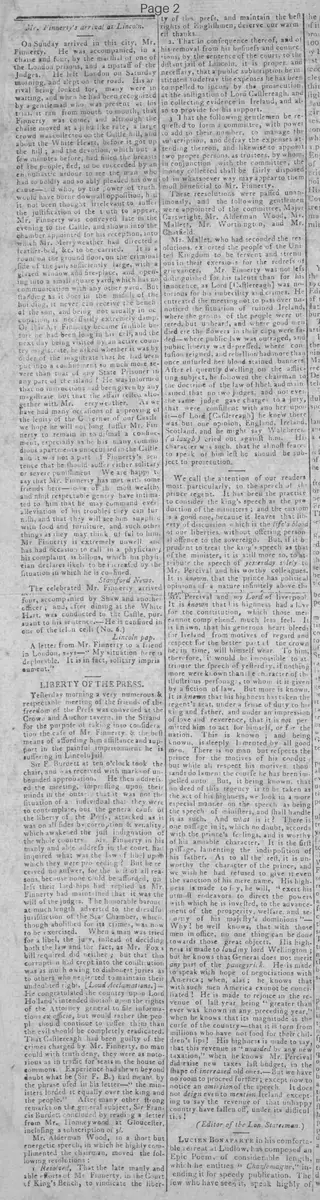
On Sunday arrived in this city, Mr. Finnerty. He was accompanied, in a chaise and four, by the marshal of one of the London prisons, and a tipstaff of the Judges. He left London on Saturday morning, and slept on the road. His arrival being looked for, many were in waiting, and when he had been recognized by a gentleman who was present at his trial, it ran from mouth to mouth, that Finnerty was come, and although the chaise moved at a rapid rate, a large crowd was collected on the Castle hill, and about the White Heart, before it got up the hill: and the devotion, which but a few minutes before, had filled the breasts of the people, fled, to be succeeded by an enthusiastic ardour to see the man who had so boldly and so ably pleaded his own cause—and who, by the power of truth, would have borne down all opposition, had it not been thought irrelevant to suffer the justification of the truth to appear.
Mr. Finnerty was conveyed late in the evening to the Castle, and shown into the chamber appointed for his reception, into which Mr. Merryweather had directed feather-bed, &c. to be carried. It is a room on the ground floor, on the criminal side of the jail, sufficiently large, with a window into a small square yard, which has no glazed window and fire-place, and open communication with any other yard. But standing as it does in the middle of the building, it never can receive the benefit of the sun, and being not usually in occupation, is necessarily extremely damp.
Of this, Mr. Finnerty became sensible before he had been long in his cell, and the next day being visited by an active country magistrate, he asked whether it was by order of the magistrate that he had been put into a confinement so much more severe than that of any State Prisoner in any part of the island? He was informed that no instructions had been given by any magistrate but that the affair related altogether with Mr. Merryweather. As we have had many occasions of approving of the lenity of the Governor of our Castle we hope he will not long suffer Mr. Finnerty to remain in so dismal a confinement, especially as he has many commodious apartments unoccupied in the Castle and it was not a part of Finnerty's Sentence that he should suffer either solitary or severe punishment. We are happy to say that Mr. Finnerty has met with some friends here—one of the most wealthy and most respectable gentry have intimated to him that he may command every alleviation of his troubles they can furnish, and that they will see him supplied with food and furniture, and such other things as they may think fit to him.
Mr. Finnerty is extremely unwell and has had occasion to call in a physician; his complaint is bilious, which his physician declares likely to be increased by the situation in which he is confined.
Stamford News.
The celebrated Mr. Finnerty arrived in a chaise and four, accompanied by Shaw and another officer; and, after dining at the White Hart, was conducted to the Castle, pursuant to his sentence.—He is confined in one of the dungeon cells (No. 6.)
Lincoln pap.
A letter from Mr. Finnerty to a friend in London, says—“My situation here is deplorable. It is in fact, solitary imprisonment."
LIBERTY OF THE PRESS.
Yesterday morning a very numerous & respectable meeting of the friends of the freedom of the Press was convened at the Crown and Anchor tavern, in the Strand for the purpose of taking into consideration the case of Mr Finnerty. & the best means of affording him assistance and support in the painful imprisonment he is suffering in Lincoln jail
Sir F Burdett at ten o'clock took the chair, and was received with marks of unbounded approbation,
He then addressed the meeting, impressing upon their minds in the outset, that it was not the situation of an individual that they were to contemplate, but the general cause of the liberty of the Press, attacked as it was on all sides by corruption & venality. which awakened the just indignation of the whole country Mr. Finnerty in his manly and able address in the court. had inquired what was the law of libel upon which they were proceeding? But he received no answer, for the best of all reasons, because none could be afforded, unless their lordships had replied as Mr. Finnerty had maintained that it was the will of the judges. The honorable baronet at much length adverted to the dreadful jurisdiction of the Star Chamber, which. though abolished for its crimes, was now to be exercised. When a man was tried for a libel, the jury instead of deciding both the law and the fact, as Mr. Fox's bill required did neither ; but that this corruption had crept into the constitution was as much owing to dishonest juries as to others who neglected to maintain their undoubted right. [Loud Acclamations.]
He congratulated the country upon Lord Holland's intended motion upon the rights of the Attorney general to file informations ex officio, but would rather the people should continue to suffer them than the evil should be completely eradicated. That Castlereagh had been guilty of the crimes charged by Mr. Finnerty, no man could with truth deny, they were as notorious as in traffic for seats in the house of commons. Experience had shewn beyond doubt what he(Sir F. B.) had meant by the phrase used in his letter—“the ministers lorded it equally over the king and the people." After many other strong remarks on the general subject, Sir Francis Burdett concluded by reading a letter from Mr. Honeywood at Gloucester, enclosing a subscription of £1.
Mr. Alderman Wood, in a short but energetic speech, in which he highly complimented the chairman, moved the following resolutions :
1 Resolved, That the late manly and able efforts of Mr Finnerty, in the Court of King's Bench, to vindicate the liberty of the press. and maintain the best rights of Englishmen, deserve our warmest thanks.
2. That in consequence thereof. and of his removal from his business and connexions, by the sentence of the court, to the distant jail of Lincoln, it is proper and necessary, that a public subscription be instituted to defray the expenses he has been compelled to incur, by the prosecution, at the instigation of Lord Castlereagh, and in collecting evidence in Ireland, and also to provide for his support.
3 That the following gentlemen be requested to form a committee, with power to add to their number, to manage the subscription, and defray the expenses attending thereon, and likewise to appoint two proper persons, as trustees, by whom. in conjunction with the committee, the money collected shall be fairly disposed of in whatsoever way may appear to them most beneficial to Mr. Finnerty.
These resolutions were passed unanimously, and the following gentlemen were appointed of the committee, Major Cartwright, Mr. Alderman Wood, Mr. Mallet, Mr. Worthington, and Mr, Chatfield.
Mr. Mallet. who had seconded the resolutions, exhorted the people of the United Kingdom to be fervent and strenuous in their exertions for the redress of grievances. Mr. Finnerty was not less distinguished for his talents than for his innocence, as Lord Castlereagh was notorious for his imbecility and crimes. He entreated the meeting not to pass over unnoticed the situation of ruined Ireland, where the groans of the people were uttered. but unheard, and where good men died ere the flowers in their caps were faded—where public law was outraged, and public liberty was depressed, where confusion reigned, and rebellion had more than once unfurled her blood stained banners
After eloquently dwelling on the afflicting subject, he followed the chairman to the doctrine of the law of libel, and maintained that no two judges. and not even the same judge gave charges to a jury, that were consistent with another upon it—of Lord Castlereagh he knew there was but one opinion, England, Ireland, Scotland, and he might say Wales. (a laugh) cried out against him. His character was such, that he almost feared to speak of him lest he should be subject to prosecution.
What sub-type of article is it?
What keywords are associated?
What entities or persons were involved?
Where did it happen?
Foreign News Details
Primary Location
Lincoln
Key Persons
Outcome
mr. finnerty imprisoned in damp cell no. 6 at lincoln castle, health deteriorating; london meeting establishes subscription committee for his support and press freedom defense.
Event Details
Mr. Finnerty arrived in Lincoln on Sunday, escorted from London, and confined in a damp, sunless cell despite available better accommodations; he complains of solitary conditions and bilious illness worsened by confinement; local gentry offer aid. A meeting at Crown and Anchor tavern, chaired by Sir F. Burdett, condemns libel laws, supports Finnerty's defense of press liberty, and passes resolutions for public subscription managed by committee including Major Cartwright and Mr. Alderman Wood.