Thank you for visiting SNEWPapers!
Sign up free
Editorial
July 25, 1953
The Tribune
Roanoke, Virginia
What is this article about?
An editorial evaluates S.J. Phillips' speech defending aspects of racial segregation as beneficial for Negro economic progress and race pride in the South, while advocating eventual abolition and emphasizing education's role in racial adjustment.
Clipping
OCR Quality
98%
Excellent
Full Text
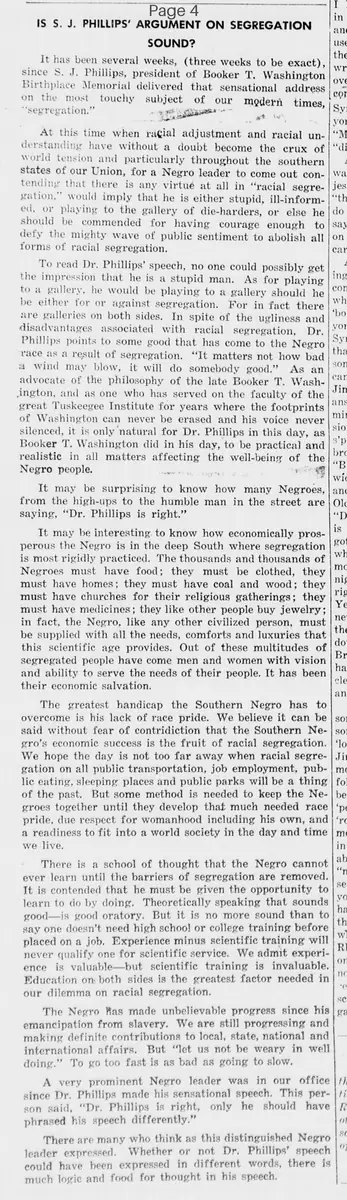
IS S. J. PHILLIPS' ARGUMENT ON SEGREGATION SOUND?
It has been several weeks, (three weeks to be exact), since S. J. Phillips, president of Booker T. Washington Birthplace Memorial delivered that sensational address on the most touchy subject of our modern times, "segregation."
At this time when racial adjustment and racial understanding have without a doubt become the crux of world tension and particularly throughout the southern states of our Union, for a Negro leader to come out contending that there is any virtue at all in "racial segregation," would imply that he is either stupid, ill-informed, or playing to the gallery of die-harders, or else he should be commended for having courage enough to defy the mighty wave of public sentiment to abolish all forms of racial segregation.
To read Dr. Phillips' speech, no one could possibly get the impression that he is a stupid man. As for playing to a gallery, he would be playing to a gallery should he be either for or against segregation. For in fact there are galleries on both sides. In spite of the ugliness and disadvantages associated with racial segregation, Dr. Phillips points to some good that has come to the Negro race as a result of segregation. "It matters not how bad a wind may blow, it will do somebody good." As an advocate of the philosophy of the late Booker T. Washington, and as one who has served on the faculty of the great Tuskegee Institute for years where the footprints of Washington can never be erased and his voice never silenced, it is only natural for Dr. Phillips in this day, as Booker T. Washington did in his day, to be practical and realistic in all matters affecting the well-being of the Negro people.
It may be surprising to know how many Negroes, from the high-ups to the humble man in the street are saying, "Dr. Phillips is right."
It may be interesting to know how economically prosperous the Negro is in the deep South where segregation is most rigidly practiced. The thousands and thousands of Negroes must have food; they must be clothed, they must have homes; they must have coal and wood; they must have churches for their religious gatherings; they must have medicines; they like other people buy jewelry; in fact, the Negro, like any other civilized person, must be supplied with all the needs, comforts and luxuries that this scientific age provides. Out of these multitudes of segregated people have come men and women with vision and ability to serve the needs of their people. It has been their economic salvation.
The greatest handicap the Southern Negro has to overcome is his lack of race pride. We believe it can be said without fear of contradiction that the Southern Negro's economic success is the fruit of racial segregation.
We hope the day is not too far away when racial segregation on all public transportation, job employment, public eating, sleeping places and public parks will be a thing of the past. But some method is needed to keep the Negroes together until they develop that much needed race pride, due respect for womanhood including his own, and a readiness to fit into a world society in the day and time we live.
There is a school of thought that the Negro cannot ever learn until the barriers of segregation are removed. It is contended that he must be given the opportunity to learn to do by doing. Theoretically speaking that sounds good—is good oratory. But it is no more sound than to say one doesn't need high school or college training before placed on a job. Experience minus scientific training will never qualify one for scientific service. We admit experience is valuable—but scientific training is invaluable.
Education on both sides is the greatest factor needed in our dilemma on racial segregation.
The Negro has made unbelievable progress since his emancipation from slavery. We are still progressing and making definite contributions to local, state, national and international affairs. But "let us not be weary in well doing." To go too fast is as bad as going too slow.
A very prominent Negro leader was in our office since Dr. Phillips made his sensational speech. This person said, "Dr. Phillips is right, only he should have phrased his speech differently."
There are many who think as this distinguished Negro leader expressed. Whether or not Dr. Phillips' speech could have been expressed in different words, there is much logic and food for thought in his speech.
It has been several weeks, (three weeks to be exact), since S. J. Phillips, president of Booker T. Washington Birthplace Memorial delivered that sensational address on the most touchy subject of our modern times, "segregation."
At this time when racial adjustment and racial understanding have without a doubt become the crux of world tension and particularly throughout the southern states of our Union, for a Negro leader to come out contending that there is any virtue at all in "racial segregation," would imply that he is either stupid, ill-informed, or playing to the gallery of die-harders, or else he should be commended for having courage enough to defy the mighty wave of public sentiment to abolish all forms of racial segregation.
To read Dr. Phillips' speech, no one could possibly get the impression that he is a stupid man. As for playing to a gallery, he would be playing to a gallery should he be either for or against segregation. For in fact there are galleries on both sides. In spite of the ugliness and disadvantages associated with racial segregation, Dr. Phillips points to some good that has come to the Negro race as a result of segregation. "It matters not how bad a wind may blow, it will do somebody good." As an advocate of the philosophy of the late Booker T. Washington, and as one who has served on the faculty of the great Tuskegee Institute for years where the footprints of Washington can never be erased and his voice never silenced, it is only natural for Dr. Phillips in this day, as Booker T. Washington did in his day, to be practical and realistic in all matters affecting the well-being of the Negro people.
It may be surprising to know how many Negroes, from the high-ups to the humble man in the street are saying, "Dr. Phillips is right."
It may be interesting to know how economically prosperous the Negro is in the deep South where segregation is most rigidly practiced. The thousands and thousands of Negroes must have food; they must be clothed, they must have homes; they must have coal and wood; they must have churches for their religious gatherings; they must have medicines; they like other people buy jewelry; in fact, the Negro, like any other civilized person, must be supplied with all the needs, comforts and luxuries that this scientific age provides. Out of these multitudes of segregated people have come men and women with vision and ability to serve the needs of their people. It has been their economic salvation.
The greatest handicap the Southern Negro has to overcome is his lack of race pride. We believe it can be said without fear of contradiction that the Southern Negro's economic success is the fruit of racial segregation.
We hope the day is not too far away when racial segregation on all public transportation, job employment, public eating, sleeping places and public parks will be a thing of the past. But some method is needed to keep the Negroes together until they develop that much needed race pride, due respect for womanhood including his own, and a readiness to fit into a world society in the day and time we live.
There is a school of thought that the Negro cannot ever learn until the barriers of segregation are removed. It is contended that he must be given the opportunity to learn to do by doing. Theoretically speaking that sounds good—is good oratory. But it is no more sound than to say one doesn't need high school or college training before placed on a job. Experience minus scientific training will never qualify one for scientific service. We admit experience is valuable—but scientific training is invaluable.
Education on both sides is the greatest factor needed in our dilemma on racial segregation.
The Negro has made unbelievable progress since his emancipation from slavery. We are still progressing and making definite contributions to local, state, national and international affairs. But "let us not be weary in well doing." To go too fast is as bad as going too slow.
A very prominent Negro leader was in our office since Dr. Phillips made his sensational speech. This person said, "Dr. Phillips is right, only he should have phrased his speech differently."
There are many who think as this distinguished Negro leader expressed. Whether or not Dr. Phillips' speech could have been expressed in different words, there is much logic and food for thought in his speech.
What sub-type of article is it?
Social Reform
Slavery Abolition
What keywords are associated?
Racial Segregation
Negro Economic Success
Race Pride
Booker T Washington Philosophy
Southern States
Racial Adjustment
What entities or persons were involved?
S.J. Phillips
Booker T. Washington
Tuskegee Institute
Editorial Details
Primary Topic
Evaluation Of S.J. Phillips' Argument On Racial Segregation
Stance / Tone
Supportive Of Practical Benefits Of Segregation For Negro Progress While Advocating Eventual Integration
Key Figures
S.J. Phillips
Booker T. Washington
Tuskegee Institute
Key Arguments
Segregation Has Led To Economic Prosperity And Self Sufficiency For Negroes In The South
Lack Of Race Pride Is The Greatest Handicap For Southern Negroes
Economic Success Of Southern Negroes Is The Fruit Of Racial Segregation
Method Needed To Maintain Segregation Until Negroes Develop Race Pride And Respect
Education And Scientific Training Are Essential Beyond Mere Experience
Racial Adjustment Requires Education On Both Sides
Negroes Have Made Progress Since Emancipation But Should Not Rush Integration
Phillips' Speech Contains Logic Despite Potential Phrasing Issues