Thank you for visiting SNEWPapers!
Sign up free
Editorial
June 28, 1878
Springfield Weekly Republican
Springfield, Hampden County, Massachusetts
What is this article about?
Editorial from June 28, 1878, critiques the insubstantial platforms of the Illinois Republican convention in Springfield and Ohio Democratic convention in Columbus, both held June 26, blaming each other for economic woes and urging voters to prioritize candidates over parties.
Clipping
OCR Quality
98%
Excellent
Full Text
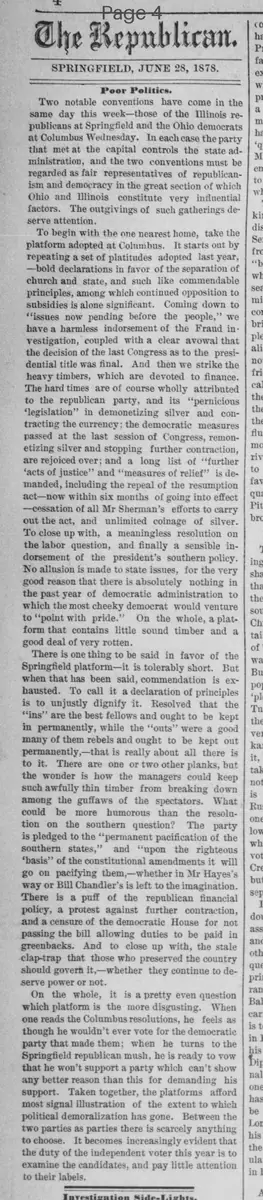
The Republican.
SPRINGFIELD, JUNE 28, 1878.
Poor Politics.
Two notable conventions have come in the same day this week—those of the Illinois republicans at Springfield and the Ohio democrats at Columbus Wednesday. In each case the party that met at the capital controls the state administration, and the two conventions must be regarded as fair representatives of republicanism and democracy in the great section of which Ohio and Illinois constitute very influential factors. The outgivings of such gatherings deserve attention.
To begin with the one nearest home, take the platform adopted at Columbus. It starts out by repeating a set of platitudes adopted last year,—bold declarations in favor of the separation of church and state, and such like commendable principles, among which continued opposition to subsidies is alone significant. Coming down to "issues now pending before the people," we have a harmless indorsement of the Fraud investigation, coupled with a clear avowal that the decision of the last Congress as to the presidential title was final. And then we strike the heavy timbers, which are devoted to finance. The hard times are of course wholly attributed to the republican party, and its "pernicious legislation" in demonetizing silver and contracting the currency: the democratic measures passed at the last session of Congress, remonetizing silver and stopping further contraction, are rejoiced over: and a long list of "further acts of justice" and "measures of relief" is demanded, including the repeal of the resumption act—now within six months of going into effect—cessation of all Mr. Sherman's efforts to carry out the act, and unlimited coinage of silver. To close up with, a meaningless resolution on the labor question, and finally a sensible indorsement of the president's southern policy.
No allusion is made to state issues, for the very good reason that there is absolutely nothing in the past year of democratic administration to which the most cheeky democrat would venture to "point with pride." On the whole, a platform that contains little sound timber and a good deal of very rotten.
There is one thing to be said in favor of the Springfield platform—it is tolerably short. But when that has been said, commendation is exhausted. To call it a declaration of principles is to unjustly dignify it. Resolved that the "ins" are the best fellows and ought to be kept in permanently, while the "outs" were a good many of them rebels and ought to be kept out permanently,—that is really about all there is to it. There are one or two other planks, but the wonder is how the managers could keep such awfully thin timber from breaking down among the guffaws of the spectators. What could be more humorous than the resolution on the southern question? The party is pledged to the "permanent pacification of the southern states," and "upon the righteous basis" of the constitutional amendments it will go on pacifying them,—whether in Mr. Hayes's way or Bill Chandler's is left to the imagination. There is a puff of the republican financial policy, a protest against further contraction, and a censure of the democratic House for not passing the bill allowing duties to be paid in greenbacks. And to close up with, the stale clap-trap that those who preserved the country should govern it,—whether they continue to deserve power or not.
On the whole, it is a pretty even question which platform is the more disgusting. When one reads the Columbus resolutions, he feels as though he wouldn't ever vote for the democratic party that made them; when he turns to the Springfield republican mush, he is ready to vow that he won't support a party which can't show any better reason than this for demanding his support. Taken together, the platforms afford most signal illustration of the extent to which political demoralization has gone. Between the two parties as parties there is scarcely anything to choose. It becomes increasingly evident that the duty of the independent voter this year is to examine the candidates, and pay little attention to their labels.
SPRINGFIELD, JUNE 28, 1878.
Poor Politics.
Two notable conventions have come in the same day this week—those of the Illinois republicans at Springfield and the Ohio democrats at Columbus Wednesday. In each case the party that met at the capital controls the state administration, and the two conventions must be regarded as fair representatives of republicanism and democracy in the great section of which Ohio and Illinois constitute very influential factors. The outgivings of such gatherings deserve attention.
To begin with the one nearest home, take the platform adopted at Columbus. It starts out by repeating a set of platitudes adopted last year,—bold declarations in favor of the separation of church and state, and such like commendable principles, among which continued opposition to subsidies is alone significant. Coming down to "issues now pending before the people," we have a harmless indorsement of the Fraud investigation, coupled with a clear avowal that the decision of the last Congress as to the presidential title was final. And then we strike the heavy timbers, which are devoted to finance. The hard times are of course wholly attributed to the republican party, and its "pernicious legislation" in demonetizing silver and contracting the currency: the democratic measures passed at the last session of Congress, remonetizing silver and stopping further contraction, are rejoiced over: and a long list of "further acts of justice" and "measures of relief" is demanded, including the repeal of the resumption act—now within six months of going into effect—cessation of all Mr. Sherman's efforts to carry out the act, and unlimited coinage of silver. To close up with, a meaningless resolution on the labor question, and finally a sensible indorsement of the president's southern policy.
No allusion is made to state issues, for the very good reason that there is absolutely nothing in the past year of democratic administration to which the most cheeky democrat would venture to "point with pride." On the whole, a platform that contains little sound timber and a good deal of very rotten.
There is one thing to be said in favor of the Springfield platform—it is tolerably short. But when that has been said, commendation is exhausted. To call it a declaration of principles is to unjustly dignify it. Resolved that the "ins" are the best fellows and ought to be kept in permanently, while the "outs" were a good many of them rebels and ought to be kept out permanently,—that is really about all there is to it. There are one or two other planks, but the wonder is how the managers could keep such awfully thin timber from breaking down among the guffaws of the spectators. What could be more humorous than the resolution on the southern question? The party is pledged to the "permanent pacification of the southern states," and "upon the righteous basis" of the constitutional amendments it will go on pacifying them,—whether in Mr. Hayes's way or Bill Chandler's is left to the imagination. There is a puff of the republican financial policy, a protest against further contraction, and a censure of the democratic House for not passing the bill allowing duties to be paid in greenbacks. And to close up with, the stale clap-trap that those who preserved the country should govern it,—whether they continue to deserve power or not.
On the whole, it is a pretty even question which platform is the more disgusting. When one reads the Columbus resolutions, he feels as though he wouldn't ever vote for the democratic party that made them; when he turns to the Springfield republican mush, he is ready to vow that he won't support a party which can't show any better reason than this for demanding his support. Taken together, the platforms afford most signal illustration of the extent to which political demoralization has gone. Between the two parties as parties there is scarcely anything to choose. It becomes increasingly evident that the duty of the independent voter this year is to examine the candidates, and pay little attention to their labels.
What sub-type of article is it?
Partisan Politics
Economic Policy
What keywords are associated?
Party Platforms
Republican Convention
Democratic Platform
Financial Policy
Independent Voter
Southern Policy
What entities or persons were involved?
Illinois Republicans
Ohio Democrats
Mr. Hayes
Bill Chandler
Mr. Sherman
Congress
Editorial Details
Primary Topic
Critique Of Illinois Republican And Ohio Democratic Party Platforms
Stance / Tone
Critical Of Both Parties, Advocating Independent Voting
Key Figures
Illinois Republicans
Ohio Democrats
Mr. Hayes
Bill Chandler
Mr. Sherman
Congress
Key Arguments
Democratic Platform Repeats Platitudes, Attributes Hard Times To Republicans, Demands Repeal Of Resumption Act And Unlimited Silver Coinage
Republican Platform Is Short But Lacks Principles, Focuses On Keeping 'Ins' In Power And Excluding Rebels
Both Platforms Illustrate Political Demoralization
Independent Voters Should Examine Candidates Over Party Labels