Thank you for visiting SNEWPapers!
Sign up free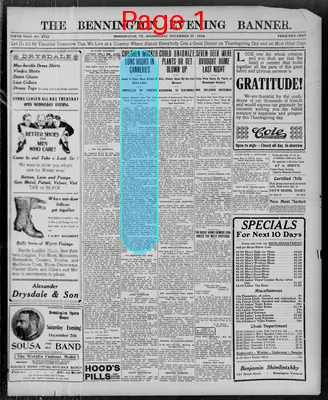
The Bennington Evening Banner
Bennington, Bennington County, Vermont
What is this article about?
Miss Mary Elizabeth Chamberlain testified before the New York state factory investigating commission in Albany on Nov. 26 about exploitative child labor in canneries, where children as young as four worked up to 18 hours daily, often compelled by immigrant parents. Zenas L. Potter reported women working up to 118 hours weekly.
Clipping
OCR Quality
Full Text
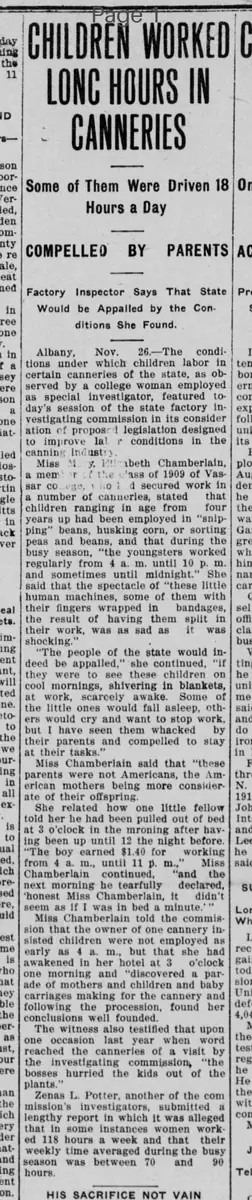
Some of Them Were Driven 18 Hours a Day
COMPELLED BY PARENTS
Factory Inspector Says That State Would be Appalled by the Conditions She Found.
Albany, Nov. 26.-The conditions under which children labor in certain canneries of the state, as observed by a college woman employed as special investigator, featured today's session of the state factory investigating commission in its consideration of proposed legislation designed to improve labor conditions in the canning industry.
Miss Mary Elizabeth Chamberlain, a member of the class of 1909 of Vassar college, who had secured work in a number of canneries, stated that children ranging in age from four years up had been employed in "snipping" beans, husking corn, or sorting peas and beans, and that during the busy season, "the youngsters worked regularly from 4 a. m. until 10 p. m. and sometimes until midnight." She said that the spectacle of "these little human machines, some of them with their fingers wrapped in bandages, the result of having them split in their work, was as sad as it was shocking."
"The people of the state would indeed be appalled," she continued, "if they were to see these children on cool mornings, shivering in blankets, at work, scarcely awake. Some of the little ones would fall asleep, others would cry and want to stop work, but I have seen them whacked by their parents and compelled to stay at their tasks."
Miss Chamberlain said that "these parents were not Americans, the American mothers being more considerate of their offspring."
She related how one little fellow told her he had been pulled out of bed at 3 o'clock in the morning after having been up until 12 the night before. "The boy earned $1.40 for working from 4 a. m., until 11 p. m.," Miss Chamberlain continued, "and the next morning he tearfully declared, 'honest Miss Chamberlain, it didn't seem as if I was in bed a minute.'"
Miss Chamberlain told the commission that the owner of one cannery insisted children were not employed as early as 4 a. m., but that she had awakened in her hotel at 3 o'clock one morning and "discovered a parade of mothers and children and baby carriages making for the cannery and following the procession, found her conclusions well founded."
The witness also testified that upon one occasion last year when word reached the canneries of a visit by the investigating commission "the bosses hurried the kids out of the plants."
Zenas L. Potter, another of the commission's investigators, submitted a lengthy report in which it was alleged that in some instances women worked 118 hours a week and that their weekly time averaged during the busy season was between 70 and 90 hours.
What sub-type of article is it?
What themes does it cover?
What keywords are associated?
What entities or persons were involved?
Where did it happen?
Story Details
Key Persons
Location
Canneries Of The State
Event Date
Albany, Nov. 26.
Story Details
Miss Chamberlain investigated child labor in canneries, finding children aged four and up working 18-hour shifts snipping beans, husking corn, sorting peas, often compelled by non-American parents; one boy earned $1.40 for such a shift. Potter reported women working up to 118 hours weekly.