Thank you for visiting SNEWPapers!
Sign up free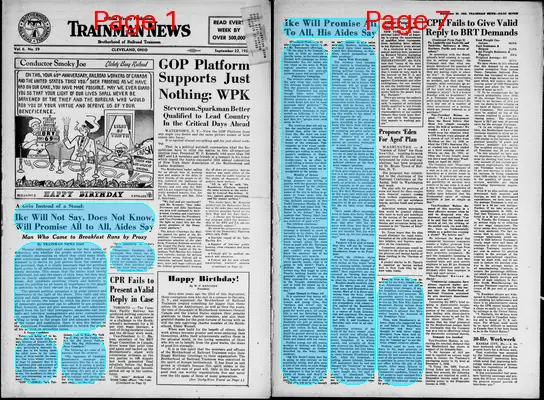
Trainman News
Indianapolis, Marion County, Indiana
What is this article about?
This editorial criticizes General Dwight D. Eisenhower's 1952 presidential campaign strategy for deliberately avoiding specific positions on key issues, relying instead on his popularity, as revealed by a Wall Street Journal article. It contrasts this with democratic ideals of transparency and highlights the influence of Senator Robert A. Taft.
Merged-components note: Continuation of editorial on Eisenhower's campaign strategy from page 1 to page 7.
Clippings
1 of 2
OCR Quality
Full Text
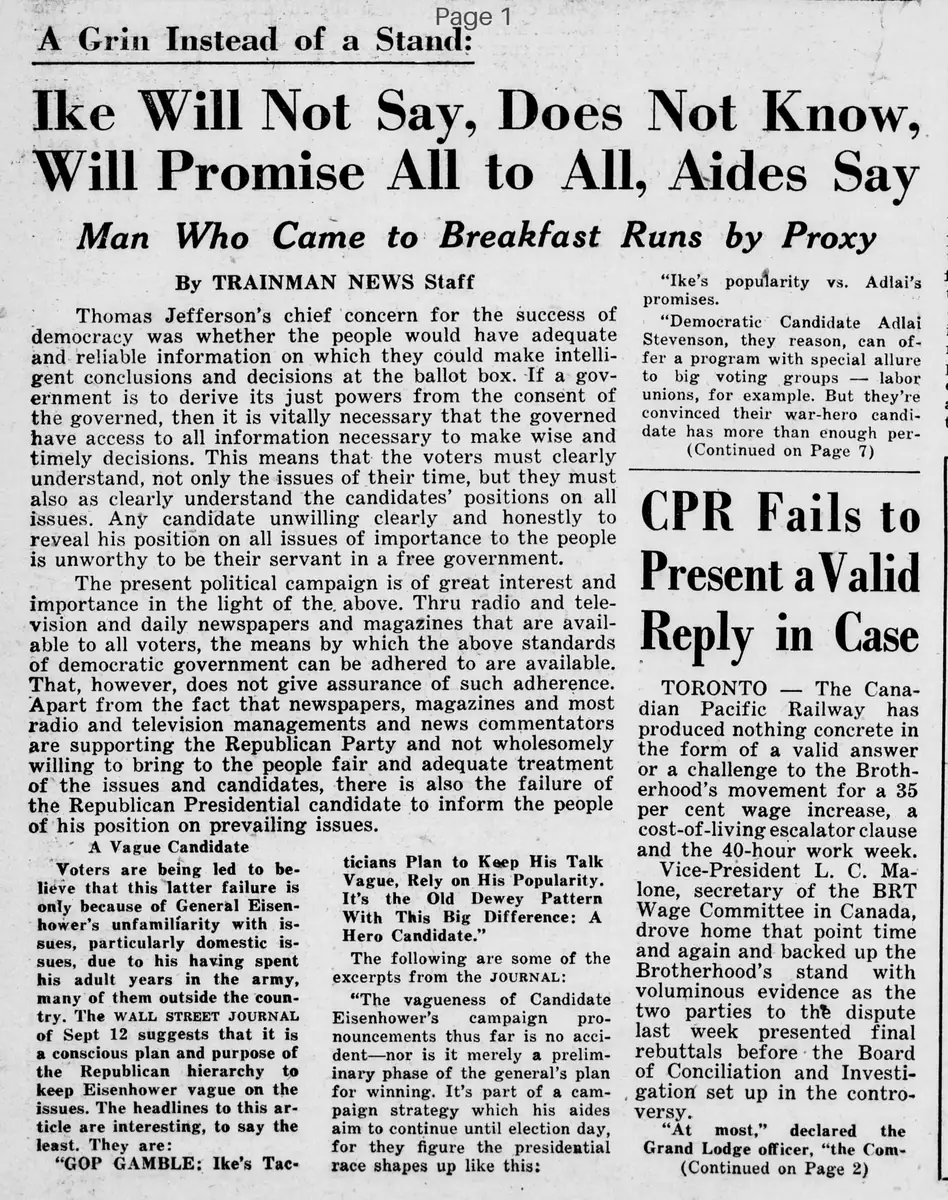
Ike Will Not Say, Does Not Know,
Will Promise All to All, Aides Say
By TRAINMAN NEWS Staff
Thomas Jefferson's chief concern for the success of
democracy was whether the people would have adequate
and reliable information on which they could make intelli-
gent conclusions and decisions at the ballot box. If a gov-
ernment is to derive its just powers from the consent of
the governed, then it is vitally necessary that the governed
have access to all information necessary to make wise and
timely decisions. This means that the voters must clearly
understand, not only the issues of their time, but they must
also as clearly understand the candidates' positions on all
issues. Any candidate unwilling clearly and honestly to
reveal his position on all issues of importance to the people
is unworthy to be their servant in a free government.
The present political campaign is of great interest and
importance in the light of the above. Thru radio and tele-
vision and daily newspapers and magazines that are avail-
able to all voters, the means by which the above standards
of democratic government can be adhered to are available.
That, however. does not give assurance of such adherence.
Apart from the fact that newspapers, magazines and most
radio and television managements and news commentators
are supporting the Republican Party and not wholesomely
willing to bring to the people fair and adequate treatment
of the issues and candidates, there is also the failure of
the Republican Presidential candidate to inform the people
of his position on prevailing issues.
Voters are being led to be-
lieve that this latter failure is
only because of General Eisen-
hower's unfamiliarity with is-
sues, particularly domestic is-
sues, due to his having spent
his adult years in the army,
many of them outside the coun-
try. The WALL STREET JOURNAL
of Sept 12 suggests that it is
a conscious plan and purpose of
the Republican hierarchy to
keep Eisenhower vague on the
issues. The headlines to this ar-
ticle are interesting, to say the
least. They are:
"GOP GAMBLE: Ike's Tac-
ticians Plan to Keep His Talk
Vague, Rely on His Popularity.
It's the Old Dewey Pattern
With This Big Difference: A
Hero Candidate."
The following are some of the
excerpts from the JoURNAL:
"The vagueness of Candidate
Eisenhower's
campaign
pro-
nouncements thus far is no acci-
dent-nor is it merely a prelim-
inary phase of the general's plan
for winning. It's part of a cam-
paign strategy which his aides
aim to continue until election day,
for they figure the presidential
race shapes up like this:
"Ike's popularity
vs.
Adlai's
promises.
"Democratic Candidate Adlai
Stevenson, they reason, can of-
fer a program with special allure
to big voting groups
labor
unions, for example. But they're
convinced their war-hero candi-
date has more than enough per-
(Continued on Page 7)
Ike Will Promise All To All, His Aides Say
(Continued From Page 1)
sonal appeal to the voters to offset Mr. Stevenson's offerings.
"So the plan is for General Ike to talk as little as possible in specific terms, in the weeks ahead. Instead he'll campaign as Army-Commander Ike, the leader who can 'clean up the mess in Washington.' somehow solve the Korean stalemate, and generally promote peace and prosperity."
Popularity Campaign
The JOURNAL states that "about the only thing that could upset this strategy would be some hint that the general's popularity is fading." Eisenhower can garner enough labor votes "without matching Stevenson's repeal-Taft-Hartley promise, or spelling out in much detail just how he would approach labor problems." The high command that is running the general's campaign is represented as believing it is "all a question of who the voters trust," "and that the "people have confidence in Ike."
The JOURNAL does not say so, but the conclusion certainly is forced that. altho the voters trust Ike. Ike must not trust . the voters with information about where he stands on the 'issues of the campaign. This suggests an even worse conclusion-that the general's supporters are willing to make the people's confidence in Eisenhower the basis for a grand double-cross, in an effort to avoid taking a chance that their candidate's true stand on issues, if revealed, might not be acceptable to the people.
Mindful of Dewey
That these Eisenhower campaign planners are willing to gamble with the general's reputation is revealed by the JOURNAL asserting that they "are well aware of the risk in failing to get down to brass tacks with the voters." They are keenly aware of "the ill-fated campaign of New York's Governor Thomas E. Dewey in 1948," and admit that "Mr. Dewey's generalities were a big factor in his defeat." But they contend that "Dewey didn't have what the general has--a tremendous reservoir of good will."
The JOURNAL continues:
"Furthermore. Mr. Eisenhower's strategy is dictated as much by necessity as by choice, his advisers agree. Even Ike's most ardent admirers say he simply doesn't know enough about the home front to joust with Mr. Stevenson on many specific issues. 'The general couldn't even pretend to know the answers,' one of his braintrusters (sic) asserts.
"If Ike isn't going to talk much about specific issues, what is he going to talk about? That's a problem the general's speech-writers may find tough to solve. They're banking heavily on the general's ability to keep up a lively running-fire on corruption in the Truman Administration, and to build his attack up to a crescendo just before election day."
Vague Enough to Please All
It is explained that heavy reliance is made on the votes of women and young folks, that "mothers and wives" can be moved by the war general's appeals for world peace. Of course, this is not too flattering to the intelligence and responsibility of women and young voters, who undoubtedly are just as anxious to know the candidates' views as are any other voters. In fact, daring youth and courageous mothers would be greater moved by a candidate who has the courage to be frank and honest with the voters.
Neither young, nor old, voters, mothers or fathers. will like the Republican strategy as further described by the WALL STREET JOURNAL:
"All this doesn't mean that Ike is going to rely entirely on his popularity rating, and give nary a hint of his views on such things as labor laws and social security. The prospect is that he will give plenty of hints, and they'll be just vague. enough to please everybody, at least a little bit.
"The idea will be to say enough on each subject to give union members, farmers, businessmen, and most every voter reason to expect that Eisenhower, as President, would sympathize with their problems."
Agree With Everybody
The JOURNAL then becomes more explicit in illustrating the GOP theory and practice of attaining political victory. On the tidelands oil question. those who favor the federal government having control of this great wealth will be led to believe that Eisenhower will go along with the decision of the U. S. Supreme Court which so held. Those who favor turning this vast wealth over to states for private exploitation by oil millionaires. the proposition which Eisenhower has already said he favors, will be given to understand that if Congress should pass legislation giving this wealth to the states he would approve the bill.
On the question of price supports, according to the JOURNAL, those who favor them will be assured "that Ike has no intention of scrapping pay-price curbs too hastily. But opponents of economic controls will be advised that the general is dead set against an economic strait-jacket' in times like these."
Apparently the Eisenhower high command figures the farmers are at least as dumb as the rest of us. for the JOURNAL has this to say about Eisenhower's political advisers on the farm price support question:
"Even on the crucial question of farm price supports, Ike's position is a lot more flexible than it has perhaps sounded. Aides say the general is unalterably opposed, on principle, to permanent rigid supports at 90 per cent of parity for the goods farmers produce. But Ike's Minnesota oration on this topic, last week-end, indicated he won't tamper with a law now on the books, guaranteeing supports at 90 per cent of parity for the six basic crops through 1954.
"Ike's stand offers encouragement to those who favor 'flexible' price supports, instead of fixed 90 per cent supports. They can hope that after 1954 Ike will agree with them. And those who want supports pegged at 90 per cent are satisfied that Ike won't cross them up, for two years anyway."
Taft Comes to Stay
Farmers will be glad to know that they will not be "crossed up" for two of the four years Eisenhower hopes to be President.
Finally the JOURNAL states there is "an obvious danger" in such tactics, as they might "wind up by pleasing nobody, instead of making everybody somewhat satisfied." Ike's supporters are represented as "betting that what Ike thinks won't be as important as what the voters think of Ike."
Readers should carefully note that the above does not come from some anti-Eisenhower advocate. Most of it is direct quotations from the WALL STREET JOURNAL, a newspaper read widely by those interests who are sympathetic with conservative control of the Republican Party, for whom the JOURNAL is a source of frank information and appraisal. The masses of voters seldom come in contact with it. and frankness is therefore safe even in an election year.
Supporting evidence of the truth of the WALL STREET JOURNAL's article was afforded last week at the famous Taft-Eisenhower breakfast. It is widely known, and certainly all those who observed the Republican National Convention last July know, that there is a great divergence in views between Eisenhower and Taft. After the breakfast, 'a smiling, almost jubilant. Senator Taft announced that he had not changed his "intention" or abandoned "in any way the principles I..have fought for, the past 14 years," or abandoned "those countless friends who supported me in the pre-convention campaign."
Running true to the form described by the WALL STREET JOURNAL, Eisenhower did not advise the people what changes, if any, his breakfast conference brought in his policies and program. He apparently agreed to the terms of surrender which were brought to him by The Man Who Came to Breakfast. Having written those terms several days before the conference, it appears that Ike's visitor became the Autocrat of the Breakfast Table.
Thus, with Eisenhower's silence, those who supported him at and before the Republican Convention and those who thought he held views widely divergent from those held by Taft, can only wait to see who may be "crossed up," to use the WALL STREET JOURNAL phrase.
Nothing could be more contrary to the basic principle of democracy and a government that derives its just powers from consent of the governed than to have a candidate by proxy for the highest office within the gift of the people. After many failures to become the actual Republican Presidential candidate, Robert A. Taft seems to have emerged from the breakfast table conference as the GOP Presidential candidate by proxy.
What sub-type of article is it?
What keywords are associated?
What entities or persons were involved?
Editorial Details
Primary Topic
Criticism Of Eisenhower's Vague Campaign Strategy
Stance / Tone
Strongly Critical Of Republican Vagueness And Pro Transparency In Democracy
Key Figures
Key Arguments