Thank you for visiting SNEWPapers!
Sign up free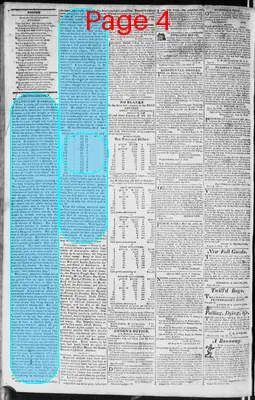
Literary
October 2, 1828
Martinsburg Gazette And Public Advertiser
Martinsburg, Berkeley County, West Virginia
What is this article about?
An essay exploring women's evolving thoughts on marriage from age 15, peaking in susceptibility around 18-20, and declining chances after 30. Includes a statistical table from Dr. Granville on marriage ages among 876 poor women, showing most marry young.
Merged-components note: Merged the 'Chances of Marriage' article with its statistical table of marriage ages.
Clipping
OCR Quality
70%
Good
Full Text
MISCELLANEOUS.
CHANCES OF MARRIAGE.
When a young girl reaches the age of fifteen or sixteen years, she begins to think of the mysterious subject of matrimony; a state the delights of which her youthful imagination shadows forth in the most captivating forms. It is made the topic of light and incidental discourse among her companions, and it is recurred to with increasing interest every time it is brought upon the tapis. When she grows a little older, she ceases to smatter about matrimony, and thinks more intently on the all important subject. It engrosses her thoughts by day and her dreams by night; and she pictures to herself the felicity of being wedded to the youth for whom she cherishes a secret, but consuming flame. She surveys herself in the mirror, and as it generally tells "a flattering tale," she turns from it with a pleasing conviction, that her beauty will enable her to conquer the heart of the most obdurate, and that, whoever else may die in a state of "single blessedness," she is destined to become, ere many years roll by, a happy bride.
From the age of eighteen to twenty is "the very witching time" of female life. During that period, the female heart is more susceptible of the soft and tender influences of love than at any other: and we appeal to our fair readers to say, whether, if inclination alone were consulted in the business, more marriages would not take place, during that ticklish season, than in any by which it is preceded or followed. It is the grand climacter of love; and she who passes it, without entering into the state matrimonial, may chance to pass several years of her life ere she is caught in the meshes of Hymen. The truth is, that the majority of women begin to be more thoughtful when they have turned the age of twenty. The giddiness of the girl gives place to the sobriety of the woman. Frivolity is succeeded by reflection; and reason reigns where passion previously held undisputed sway. The cares and the anxieties of life press themselves more on the attention; and, as its sober realities become more palpable, they tend to weaken the effect of sanguine anticipations of unmingled felicity in the marriage state which the mind had formed in its youthful day dreams. In short, to use a common phrase, women, after twenty-one, "look before they leap."
Matrimony, however, though not so ardently longed for by the damsel who has passed what we have styled the grand climacter of love, is never lost sight of, either by the youngest or by the most aged spinster in his Majesty's dominions. It is a state on which the eyes of the whole female world are turned with the most pleasurable anticipations; and the spinster of forty is as full of hope of one day being married as the damsel of twenty one. But sorry as we always are to utter any thing which may tend to damp the hopes or to cloud the prospects of a fair lady, truth compels us to say, that, when once she has crossed the line, which, on the map of love, is marked thirty, the chances are fearfully against the probability of her obtaining a husband—even of the sedate age of forty or fifty. If she pass many degrees beyond the line, her state becomes almost hopeless, nay, desperate, and she may reconcile herself to live and die an old maid—All experience confirms this lamentable truth. No wonder, therefore, that women make a mighty secret of their age, and that they occasionally tell a pardonable fib, in the attempt to induce the men to believe that they are several years younger than they really are—Who can blame them for practising a little finesse on this awful subject, seeing that their age, if divulged, might utterly annihilate the chances of their ever enjoying the blessings of wedded love!
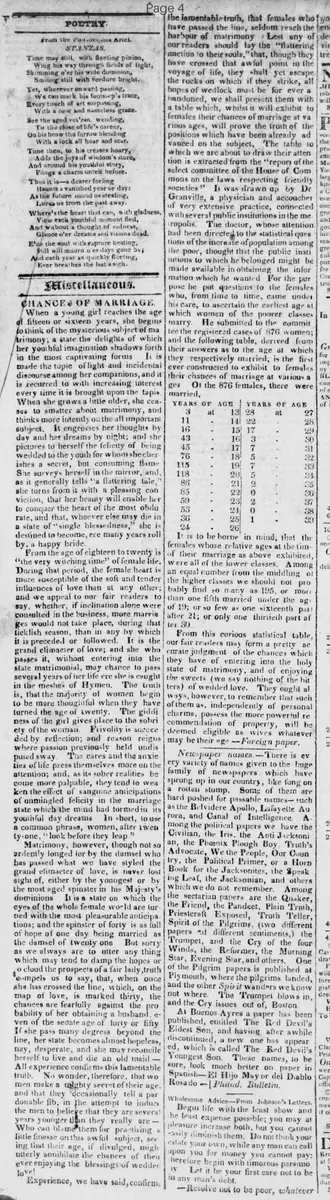
Experience, we have said, confirms the lamentable truth, that females who have passed the line, seldom reach the harbour of matrimony—Lest any of our readers should lay the "flattering unction to their souls," that, though they have crossed that awful point in the voyage of life, they shall yet escape the rocks on which if they strike, all hopes of wedlock must be for ever abandoned, we shall present them with a table which, whilst it will exhibit to females their chances of marriage at various ages, will prove the truth of the positions which have been already advanced on the subject. The table to which we are about to draw their attention is extracted from the "report of the select committee of the House of Commons on the laws respecting friendly societies." It was drawn up by Dr. Granville, a physician and accoucher of very extensive practice, connected with several public institutions in the metropolis. The doctor, whose attention had been directed to the statistical questions of the increase of population among the poor, thought that the public institutions to which he belonged might be made available in obtaining the information which he wanted. For the purpose he put questions to the females who, from time to time, came under his care, to ascertain the earliest age at which women of the poorer classes marry. He submitted to the committee the registered cases of 876 women; and the following table, derived from their answers as to the age at which they respectively married, is the first ever constructed to exhibit to females their chances of marriage at various ages. Of the 876 females, there were married,
It is to be borne in mind, that the females whose relative ages at the time of their marriage as above exhibited, were all of the lower classes. Among an equal number from the middling or the higher classes we should not probably find so many as 195, or more than one fifth married under the age of 19; or so few as one sixteenth part after 21; or only one thirtieth part after 30.
From this curious statistical table, our fair readers may form a pretty accurate judgment of the chances which they have of entering into the holy state of matrimony, and of enjoying the sweets (we say nothing of the bitters) of wedded love. They ought always, however, to remember that such of them as, independently of personal charms, possess the more powerful recommendation of property, will be deemed eligible as wives whatever may be their age—Foreign paper.
CHANCES OF MARRIAGE.
When a young girl reaches the age of fifteen or sixteen years, she begins to think of the mysterious subject of matrimony; a state the delights of which her youthful imagination shadows forth in the most captivating forms. It is made the topic of light and incidental discourse among her companions, and it is recurred to with increasing interest every time it is brought upon the tapis. When she grows a little older, she ceases to smatter about matrimony, and thinks more intently on the all important subject. It engrosses her thoughts by day and her dreams by night; and she pictures to herself the felicity of being wedded to the youth for whom she cherishes a secret, but consuming flame. She surveys herself in the mirror, and as it generally tells "a flattering tale," she turns from it with a pleasing conviction, that her beauty will enable her to conquer the heart of the most obdurate, and that, whoever else may die in a state of "single blessedness," she is destined to become, ere many years roll by, a happy bride.
From the age of eighteen to twenty is "the very witching time" of female life. During that period, the female heart is more susceptible of the soft and tender influences of love than at any other: and we appeal to our fair readers to say, whether, if inclination alone were consulted in the business, more marriages would not take place, during that ticklish season, than in any by which it is preceded or followed. It is the grand climacter of love; and she who passes it, without entering into the state matrimonial, may chance to pass several years of her life ere she is caught in the meshes of Hymen. The truth is, that the majority of women begin to be more thoughtful when they have turned the age of twenty. The giddiness of the girl gives place to the sobriety of the woman. Frivolity is succeeded by reflection; and reason reigns where passion previously held undisputed sway. The cares and the anxieties of life press themselves more on the attention; and, as its sober realities become more palpable, they tend to weaken the effect of sanguine anticipations of unmingled felicity in the marriage state which the mind had formed in its youthful day dreams. In short, to use a common phrase, women, after twenty-one, "look before they leap."
Matrimony, however, though not so ardently longed for by the damsel who has passed what we have styled the grand climacter of love, is never lost sight of, either by the youngest or by the most aged spinster in his Majesty's dominions. It is a state on which the eyes of the whole female world are turned with the most pleasurable anticipations; and the spinster of forty is as full of hope of one day being married as the damsel of twenty one. But sorry as we always are to utter any thing which may tend to damp the hopes or to cloud the prospects of a fair lady, truth compels us to say, that, when once she has crossed the line, which, on the map of love, is marked thirty, the chances are fearfully against the probability of her obtaining a husband—even of the sedate age of forty or fifty. If she pass many degrees beyond the line, her state becomes almost hopeless, nay, desperate, and she may reconcile herself to live and die an old maid—All experience confirms this lamentable truth. No wonder, therefore, that women make a mighty secret of their age, and that they occasionally tell a pardonable fib, in the attempt to induce the men to believe that they are several years younger than they really are—Who can blame them for practising a little finesse on this awful subject, seeing that their age, if divulged, might utterly annihilate the chances of their ever enjoying the blessings of wedded love!
Experience, we have said, confirms the lamentable truth, that females who have passed the line, seldom reach the harbour of matrimony—Lest any of our readers should lay the "flattering unction to their souls," that, though they have crossed that awful point in the voyage of life, they shall yet escape the rocks on which if they strike, all hopes of wedlock must be for ever abandoned, we shall present them with a table which, whilst it will exhibit to females their chances of marriage at various ages, will prove the truth of the positions which have been already advanced on the subject. The table to which we are about to draw their attention is extracted from the "report of the select committee of the House of Commons on the laws respecting friendly societies." It was drawn up by Dr. Granville, a physician and accoucher of very extensive practice, connected with several public institutions in the metropolis. The doctor, whose attention had been directed to the statistical questions of the increase of population among the poor, thought that the public institutions to which he belonged might be made available in obtaining the information which he wanted. For the purpose he put questions to the females who, from time to time, came under his care, to ascertain the earliest age at which women of the poorer classes marry. He submitted to the committee the registered cases of 876 women; and the following table, derived from their answers as to the age at which they respectively married, is the first ever constructed to exhibit to females their chances of marriage at various ages. Of the 876 females, there were married,
It is to be borne in mind, that the females whose relative ages at the time of their marriage as above exhibited, were all of the lower classes. Among an equal number from the middling or the higher classes we should not probably find so many as 195, or more than one fifth married under the age of 19; or so few as one sixteenth part after 21; or only one thirtieth part after 30.
From this curious statistical table, our fair readers may form a pretty accurate judgment of the chances which they have of entering into the holy state of matrimony, and of enjoying the sweets (we say nothing of the bitters) of wedded love. They ought always, however, to remember that such of them as, independently of personal charms, possess the more powerful recommendation of property, will be deemed eligible as wives whatever may be their age—Foreign paper.
| YEARS | OF | AGE | YEARS | OF | AGE |
| 3 | at | 13 | 28 | at | 27 |
| 11 | - | 14 | 22 | - | 28 |
| 16 | - | 15 | 17 | - | 29 |
| 43 | - | 16 | 3 | - | 30 |
| 45 | - | 17 | 7 | - | 31 |
| 76 | - | 18 | 5 | - | 32 |
| 115 | - | 19 | 7 | - | 33 |
| 118 | - | 20 | 5 | - | 34 |
| 86 | - | 21 | 2 | - | 35 |
| 85 | - | 22 | 0 | - | 36 |
| 59 | - | 23 | 2 | - | 37 |
| 53 | - | 24 | 0 | - | 38 |
| 36 | - | 25 | 1 | - | 39 |
| 24 | - | 26 |
What sub-type of article is it?
Essay
What themes does it cover?
Love Romance
Social Manners
What keywords are associated?
Marriage Chances
Women Ages
Matrimony Statistics
Female Susceptibility
Age Line Thirty
Poor Women Marriages
Literary Details
Title
Chances Of Marriage
Subject
Chances Of Marriage At Various Ages For Women
Form / Style
Prose Essay With Statistical Table
Key Lines
From The Age Of Eighteen To Twenty Is "The Very Witching Time" Of Female Life.
Women, After Twenty One, "Look Before They Leap."
The Chances Are Fearfully Against The Probability Of Her Obtaining A Husband—Even Of The Sedate Age Of Forty Or Fifty.