Thank you for visiting SNEWPapers!
Sign up free
The Rhode Island American, And General Advertiser
Providence, Providence County, Rhode Island
What is this article about?
In Renfrewshire, Scotland, justices ruled against a toll-man in a dispute with a Paisley carpenter who transported timber on a hand barrow, arguing he wasn't a beast of burden subject to tolls.
Clipping
OCR Quality
Full Text
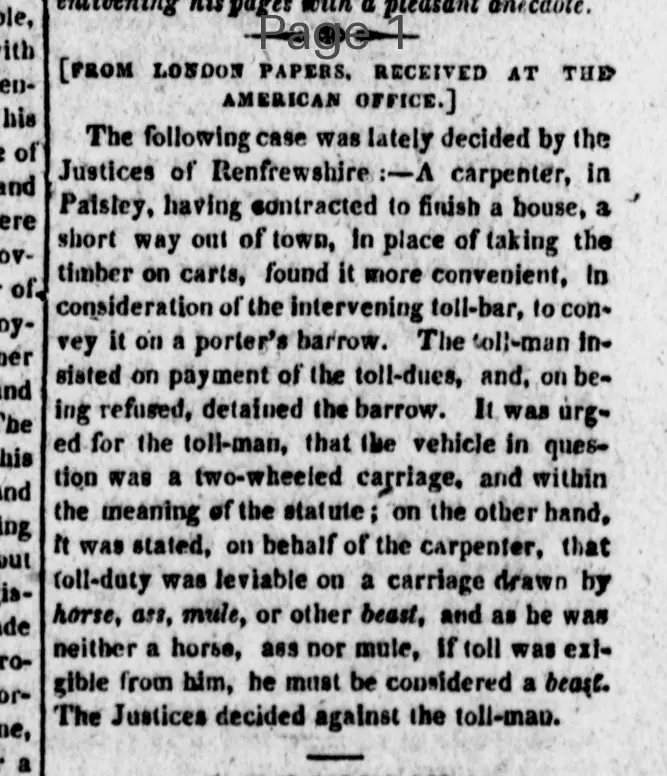
The following case was lately decided by the Justices of Renfrewshire: A carpenter, in Paisley, having contracted to finish a house, a short way out of town, in place of taking the timber on carts, found it more convenient, in consideration of the intervening toll-bar, to convey it on a porter's barrow. The toll-man insisted on payment of the toll-dues, and, on being refused, detained the barrow. It was urged, on the part of the toll-man, that the vehicle in question was a two-wheeled carriage, and within the meaning of the statute; on the other hand, it was stated, on behalf of the carpenter, that coat-duty was leviable on a carriage drawn by horse, ass, mule, or other beast, and as he was neither a horse, ass nor mule, if toll was exigible from him, he must be considered a beast. The Justices decided against the toll-man.
What sub-type of article is it?
What keywords are associated?
Where did it happen?
Foreign News Details
Primary Location
Renfrewshire
Event Date
Lately
Outcome
the justices decided against the toll-man.
Event Details
A carpenter in Paisley contracted to finish a house outside town and conveyed timber on a porter's barrow to avoid the toll-bar. The toll-man demanded payment, claiming the barrow was a two-wheeled carriage under the statute, and detained it when refused. The carpenter argued that coat-duty applied to carriages drawn by horse, ass, mule, or other beast, and since he was not such, he would have to be considered a beast if toll was exigible.