Thank you for visiting SNEWPapers!
Sign up free
Yorkville Enquirer
York, York County, South Carolina
What is this article about?
In the U.S. Senate on Tuesday, a proposed constitutional amendment for women's suffrage was debated and rejected by a vote of 34 to 16. Senators Brown and others opposed it, arguing against altering gender roles, while supporters like Dolph and Hoar advocated submitting it to states.
Clipping
OCR Quality
Full Text
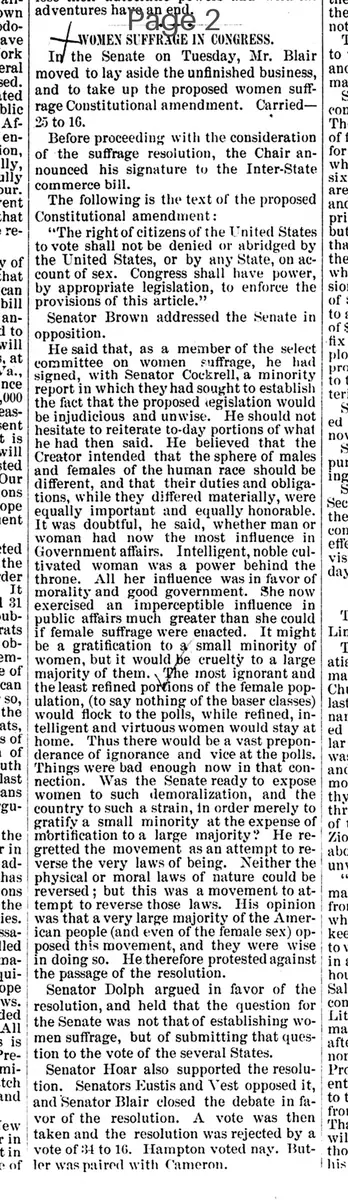
In the Senate on Tuesday, Mr. Blair moved to lay aside the unfinished business and to take up the proposed women suffrage Constitutional amendment. Carried—25 to 16.
Before proceeding with the consideration of the suffrage resolution, the Chair announced his signature to the Inter-State commerce bill.
The following is the text of the proposed Constitutional amendment:
"The right of citizens of the United States to vote shall not be denied or abridged by the United States, or by any State, on account of sex. Congress shall have power, by appropriate legislation, to enforce the provisions of this article."
Senator Brown addressed the Senate in opposition. He said that as a member of the select committee on women suffrage, he had signed, with Senator Cockrell, a minority report in which they had sought to establish the fact that the proposed legislation would be injudicious and unwise. He should not hesitate to reiterate to-day portions of what he had then said. He believed that the Creator intended that the sphere of males and females of the human race should be different, and that their duties and obligations, while they differed materially, were equally important and equally honorable. It was doubtful, he said, whether man or woman had now the most influence in Government affairs. Intelligent, noble cultivated woman was a power behind the throne. All her influence was in favor of morality and good government. She now exercised an "imperceptible influence in public affairs much greater than she could if female suffrage were enacted. It might be a gratification to a small minority of women, but it would be cruelty to a large majority of them. The most ignorant and the least refined portions of the female population, (to say nothing of the baser classes would flock to the polls, while refined, intelligent and virtuous women would stay at home. Thus there would be a vast preponderance of ignorance and vice at the polls. Things were bad enough now in that connection. Was the Senate ready to expose women to such demoralization, and the country to such a strain, in order merely to gratify a small minority at the expense of mortification to a large majority? He regretted the movement as an attempt to reverse the very laws of being. Neither the physical or moral laws of nature could be reversed; but this was a movement to attempt to reverse those laws. His opinion was that a very large majority of the American people (and even of the female sex) opposed this movement, and they were wise in doing so. He therefore protested against the passage of the resolution.
Senator Dolph argued in favor of the resolution, and held that the question for the Senate was not that of establishing women suffrage, but of submitting that question to the vote of the several States.
Senator Hoar also supported the resolution. Senators Eustis and Vest opposed it, and Senator Blair closed the debate in favor of the resolution. A vote was then taken and the resolution was rejected by a vote of 34 to 16. Hampton voted nay. But Butler was paired with Cameron.
What sub-type of article is it?
What themes does it cover?
What keywords are associated?
What entities or persons were involved?
Where did it happen?
Story Details
Key Persons
Location
The Senate
Event Date
On Tuesday
Story Details
Mr. Blair moved to take up the women suffrage constitutional amendment, which passed 25 to 16. The amendment text grants voting rights regardless of sex. Senator Brown opposed, arguing it reverses natural gender roles and would lead to ignorance and vice at polls. Senators Dolph and Hoar supported submitting it to states. Eustis and Vest opposed. Debate closed by Blair. Resolution rejected 34 to 16, with Hampton nay and Butler paired with Cameron.