Thank you for visiting SNEWPapers!
Sign up free
Editorial
May 25, 1839
The Phenix
Bristol, Bristol County, Rhode Island
What is this article about?
Editorial praises farming as idyllic and independent, contrasting it with urban struggles and dishonest ambitions; criticizes young men leaving farms, linking it to overstocked professions, hard times, and food imports from Europe. Urges viewing farming as honorable amid economic woes.
Clipping
OCR Quality
98%
Excellent
Full Text
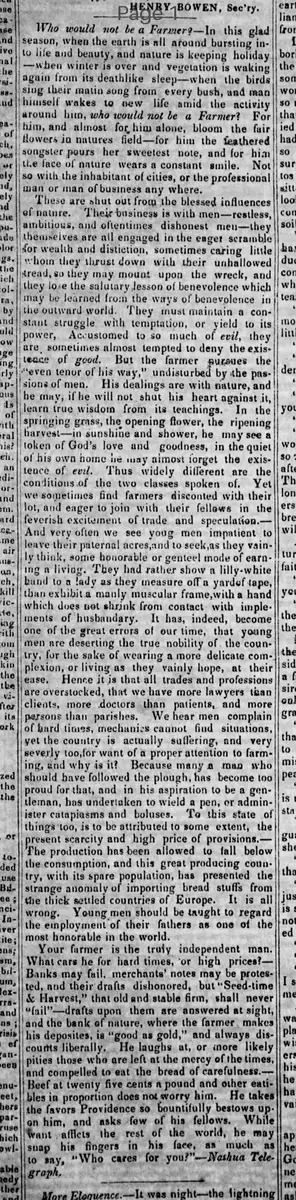
Who would not be a Farmer?—In this glad season, when the earth is all around bursting into life and beauty, and nature is keeping holiday—when winter is over and vegetation is waking again from its deathlike sleep—when the birds sing their matin song from every bush, and man himself wakes to new life amid the activity around him, who would not be a Farmer? For him, and almost for him alone, bloom the air flowers in nature's field—for him the feathered songster pours her sweetest note, and for him the face of nature wears a constant smile. Not so with the inhabitant of cities, or the professional man or man of business any where. These are shut out from the blessed influences of nature. Their business is with men—restless, ambitious, and oftentimes dishonest men—they themselves are all engaged in the eager scramble for wealth and distinction, sometimes caring little whom they thrust down with their unhallowed tread, so they may mount upon the wreck, and they lose the salutary lesson of benevolence which may be learned from the ways of benevolence in the outward world. They must maintain a constant struggle with temptation, or yield to its power. Accustomed to so much of evil, they are sometimes almost tempted to deny the existence of good. But the farmer pursues the "even tenor of his way," undisturbed by the passions of men. His dealings are with nature, and he may, if he will not shut his heart against it, learn true wisdom from its teachings. In the springing grass, the opening flower, the ripening harvest—in sunshine and shower, he may see a token of God's love and goodness, in the quiet of his own home he may almost forget the existence of evil. Thus widely different are the conditions of the two classes spoken of. Yet we sometimes find farmers discontented with their lot, and eager to join with their fellows in the feverish excitement of trade and speculation.—And very often we see young men impatient to leave their paternal acres, and to seek, as they vainly think, some honorable or genteel mode of earning a living. They had rather show a lily-white hand to a lady as they measure off a yard of tape, than exhibit a manly muscular frame, with a hand which does not shrink from contact with implements of husbandry. It has, indeed, become one of the great errors of our time, that young men are deserting the true nobility of the country, for the sake of wearing a more delicate complexion, or living as they vainly hope, at their ease. Hence it is that all trades and professions are overstocked, that we have more lawyers than clients, more doctors than patients, and more persons than parishes. We hear men complain of hard times, mechanics cannot find situations, yet the country is actually suffering, and very severely too, for want of a proper attention to farming, and why is it? Because many a man who should have followed the plough, has become too proud for that, and in his aspiration to be a gentleman, has undertaken to wield a pen, or administer cataplasms and boluses. To this state of things too, is to be attributed to some extent, the present scarcity and high price of provisions.—The production has been allowed to fall below the consumption, and this great producing country, with its spare population, has presented the strange anomaly of importing bread stuffs from the thick settled countries of Europe. It is all wrong. Young men should be taught to regard the employment of their fathers as one of the most honorable in the world.
Your farmer is the truly independent man. What cares he for hard times, or high prices?—Banks may fail, merchants' notes may be protested, and their drafts dishonored, but "Seed-time & Harvest." that old and stable firm, shall never "fail"—drafts upon them are answered at sight, and the bank of nature, where the farmer makes his deposites, is "good as gold," and always discounts liberally. He laughs at, or more likely pities those who are left at the mercy of the times, and compelled to eat the bread of carefulness.—Beef at twenty five cents a pound and other eatables in proportion does not worry him. He takes the favors Providence so bountifully bestows upon him, and asks few of his fellows. While want afflicts the rest of the world, he may snap his fingers in its face, as much as to say, "Who cares for you?"—Nashua Telegraph.
Your farmer is the truly independent man. What cares he for hard times, or high prices?—Banks may fail, merchants' notes may be protested, and their drafts dishonored, but "Seed-time & Harvest." that old and stable firm, shall never "fail"—drafts upon them are answered at sight, and the bank of nature, where the farmer makes his deposites, is "good as gold," and always discounts liberally. He laughs at, or more likely pities those who are left at the mercy of the times, and compelled to eat the bread of carefulness.—Beef at twenty five cents a pound and other eatables in proportion does not worry him. He takes the favors Providence so bountifully bestows upon him, and asks few of his fellows. While want afflicts the rest of the world, he may snap his fingers in its face, as much as to say, "Who cares for you?"—Nashua Telegraph.
What sub-type of article is it?
Agriculture
Social Reform
Moral Or Religious
What keywords are associated?
Farming
Rural Life
Agriculture
Urban Discontent
Youth Desertion
Economic Independence
Nature's Benevolence
Provisions Scarcity
What entities or persons were involved?
Farmers
Young Men
City Inhabitants
Professional Men
Editorial Details
Primary Topic
Virtues Of Farming Life Over Urban Pursuits
Stance / Tone
Exhortative Praise Of Farming And Criticism Of Deserting Rural Labor
Key Figures
Farmers
Young Men
City Inhabitants
Professional Men
Key Arguments
Farmers Enjoy Nature's Beauty, Songbirds, And Constant Smile While City Dwellers Face Restless, Ambitious, Dishonest Men
Urban Life Involves Scramble For Wealth, Thrusting Others Down, Losing Benevolence Lessons From Nature
Farmers Pursue Even Tenor Of Way, Learn Wisdom From Nature, See God's Love In Growth And Harvest, Forget Evil
Young Men Impatiently Leave Farms For Genteel Trades, Leading To Overstocked Professions And Lawyer Surpluses
Deserting Farms Causes Hard Times, Mechanics Without Work, Scarcity Of Provisions, Importing Bread From Europe
Farming Is Truly Honorable And Independent; Seed Time And Harvest Never Fail, Unlike Banks And Merchants
Farmers Unaffected By High Prices, Take Providence's Favors, Snap Fingers At Want While Others Suffer