Thank you for visiting SNEWPapers!
Sign up free
Gazette Of The United States And Daily Evening Advertiser
Philadelphia, Philadelphia County, Pennsylvania
What is this article about?
In the Irish House of Commons on Jan. 22, the Lord Lieutenant delivered a speech urging support for the British war effort against France amid allied setbacks. Henry Grattan moved an address affirming loyalty and commitment to the war, which passed overwhelmingly (150-2) after debate opposing peace negotiations under French terms.
Clipping
OCR Quality
Full Text
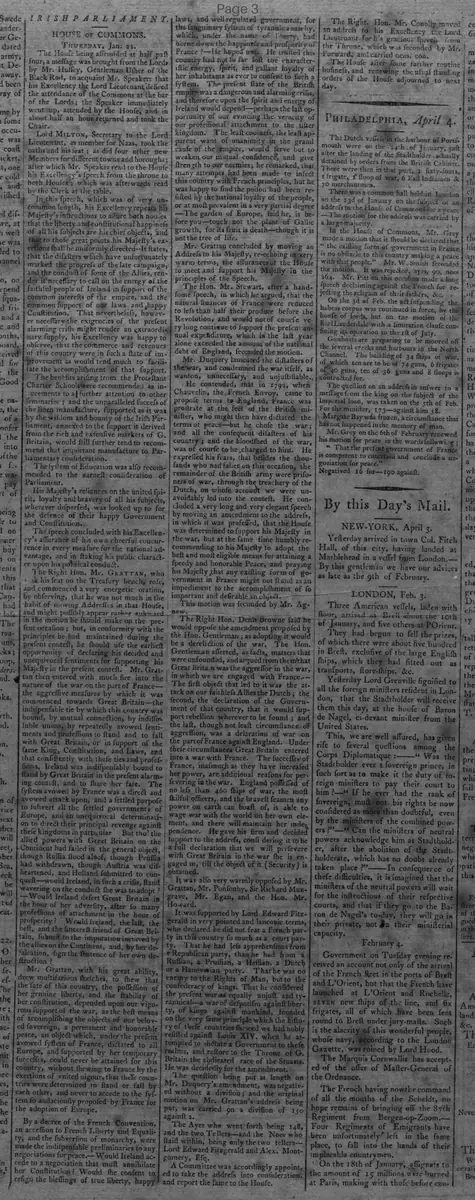
HOUSE OF COMMONS.
THURSDAY, Jan. 22.
The House being assembled at half past four, a message was brought from the Lords by Mr. Hussey, Gentleman Usher of the Black Rod, to acquaint Mr. Speaker: that his Excellency the Lord Lieutenant desired the attendance of the Commons at the bar of the Lords; the Speaker immediately went up, attended by the House, and in about half an hour returned and took the Chair. Lord Milton, Secretary to the Lord Lieutenant, as member for Naas, took the oaths and his seat; as did four other new Members for different towns and boroughs; after which Mr. Speaker read to the House his Excellency's speech from the throne to both Houses; which was afterwards read by the Clerk at the table. In this speech, which was of very uncommon length, his Excellency repeats his Majesty's instructions to assure both houses that the liberty and constitutional happiness of all his subjects are his chief objects, and that to those great points his Majesty's exertions shall be uniformly directed. It states, that the disasters which have unfortunately marked the progress of the late campaign, and the conduct of some of the Allies, render it necessary to call on the energy of the faithful people of Ireland in support of the common interests of the empire, and the common support of our laws and happy Constitution. Nevertheless, however necessary the exigencies of the present alarming crisis might render an extraordinary supply, his Excellency was happy to observe, that the commerce and revenues of this country were in such a state of improvement as would tend much to facilitate the accomplishment of that support. The benefits arising from the Protestant Charter Schools were recommended as inducements to all further attention to other seminaries; and the unparalleled success of the linen manufacture, supported as it was by the wisdom and bounty of the Irish Parliament, annexed to the support it derived from the rich and extensive markets of G. Britain, would still further tend to recommend that important manufacture to Parliamentary consideration. The system of Education was also recommended to the earnest consideration of Parliament. His Majesty's reliance on the united spirit, loyalty and bravery of all his subjects, wherever dispersed, was looked up to for the defence of their happy Government and Constitution. The speech concluded with his Excellency's assurance of his own cheerful concurrence in every measure for the national advantage, and in taking his public character upon his political conduct.
The Right Hon. Mr. GRATTAN, who took his seat on the Treasury bench, rose, and commenced a very energetic oration, by observing, that he was not much in the habit of moving Addresses in that House, and might possibly appear rather awkward in the motion he should make on the present occasion; but, in conformity with the principles he had maintained during the present contest, he should use the earliest opportunity of declaring his decided and unequivocal sentiments for supporting his Majesty in the present contest. Mr. Grattan then entered with much fire into the nature of the war—on the part of France—the aggressive measures by which it was commenced towards Great Britain—the indispensable tie by which this country was bound, by mutual connection, by indissoluble union, by repeatedly avowed sentiments and professions to stand and to fall with Great Britain, or in support of the same King, Constitution, and Laws, and that consistently with these ties and professions, Ireland was indispensably bound to stand by Great Britain in the present alarming contest, and to share her fate. The system avowed by France was a direct and avowed attack upon, and a settled purpose to subvert all the settled governments of Europe, and an unequivocal determination to direct their principal revenge against these kingdoms in particular. But tho' the allied powers with Great Britain on the Continent had failed in the general object, though Russia stood aloof, though Prussia had withdrawn, though Austria was disheartened, and Holland submitted to conquest—would Ireland, in such a crisis, stand wavering on the conduct she was to adopt? Would Ireland desert Great Britain in the hour of her adversity, after so many professions of attachment in the hour of prosperity? Would Ireland, the last, the best, and the sincerest friend of Great Britain, submit to the imputation incurred by the allies on the Continent, and, by her defalcation, sign the sentence of her own destruction? Mr. Grattan, with his great ability, drew multifarious sketches, to show that the fate of this country, the possession of her genuine liberty, and the stability of her constitution, depended upon our vigorous support of the war, as the best means of accomplishing the objects of our beloved sovereign, a permanent and honorable peace, an object which, under the present avowed system of France, dictated to all Europe, and supported by her temporary success, could never be attained for this country, without showing to France by the exertions of united vigour, that these countries were determined to stand or fall by each other, and never to accede to the system so audaciously proposed by France for the adoption of Europe.
By a decree of the French Convention, an accession to French Liberty and Equality, and the subversion of monarchy, were made the indispensable preliminaries to any negotiations for peace. Would Ireland accede to a negotiation that must annihilate her Constitution? Would she consent to resign the blessings of true liberty, happy laws, and well regulated government, for the sanguinary system of tyrannic anarchy, which under the name of liberty, had borne down the happiness and prosperity of France? He hoped not. He trusted this country had not so far lost the characteristic energy, spirit, and gallant loyalty of her inhabitants as ever to consent to such a system. The present state of the British empire was a dangerous and alarming crisis. and therefore upon the spirit and energy of Ireland would depend—perhaps the last opportunity of our evincing the veracity of our professional attachment to the sister kingdom. The least coolness, the least apparent want of unanimity in the grand cause of the empire, would serve but to weaken our mutual confidence, and give strength to our enemies; he remarked, that many attempts had been made to infect this country with French principles, but he was happy to find the poison had been rejected by the national loyalty of the people, or at most prevalent in a very partial degree.—The garden of Europe, said he, is before you—touch not the plant of Gallic growth, for its fruit is death—though it is not the tree of life. Mr. Grattan concluded by moving an Address to his Majesty, re-echoing in very warm terms, the assurances of the House to meet and support his Majesty in the principles of the Speech.
The Hon. Mr. Stewart, after a handsome speech, in which he argued, that the natural finances of France were reduced to less than half their produce before the Revolution, and would not of course very long continue to support the present annual expenditure, which in the last year alone exceeded the amount of the national debt of England, seconded the motion.
Mr. Duquery lamented the disasters of the war, and condemned the war itself, as wanton, unnecessary, and unjustifiable. He contended, that in 1792, when Chauvelin, the French Envoy, came to propose terms to England, France was prostrate at the feet of the British minister, who might then have dictated the terms of peace—but he chose the war; and all the consequent disasters of his country ; and the bloodshed of the war, was of course to be charged to him. He expressed his fears, that besides the thousands who had fallen on this occasion, the remainder of the British army were prisoners of war, through the treachery of the Dutch, on whose account we were unavoidably led into the contest. He concluded a very long and very elegant speech by moving an amendment to the address, in which it was professed, that the House was determined to support his Majesty in the war, but at the same time humbly recommending to his Majesty to adopt the best and most eligible means for attaining a speedy and honorable Peace, and praying his Majesty that any existing form of government in France might not stand as an impediment to the accomplishment of so important and desirable an object.
This motion was seconded by Mr. Agnew.
The Right Hon. Denis Browne said he would oppose the amendment proposed by the Hon. Gentleman ; as adopting it would be a dereliction of the war. The Hon. Gentleman asserted, as facts, matters that were unfounded, and argued from them—that Great Britain was the aggressor in the war, in which we are engaged with France.—The first object that led to it was the attack on our faithless Allies the Dutch; the second, the declaration of the Government of that country, that it would support rebellion wherever to be found ; and the last, though not least circumstance of aggression, was a declaration of war on the part of France against England. Under these circumstances Great Britain entered into a war with France. The successes of France, inasmuch as they have increased her power, are additional reasons for persevering in the war. England possessed of no less than 460 ships of war, the most skillful officers, and the bravest seamen any power on earth can boast of, is able to wage war with the world on her own element, and there will maintain her independence. He gave his firm and decided support to the address, considering it to be a full declaration that we will persevere with Great Britain in the war he is engaged in, 'till the object of it (Security) is obtained.
It was also very warmly opposed by Mr. Grattan, Mr. Ponsonby, Sir Richard Musgrave, Mr. Egan, and the Hon. Mr. Howard.
It was supported by Lord Edward Fitzgerald in very pointed and laconic terms, who declared he did not fear a French party in this country so much as a court party. That he had less apprehensions from a Republican party, than he had from a Russian, a Prussian, a Hessian, a Dutch or a Hanoverian party. That he was no enemy to the Rights of Man, but to the confederacy of kings. That he considered the present war as equally unjust and tyrannical—a war of despotism against liberty, of kings against mankind, founded on the very same principle which the history of these countries showed we had nobly resisted against Louis XIV. when he attempted to dictate a Government to these realms, and restore to the Throne of G. Britain the abdicated race of the Stuarts. He was decidedly for the amendment.
The question being put at length on Mr. Duquery's amendment, was negatived without a division; and the original motion on Mr. Grattan's address being put, was carried on a division of 150 against 2. The Ayes who went forth being 148, and the two Tellers—and the Noes who stayed within, being only the two tellers—Lord Edward Fitzgerald and Alex. Montgomery, Esq.
A Committee was accordingly appointed to take the address into consideration, and report the same to the House.
What sub-type of article is it?
What keywords are associated?
What entities or persons were involved?
Where did it happen?
Foreign News Details
Primary Location
Ireland
Event Date
Thursday, Jan. 22
Key Persons
Outcome
grattan's address supporting the war passed 150-2; duquery's amendment for peace negotiations negatived without division.
Event Details
The Irish House of Commons convened, heard the Lord Lieutenant's speech urging support for the empire amid war disasters and allied failures. Grattan moved an address affirming loyalty to the King and commitment to the war against France's subversive aims. Debate ensued with supporters emphasizing unity with Britain and opponents like Duquery and Fitzgerald criticizing the war as unjust and advocating peace without preconditions on French government. The address was carried overwhelmingly.