Thank you for visiting SNEWPapers!
Sign up free
Editorial
December 24, 1814
Virginia Argus
Richmond, Virginia
What is this article about?
Editorial from the Aurora defends conscription as essential for U.S. defense against British threats in the War of 1812, portraying it as a fair militia draft akin to Roman and French systems, and denouncing opponents as British adherents.
Merged-components note: The table provides population data relevant to the conscription discussion in the editorial text, with spatial overlap in the column; merge as part of the same logical component.
Clipping
OCR Quality
75%
Good
Full Text
DOMESTIC
From the Aurora.
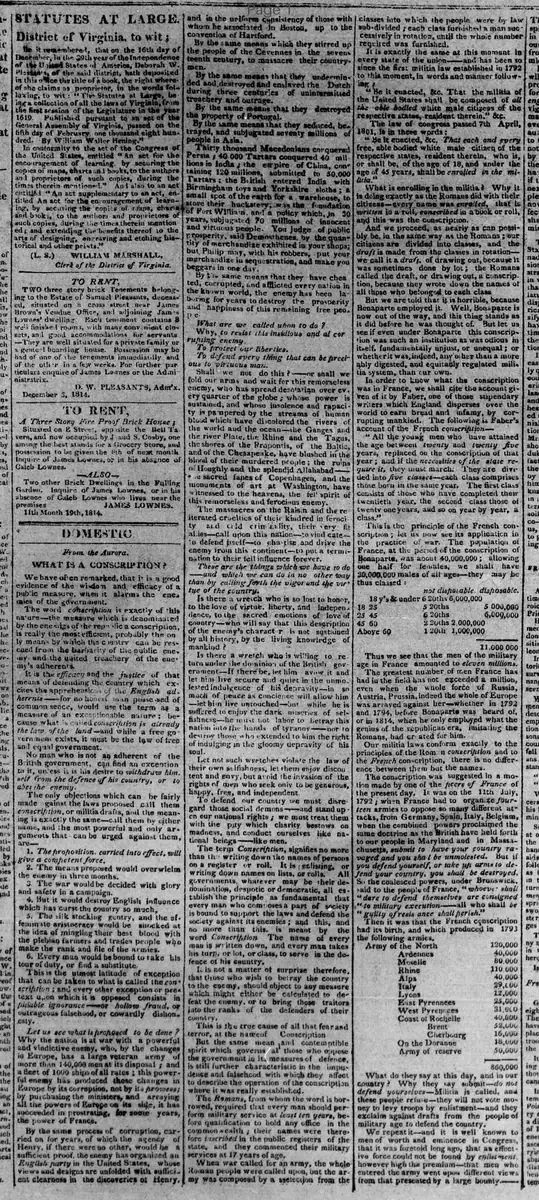
WHAT IS A CONSCRIPTION?
We have often remarked, that it is a good evidence of the wisdom and efficacy of a public measure, when it alarms the enemies of the government.
The word conscription is exactly of this nature-the measure which is denominated by the enemies of the republic a conscription, is really the most efficient, probably the only means by which the country can be rescued from the barbarity of the public enemy- and the united treachery of the enemy's adherents.
It is the efficacy and the justice of that means of defending the country which excites the apprehensions of the English adherents-for no honest man possessed of common sense, would use the term as a measure of an exceptionable nature: because what is called conscription is already the law of the land -and while a free government exists, it must be the law of free and equal government.
No man who is not an adherent of the British government, can find an exception to it, unless it is his desire to withdraw himself from the defence of his country, or to abet the enemy.
The only objections which can be fairly made against the laws proposed call them conscription, or militia drafts, and the meaning is exactly the same--call them by either name, and the most powerful and only arguments that can be urged against them, are--
1. The proposition, carried into effect, will give a competent force,
2. The means proposed would overwhelm the enemy in three months.
3. The war would be decided with glory and safety in a campaign.
4. But it would destroy English influence which has cursed the country so much.
5. The silk stocking gentry, and the unfortunate aristocracy would be shocked at the idea of mingling their best blood with the plebeian farmers and trades people who make the rank and file of the armies.
6. Every man would be bound to take his tour of duty, or find a substitute.
This is the utmost latitude of exception that can be taken to what is called the conscription ; and every other exception or pretext upon which it is opposed consists in pitiful ignorance-or hollow fraud, or outrageous falsehood, or cowardly dishonesty.
Let us see what is proposed to be done ?
Why the nation is at war with a powerful and vindictive enemy, who, by the changes in Europe, has a large veteran army of more than 140,000 men at its disposal ; and a fleet of 1000 ships of all rates ; this powerful enemy has produced those changes in Europe by its corruption, not by its prowess; by purchasing the ministers, and arraying all the powers of Europe on its side, it has succeeded in prostrating, for some years, the power of France.
By the same process of corruption, carried on for years, of which the agency of Henry, if there were no other, would be a sufficient proof, the enemy has organized an English party in the United States, whose views and designs are unfolded with sufficient clearness in the discoveries of Henry, and in the uniform consistency of those with whom he associated in Boston, up to the convention of Hartford.
By the same means which they stirred up the people of the Cevennes in the seventeenth century, to massacre their countrymen.
By the same means that they undermined and destroyed and enslaved the Dutch during three centuries of unintermitted treachery and outrage.
By the same means that they destroyed the property of Portugal.
By the same means that they seduced, betrayed, and subjugated seventy millions of people in Asia.
Thirty thousand Macedonians conquered Persia ; 40,000 Tartars conquered 40 millions in India ; the empire of China, containing 120 millions, submitted to 50,000 Tartars: the British entered India with Birmingham toys and Yorkshire cloths; a small spot of the earth for a warehouse, to store their huckstery, was the foundation of Fort William. and a policy which, in 30 years, subjugated 70 millions of innocent and virtuous people. You judge of public prosperity, said Demosthenes, by the quantity of merchandize exhibited in your shops; but Philip may, with his robbers, put your merchandize in sequestration, and make you beggars in one day.
By the same means that they have cheated, corrupted, and afflicted every nation in the known world, the enemy has been laboring for years to destroy the prosperity and happiness of this remaining free people.
What are we called upon to do ?
Why, to resist this insidious and all corrupting enemy
To protect our liberties.
To defend every thing that can be precious to virtuous man.
Shall we not do this ? or shall we fold our arms and wait for this remorseless enemy, who has spread desolation over every quarter of the globe ; whose power is sustained, and whose insolence and rapacity is pampered by the streams of human blood which have discolored the rivers of the world and the ocean-the Ganges and the river Plate. the Rhine and the Tagus, the shores of the Propontis, of the Baltic, and of the Chesapeake, have blushed in the blood of their murdered people; the ruins of Hugli and the splendid Allahabad, the sacred fanes of Copenhagen, and the monuments of art at Washington, have witnessed to the heavens, the fell spirit of this remorseless and ferocious enemy.
The massacres on the Raisin and the reiterated cruelties of their kindred in ferocity and cold criminality, their very allies--call upon this nation-to vindicate-- to defend itself--to chastise and drive the enemy from this continent-to put a termination to their fell influence forever.
These are the things which we have to do -and which we can do in no other way than by calling forth the vigor and the virtue of the country.
Is there a wretch who is so lost to honor, to the love of virtue. liberty, and independence, to the sacred emotions of love of country-who will say that this description of the enemy's character is not sustained by all history, by the living knowledge of mankind?
Is there a wretch who is willing to return under the dominion of the British government--If there be, let him avow it and let him live secure and quiet in the unmolested indulgence of his depravity--in so much of peace as conscience will allow him -let him live untouched--but while he is suffered to enjoy the dark miseries of selfishness-he must not labor to betray this nation into the hands of tyranny-and nor to destroy those who extended to him the right of indulging in the gloomy depravity of his soul.
Let not such wretches violate the law of their own selfishness, let them enjoy discontent and envy, but avoid the invasion of the rights of men who seek only to be generous, happy, free, and independent.
To defend our country we must disregard those social demons-and stand up on our national rights; we must treat them with the pity which charity bestows on madness, and conduct ourselves like national beings--like men.
The term Conscription, signifies no more than the writing down the names of persons on a register or roll. It is enlisting or writing down names on lists, or rolls. All governments, whatever may be their denomination, despotic or democratic, all establish the principle as fundamental that every man who composes a part of society is bound to support the laws and defend the society against its enemies; and this, and no more than this, is meant by the word Conscription The name of every man is written down, and every man takes his turn, or lot, or class, to serve in the defence of his country.
It is not a matter of surprise therefore, that those who wish to betray the country to the enemy, should object to any measure which might either be calculated to defeat the enemy. or to bring those traitors into the ranks of the defenders of their country.
This is the true cause of all that fear and terror, at the name of Conscription
But the same mean and contemptible spirit which governs all those who oppose the government in its measures of defence, is still further characteristic in the impudence and falsehood with which they affect to describe the operation of the conscription where it was really established.
The Romans, from whom the word is borrowed, required that every man should perform military service at least ten years, before qualification to hold any office in the commonwealth ; their names were therefore inscribed in the public registers of the state. and they commenced their military services at 17 years of age.
When war called for an army, the whole Roman people were called upon, but the army was composed by a selection from the classes into which the people were by law sub-divided : each class furnished a man successively in rotation, until the whole number required was furnished.
It is exactly the same at this moment in every state of the union -and has been so since the first militia law established in 1792 to this moment, in words and manner following
"Be it enacted, &c. That the militia of the United States shall be composed of all the able bodied white male citizens of the respective states, resident therein." &c.
The law of congress passed 7th April, 1806, is in these words:.
"Be it enacted, &c. That each and every free, able bodied white male citizen of the respective states, resident therein, who is, or shall be, of the age of 18, and under the age of 45 years, shall be enrolled in the militia."
What is enrolling in the militia ? Why it is doing exactly as the Romans did with their citizens-every name was enrolled, that is written in a roll, conscribed in a book or roll, and this was the Conscription.
And we proceed, as nearly as can possibly be, in the same way as the Romans; our citizens are divided into classes, and the draft is made from the classes in rotation- we call it a draft. of drawing out, because it was sometimes done by lot; the Romans called the draft, or drawing out, a conscription, because they wrote down the names of all those who belonged to each class
But we are told that it is horrible, because Bonaparte employed it. Well. Bonaparte is now out of the way and this thing stands as it did before he was thought of. But let us see if even under Bonaparte this conscription was such an institution as was odious in itself, fundamentally unjust, or unequal; or whether it was, indeed, any other than a more ably digested, and equitably regulated militia system, than our own.
In order to know what the conscription was in France, we shall cite the account given of it by Faber, one of those stipendary writers which England disperses over the world to earn bread and infamy, by corrupting mankind. The following is Faber's account of the French conscription---
"All the young men who have attained the age between twenty and twenty five years, replaced on the conscription of that year; and if the necessities of the state require it, they must march. They are divided into five classes--each class comprises those born in the same year, The first class consists of those who have completed their twentieth year, the second class those of twenty one years, and so on year by year, a class."
This is the principle of the French conscription; let us now see its application in the practice of war. The population of France, at the period of the conscription of Bonaparte, was about 40,000,000; allowing one half for females, we shall have 20,000,000 males of all ages--they may be thus classed :
not disposable. disposable.
11,000,000
Thus we see that the men of the military age in France amounted to eleven millions.
The greatest number of men France has had in the field has not exceeded a million, even when the whole force of Russia, Austria, Prussia, indeed the whole of Europe was arrayed against her -whether in 1792 and 1794, before Bonaparte was heard of, or in 1814, when he only employed what the genius of the republican era, imitating the Romans, had created for him.
Our militia laws conform exactly to the principles of the Roman conscription and to the French conscription, there is no difference between them but the names.
The conscription was suggested in a motion made by one of the peers of France of the present day. It was on the 11th July, 1792 ; when France had to organize fourteen armies to oppose so many different attacks, from Germany, Spain, Italy, Belgium, when the combined powers proclaimed the same doctrine as the British have held forth to our people in Maryland and in Massachusetts, submit to have your country ravaged and you shall be unmolested. But if you defend yourself, or take up arms to defend your country, you shall be destroyed.
So the coalesced powers, under Brunswick, said to the people of France, "whoever shall dare to defend themselves are consigned to military execution--all who shall be guilty of resistance shall perish."
Then it was that the French conscription had its birth, and which produced in 1793 the following armies.
Army of the North 120,000
Ardennes 40,000
Moselle 80,000
Rhine 110,000
Alps 40,000
Italy 29,100
Lyons 12,000
East Pyrenees 25,000
West Pyrenees 31,000
Coast of Rochelle 40,000
Brest 52,000
Cherbourg 16,000
On the Loire 18,000
Army of reserve 50,000
860,000
What do they say at this day, and in our Country? Why they say submit-do not defend yourselves-Militia is called, and these people refuse-they will not vote money to levy troops by enlistment-and they exclaim against drafts from the people of military age to defend the country.
We repeat it--and it is well known to men of worth and eminence in Congress, that it was foretold long ago, that an effective force could not be found by enlistment, however high the premium-that men who entered the army went upon different views from that presented by a large bounty..
The greatest portion of virtue and public spirit, and in the purest state, is to be found in that class of men who form the ranks of our army; they are a different kind of men from those who compose European armies.
Men taken up for one or even two years will not answer the purpose of an effectual prosecution of the war. An army must be formed to fulfill the service for which it is engaged, to bring the war to a close with vigor and celerity. The best economy is to make the army efficient at once, and in events authorize, as success could not but authorize, then the army might be reduced to the number required but if a force be not now raised, by the means pointed out by secretary Monroe ; if it be not done by the present Congress. then thousands will have cause to deplore their blindness-and if the government survives the shock of the next year, the Congress then, or the people themselves, will have to do what may now be done with effect- with the sure effect of glory and triumph for the republic, shame and defeat and confusion to its enemies.
From the Aurora.
WHAT IS A CONSCRIPTION?
We have often remarked, that it is a good evidence of the wisdom and efficacy of a public measure, when it alarms the enemies of the government.
The word conscription is exactly of this nature-the measure which is denominated by the enemies of the republic a conscription, is really the most efficient, probably the only means by which the country can be rescued from the barbarity of the public enemy- and the united treachery of the enemy's adherents.
It is the efficacy and the justice of that means of defending the country which excites the apprehensions of the English adherents-for no honest man possessed of common sense, would use the term as a measure of an exceptionable nature: because what is called conscription is already the law of the land -and while a free government exists, it must be the law of free and equal government.
No man who is not an adherent of the British government, can find an exception to it, unless it is his desire to withdraw himself from the defence of his country, or to abet the enemy.
The only objections which can be fairly made against the laws proposed call them conscription, or militia drafts, and the meaning is exactly the same--call them by either name, and the most powerful and only arguments that can be urged against them, are--
1. The proposition, carried into effect, will give a competent force,
2. The means proposed would overwhelm the enemy in three months.
3. The war would be decided with glory and safety in a campaign.
4. But it would destroy English influence which has cursed the country so much.
5. The silk stocking gentry, and the unfortunate aristocracy would be shocked at the idea of mingling their best blood with the plebeian farmers and trades people who make the rank and file of the armies.
6. Every man would be bound to take his tour of duty, or find a substitute.
This is the utmost latitude of exception that can be taken to what is called the conscription ; and every other exception or pretext upon which it is opposed consists in pitiful ignorance-or hollow fraud, or outrageous falsehood, or cowardly dishonesty.
Let us see what is proposed to be done ?
Why the nation is at war with a powerful and vindictive enemy, who, by the changes in Europe, has a large veteran army of more than 140,000 men at its disposal ; and a fleet of 1000 ships of all rates ; this powerful enemy has produced those changes in Europe by its corruption, not by its prowess; by purchasing the ministers, and arraying all the powers of Europe on its side, it has succeeded in prostrating, for some years, the power of France.
By the same process of corruption, carried on for years, of which the agency of Henry, if there were no other, would be a sufficient proof, the enemy has organized an English party in the United States, whose views and designs are unfolded with sufficient clearness in the discoveries of Henry, and in the uniform consistency of those with whom he associated in Boston, up to the convention of Hartford.
By the same means which they stirred up the people of the Cevennes in the seventeenth century, to massacre their countrymen.
By the same means that they undermined and destroyed and enslaved the Dutch during three centuries of unintermitted treachery and outrage.
By the same means that they destroyed the property of Portugal.
By the same means that they seduced, betrayed, and subjugated seventy millions of people in Asia.
Thirty thousand Macedonians conquered Persia ; 40,000 Tartars conquered 40 millions in India ; the empire of China, containing 120 millions, submitted to 50,000 Tartars: the British entered India with Birmingham toys and Yorkshire cloths; a small spot of the earth for a warehouse, to store their huckstery, was the foundation of Fort William. and a policy which, in 30 years, subjugated 70 millions of innocent and virtuous people. You judge of public prosperity, said Demosthenes, by the quantity of merchandize exhibited in your shops; but Philip may, with his robbers, put your merchandize in sequestration, and make you beggars in one day.
By the same means that they have cheated, corrupted, and afflicted every nation in the known world, the enemy has been laboring for years to destroy the prosperity and happiness of this remaining free people.
What are we called upon to do ?
Why, to resist this insidious and all corrupting enemy
To protect our liberties.
To defend every thing that can be precious to virtuous man.
Shall we not do this ? or shall we fold our arms and wait for this remorseless enemy, who has spread desolation over every quarter of the globe ; whose power is sustained, and whose insolence and rapacity is pampered by the streams of human blood which have discolored the rivers of the world and the ocean-the Ganges and the river Plate. the Rhine and the Tagus, the shores of the Propontis, of the Baltic, and of the Chesapeake, have blushed in the blood of their murdered people; the ruins of Hugli and the splendid Allahabad, the sacred fanes of Copenhagen, and the monuments of art at Washington, have witnessed to the heavens, the fell spirit of this remorseless and ferocious enemy.
The massacres on the Raisin and the reiterated cruelties of their kindred in ferocity and cold criminality, their very allies--call upon this nation-to vindicate-- to defend itself--to chastise and drive the enemy from this continent-to put a termination to their fell influence forever.
These are the things which we have to do -and which we can do in no other way than by calling forth the vigor and the virtue of the country.
Is there a wretch who is so lost to honor, to the love of virtue. liberty, and independence, to the sacred emotions of love of country-who will say that this description of the enemy's character is not sustained by all history, by the living knowledge of mankind?
Is there a wretch who is willing to return under the dominion of the British government--If there be, let him avow it and let him live secure and quiet in the unmolested indulgence of his depravity--in so much of peace as conscience will allow him -let him live untouched--but while he is suffered to enjoy the dark miseries of selfishness-he must not labor to betray this nation into the hands of tyranny-and nor to destroy those who extended to him the right of indulging in the gloomy depravity of his soul.
Let not such wretches violate the law of their own selfishness, let them enjoy discontent and envy, but avoid the invasion of the rights of men who seek only to be generous, happy, free, and independent.
To defend our country we must disregard those social demons-and stand up on our national rights; we must treat them with the pity which charity bestows on madness, and conduct ourselves like national beings--like men.
The term Conscription, signifies no more than the writing down the names of persons on a register or roll. It is enlisting or writing down names on lists, or rolls. All governments, whatever may be their denomination, despotic or democratic, all establish the principle as fundamental that every man who composes a part of society is bound to support the laws and defend the society against its enemies; and this, and no more than this, is meant by the word Conscription The name of every man is written down, and every man takes his turn, or lot, or class, to serve in the defence of his country.
It is not a matter of surprise therefore, that those who wish to betray the country to the enemy, should object to any measure which might either be calculated to defeat the enemy. or to bring those traitors into the ranks of the defenders of their country.
This is the true cause of all that fear and terror, at the name of Conscription
But the same mean and contemptible spirit which governs all those who oppose the government in its measures of defence, is still further characteristic in the impudence and falsehood with which they affect to describe the operation of the conscription where it was really established.
The Romans, from whom the word is borrowed, required that every man should perform military service at least ten years, before qualification to hold any office in the commonwealth ; their names were therefore inscribed in the public registers of the state. and they commenced their military services at 17 years of age.
When war called for an army, the whole Roman people were called upon, but the army was composed by a selection from the classes into which the people were by law sub-divided : each class furnished a man successively in rotation, until the whole number required was furnished.
It is exactly the same at this moment in every state of the union -and has been so since the first militia law established in 1792 to this moment, in words and manner following
"Be it enacted, &c. That the militia of the United States shall be composed of all the able bodied white male citizens of the respective states, resident therein." &c.
The law of congress passed 7th April, 1806, is in these words:.
"Be it enacted, &c. That each and every free, able bodied white male citizen of the respective states, resident therein, who is, or shall be, of the age of 18, and under the age of 45 years, shall be enrolled in the militia."
What is enrolling in the militia ? Why it is doing exactly as the Romans did with their citizens-every name was enrolled, that is written in a roll, conscribed in a book or roll, and this was the Conscription.
And we proceed, as nearly as can possibly be, in the same way as the Romans; our citizens are divided into classes, and the draft is made from the classes in rotation- we call it a draft. of drawing out, because it was sometimes done by lot; the Romans called the draft, or drawing out, a conscription, because they wrote down the names of all those who belonged to each class
But we are told that it is horrible, because Bonaparte employed it. Well. Bonaparte is now out of the way and this thing stands as it did before he was thought of. But let us see if even under Bonaparte this conscription was such an institution as was odious in itself, fundamentally unjust, or unequal; or whether it was, indeed, any other than a more ably digested, and equitably regulated militia system, than our own.
In order to know what the conscription was in France, we shall cite the account given of it by Faber, one of those stipendary writers which England disperses over the world to earn bread and infamy, by corrupting mankind. The following is Faber's account of the French conscription---
"All the young men who have attained the age between twenty and twenty five years, replaced on the conscription of that year; and if the necessities of the state require it, they must march. They are divided into five classes--each class comprises those born in the same year, The first class consists of those who have completed their twentieth year, the second class those of twenty one years, and so on year by year, a class."
This is the principle of the French conscription; let us now see its application in the practice of war. The population of France, at the period of the conscription of Bonaparte, was about 40,000,000; allowing one half for females, we shall have 20,000,000 males of all ages--they may be thus classed :
not disposable. disposable.
11,000,000
Thus we see that the men of the military age in France amounted to eleven millions.
The greatest number of men France has had in the field has not exceeded a million, even when the whole force of Russia, Austria, Prussia, indeed the whole of Europe was arrayed against her -whether in 1792 and 1794, before Bonaparte was heard of, or in 1814, when he only employed what the genius of the republican era, imitating the Romans, had created for him.
Our militia laws conform exactly to the principles of the Roman conscription and to the French conscription, there is no difference between them but the names.
The conscription was suggested in a motion made by one of the peers of France of the present day. It was on the 11th July, 1792 ; when France had to organize fourteen armies to oppose so many different attacks, from Germany, Spain, Italy, Belgium, when the combined powers proclaimed the same doctrine as the British have held forth to our people in Maryland and in Massachusetts, submit to have your country ravaged and you shall be unmolested. But if you defend yourself, or take up arms to defend your country, you shall be destroyed.
So the coalesced powers, under Brunswick, said to the people of France, "whoever shall dare to defend themselves are consigned to military execution--all who shall be guilty of resistance shall perish."
Then it was that the French conscription had its birth, and which produced in 1793 the following armies.
Army of the North 120,000
Ardennes 40,000
Moselle 80,000
Rhine 110,000
Alps 40,000
Italy 29,100
Lyons 12,000
East Pyrenees 25,000
West Pyrenees 31,000
Coast of Rochelle 40,000
Brest 52,000
Cherbourg 16,000
On the Loire 18,000
Army of reserve 50,000
860,000
What do they say at this day, and in our Country? Why they say submit-do not defend yourselves-Militia is called, and these people refuse-they will not vote money to levy troops by enlistment-and they exclaim against drafts from the people of military age to defend the country.
We repeat it--and it is well known to men of worth and eminence in Congress, that it was foretold long ago, that an effective force could not be found by enlistment, however high the premium-that men who entered the army went upon different views from that presented by a large bounty..
The greatest portion of virtue and public spirit, and in the purest state, is to be found in that class of men who form the ranks of our army; they are a different kind of men from those who compose European armies.
Men taken up for one or even two years will not answer the purpose of an effectual prosecution of the war. An army must be formed to fulfill the service for which it is engaged, to bring the war to a close with vigor and celerity. The best economy is to make the army efficient at once, and in events authorize, as success could not but authorize, then the army might be reduced to the number required but if a force be not now raised, by the means pointed out by secretary Monroe ; if it be not done by the present Congress. then thousands will have cause to deplore their blindness-and if the government survives the shock of the next year, the Congress then, or the people themselves, will have to do what may now be done with effect- with the sure effect of glory and triumph for the republic, shame and defeat and confusion to its enemies.
| 18 year's & under | 6 20ths | 6,000,000 |
| 18 25 | 5 20ths | 5,000,000 |
| 25 45 | 6 20ths | 6,000,000 |
| 45 60 | 2 20ths | 2,000,000 |
| Above 60 | 1 20th | 1,000,000 |
What sub-type of article is it?
Military Affairs
War Or Peace
Partisan Politics
What keywords are associated?
Conscription
Militia Draft
British Influence
War Of 1812
Military Defense
Anti British
Republican Virtue
What entities or persons were involved?
British Government
Bonaparte
Henry
Secretary Monroe
Congress
Editorial Details
Primary Topic
Defense Of Conscription As Necessary For War Against Britain
Stance / Tone
Strongly Pro Conscription And Anti British Sympathizers
Key Figures
British Government
Bonaparte
Henry
Secretary Monroe
Congress
Key Arguments
Conscription Is The Law Of The Land And Essential For Defense
Opponents Are British Adherents Seeking To Betray The Country
Similar To Roman And French Systems, It Is Just And Equal
Will Provide Competent Force To End War Quickly
British Corruption Has Subjugated Nations Worldwide