Thank you for visiting SNEWPapers!
Sign up free
Editorial
September 8, 1828
Phenix Gazette
Alexandria, Virginia
What is this article about?
1828 Alexandria editorial criticizing Andrew Jackson's character and actions, urging Virginia anti-Jackson activity, reporting favorable public sentiment, explaining his feud with Madison, and exposing Gen. McCoy's inconsistent anti-Jackson stance via committee response and witness testimony.
Clipping
OCR Quality
85%
Good
Full Text
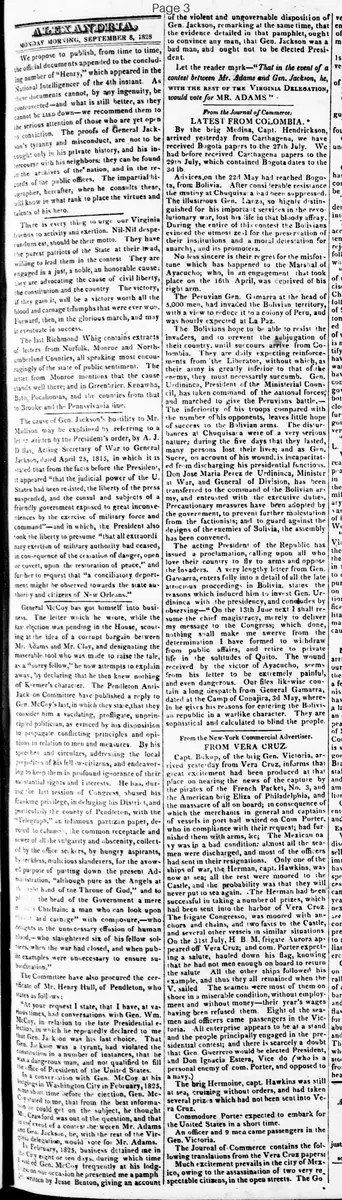
ALEXANDRIA,
MONDAY MORNING, SEPTEMBER 8, 1828.
We propose to publish, from time to time, the official documents appended to the concluding number of "Henry," which appeared in the National Intelligencer of the 4th instant. As these documents cannot, by any ingenuity, be controverted—and what is still better, as they cannot be lied down—we recommend them to the serious attention of those who are yet open to conviction. The proofs of General Jackson's tyranny only in his private history, and his son's tyranny and misconduct, are not to be found in his intercourse with his neighbors: they can be found in the archives of the nation, and in the records of the public offices. The impartial biographer, hereafter, when he consults these, will know in what rank to place the virtues and talents of his hero.
There is every thing to urge our Virginia friends to activity and exertion. Nil desperandum est, should be their motto. They have the purest patriots of the State at their head, willing to lead them in the contest. They are engaged in a just, a noble, an honorable cause: they are advocating the cause of civil liberty, the constitution and the country. The victory, if they gain it, will be a victory worth all the blood and carnage triumphs that were ever won. Forward, then, in the glorious march, and may it eventuate in success.
The last Richmond Whig contains extracts of letters from Norfolk, Monroe and Northumberland Counties, all speaking most encouragingly of the state of public sentiment. The letter from Monroe mentions that the cause stands well there; and in Greenbrier, Kanawha, Bath, Pocahontas, and the counties from that to Brooke and the Pennsylvania line.
The cause of Gen. Jackson's hostility to Mr. Madison may be explained by referring to a letter written by the President's order, by A. J. Dallas, Acting Secretary of War to General Jackson, dated April 25, 1815, in which it is stated that from the facts before the President, it appeared "that the judicial power of the U. States had been resisted, the liberty of the press suspended, and the consul and subjects of a friendly government exposed to great inconveniences by the exercise of military force and command"—and in which, the President also took the liberty to presume "that all extraordinary exertion of military authority had ceased, in consequence of the cessation of danger, open or covert, upon the restoration of peace," and further to request that "a conciliatory deportment might be observed towards the state authorities and citizens of New Orleans."
General McCoy has got himself into business. The letter which he wrote, while the late election was pending in the House, scouting at the idea of a corrupt bargain between Mr. Adams and Mr. Clay, and designating the miserable tool who was made to raise the tale, as a "sorry fellow," he now attempts to explain away, by declaring that he then knew nothing of Kremer's character. The Pendleton Anti-Jackson Committee have published a reply to Gen. McCoy's last, in which they state, that they consider him a vacillating, profligate, unprincipled politician, as evinced by his disposition to propagate conflicting principles and opinions in relation to men and measures. By his speeches and circulars, addressing the local prejudices of his fellow-citizens, and endeavoring to keep them in profound ignorance of their substantial rights and interests. He has, during the last session of Congress, abused his franking privilege, in deluging his District, and particularly the county of Pendleton, with the "Telegraph," a notorious partizan paper, devoted to calumny, the common receptacle and sewer of all the vulgarity and obscenity, collected by the office seekers, by hungry aspirants, by reckless, malicious slanderers, for the avowed purpose of putting down the present Administration, "although pure as the Angels at the right hand of the Throne of God," and to place at the head of the Government a mere Chieftain: a man who can look upon ward carnage with composure,—who delights in the unnecessary effusion of human blood,—who slaughtered six of his fellow soldiers, when the war had closed, and when public examples were unnecessary to ensure subordination."
The Committee have also procured the certificate of Mr. Henry Hull, of Pendleton, who states as follows:
"At your request I state, that I have, at various times, had conversations with Gen. Wm. McCoy, in relation to the late Presidential election, in which he repeatedly declared to me that Gen. Jackson was his last choice. That Gen. Jackson was a tyrant, had violated the constitution in a number of instances, that he was a dangerous man, and not qualified to fill the office of President of the United States.
In a conversation with Gen. McCoy at his lodgings in Washington City in February, 1825, some short time before the election, he communicated to me, that from the best information Mr. Clay could get, was out of the question he thought that in the event of a contest between Mr. Adams and Gen. Jackson he with the rest of the Virginia delegation, would vote for Mr. Adams:
In February, 1825, business detained me in the City I visited Gen. McCoy ten days frequently during at which his lodgings time on one occasion he presented written by Jesse Benton, giving an account of the violent and ungovernable disposition of Gen. Jackson, remarking at the same time, that the evidence detailed in that pamphlet, ought to convince any man, that Gen. Jackson was a bad man, and ought not to be elected President.
Let the reader mark—“That in the event of a contest between Mr. Adams and Gen. Jackson, he WITH THE REST OF THE Virginia Delegation, would vote for MR. ADAMS""
of the violent and ungovernable disposition of Gen. Jackson, remarking at the same time, that the evidence detailed in that pamphlet, ought to convince any man, that Gen. Jackson was a bad man, and ought not to be elected President.
Let the reader mark—“That in the event of a contest between Mr. Adams and Gen. Jackson, he WITH THE REST OF THE Virginia Delegation, would vote for MR. ADAMS"
MONDAY MORNING, SEPTEMBER 8, 1828.
We propose to publish, from time to time, the official documents appended to the concluding number of "Henry," which appeared in the National Intelligencer of the 4th instant. As these documents cannot, by any ingenuity, be controverted—and what is still better, as they cannot be lied down—we recommend them to the serious attention of those who are yet open to conviction. The proofs of General Jackson's tyranny only in his private history, and his son's tyranny and misconduct, are not to be found in his intercourse with his neighbors: they can be found in the archives of the nation, and in the records of the public offices. The impartial biographer, hereafter, when he consults these, will know in what rank to place the virtues and talents of his hero.
There is every thing to urge our Virginia friends to activity and exertion. Nil desperandum est, should be their motto. They have the purest patriots of the State at their head, willing to lead them in the contest. They are engaged in a just, a noble, an honorable cause: they are advocating the cause of civil liberty, the constitution and the country. The victory, if they gain it, will be a victory worth all the blood and carnage triumphs that were ever won. Forward, then, in the glorious march, and may it eventuate in success.
The last Richmond Whig contains extracts of letters from Norfolk, Monroe and Northumberland Counties, all speaking most encouragingly of the state of public sentiment. The letter from Monroe mentions that the cause stands well there; and in Greenbrier, Kanawha, Bath, Pocahontas, and the counties from that to Brooke and the Pennsylvania line.
The cause of Gen. Jackson's hostility to Mr. Madison may be explained by referring to a letter written by the President's order, by A. J. Dallas, Acting Secretary of War to General Jackson, dated April 25, 1815, in which it is stated that from the facts before the President, it appeared "that the judicial power of the U. States had been resisted, the liberty of the press suspended, and the consul and subjects of a friendly government exposed to great inconveniences by the exercise of military force and command"—and in which, the President also took the liberty to presume "that all extraordinary exertion of military authority had ceased, in consequence of the cessation of danger, open or covert, upon the restoration of peace," and further to request that "a conciliatory deportment might be observed towards the state authorities and citizens of New Orleans."
General McCoy has got himself into business. The letter which he wrote, while the late election was pending in the House, scouting at the idea of a corrupt bargain between Mr. Adams and Mr. Clay, and designating the miserable tool who was made to raise the tale, as a "sorry fellow," he now attempts to explain away, by declaring that he then knew nothing of Kremer's character. The Pendleton Anti-Jackson Committee have published a reply to Gen. McCoy's last, in which they state, that they consider him a vacillating, profligate, unprincipled politician, as evinced by his disposition to propagate conflicting principles and opinions in relation to men and measures. By his speeches and circulars, addressing the local prejudices of his fellow-citizens, and endeavoring to keep them in profound ignorance of their substantial rights and interests. He has, during the last session of Congress, abused his franking privilege, in deluging his District, and particularly the county of Pendleton, with the "Telegraph," a notorious partizan paper, devoted to calumny, the common receptacle and sewer of all the vulgarity and obscenity, collected by the office seekers, by hungry aspirants, by reckless, malicious slanderers, for the avowed purpose of putting down the present Administration, "although pure as the Angels at the right hand of the Throne of God," and to place at the head of the Government a mere Chieftain: a man who can look upon ward carnage with composure,—who delights in the unnecessary effusion of human blood,—who slaughtered six of his fellow soldiers, when the war had closed, and when public examples were unnecessary to ensure subordination."
The Committee have also procured the certificate of Mr. Henry Hull, of Pendleton, who states as follows:
"At your request I state, that I have, at various times, had conversations with Gen. Wm. McCoy, in relation to the late Presidential election, in which he repeatedly declared to me that Gen. Jackson was his last choice. That Gen. Jackson was a tyrant, had violated the constitution in a number of instances, that he was a dangerous man, and not qualified to fill the office of President of the United States.
In a conversation with Gen. McCoy at his lodgings in Washington City in February, 1825, some short time before the election, he communicated to me, that from the best information Mr. Clay could get, was out of the question he thought that in the event of a contest between Mr. Adams and Gen. Jackson he with the rest of the Virginia delegation, would vote for Mr. Adams:
In February, 1825, business detained me in the City I visited Gen. McCoy ten days frequently during at which his lodgings time on one occasion he presented written by Jesse Benton, giving an account of the violent and ungovernable disposition of Gen. Jackson, remarking at the same time, that the evidence detailed in that pamphlet, ought to convince any man, that Gen. Jackson was a bad man, and ought not to be elected President.
Let the reader mark—“That in the event of a contest between Mr. Adams and Gen. Jackson, he WITH THE REST OF THE Virginia Delegation, would vote for MR. ADAMS""
of the violent and ungovernable disposition of Gen. Jackson, remarking at the same time, that the evidence detailed in that pamphlet, ought to convince any man, that Gen. Jackson was a bad man, and ought not to be elected President.
Let the reader mark—“That in the event of a contest between Mr. Adams and Gen. Jackson, he WITH THE REST OF THE Virginia Delegation, would vote for MR. ADAMS"
What sub-type of article is it?
Partisan Politics
Constitutional
What keywords are associated?
1828 Election
Anti Jackson
Partisan Politics
Virginia Sentiment
General Mccoy
Constitutional Violations
New Orleans Incident
What entities or persons were involved?
General Jackson
Mr. Madison
A. J. Dallas
General Mccoy
Mr. Adams
Mr. Clay
Kremer
Henry Hull
Pendleton Anti Jackson Committee
Jesse Benton
Editorial Details
Primary Topic
Criticism Of Andrew Jackson And Support For Anti Jackson Cause In 1828 Election
Stance / Tone
Strongly Anti Jackson, Pro Adams Administration
Key Figures
General Jackson
Mr. Madison
A. J. Dallas
General Mccoy
Mr. Adams
Mr. Clay
Kremer
Henry Hull
Pendleton Anti Jackson Committee
Jesse Benton
Key Arguments
Official Documents Prove Jackson's Tyranny And Misconduct In National Archives
Urge Virginia Patriots To Fight For Civil Liberty And Constitution Against Jackson
Public Sentiment In Virginia Counties Favors Anti Jackson Cause
Jackson's Hostility To Madison Stems From 1815 Rebuke Over Military Overreach In New Orleans
Mccoy Is Vacillating And Unprincipled, Previously Anti Jackson As Per His Statements And Hull's Testimony
Jackson Unfit Due To Violent Disposition, Constitutional Violations, And Unnecessary Killings