Thank you for visiting SNEWPapers!
Sign up free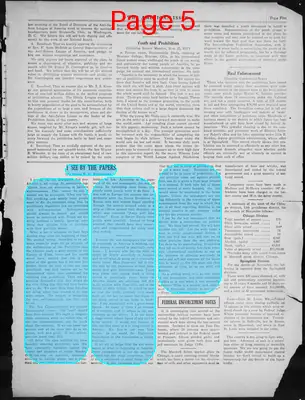
Editorial
January 1, 1928
The American Issue
Westerville, Delaware County, Ohio
What is this article about?
Bishop E. G. Richardson defends Prohibition in a satirical critique of 'wet newspapers' claiming it fails by interfering with self-expression. He argues against anti-prohibition views using biblical and historical examples, asserts liquor is not common, and challenges wets to run candidates on repeal. Quotes Proverbs on wine.
Clipping
OCR Quality
98%
Excellent
Full Text
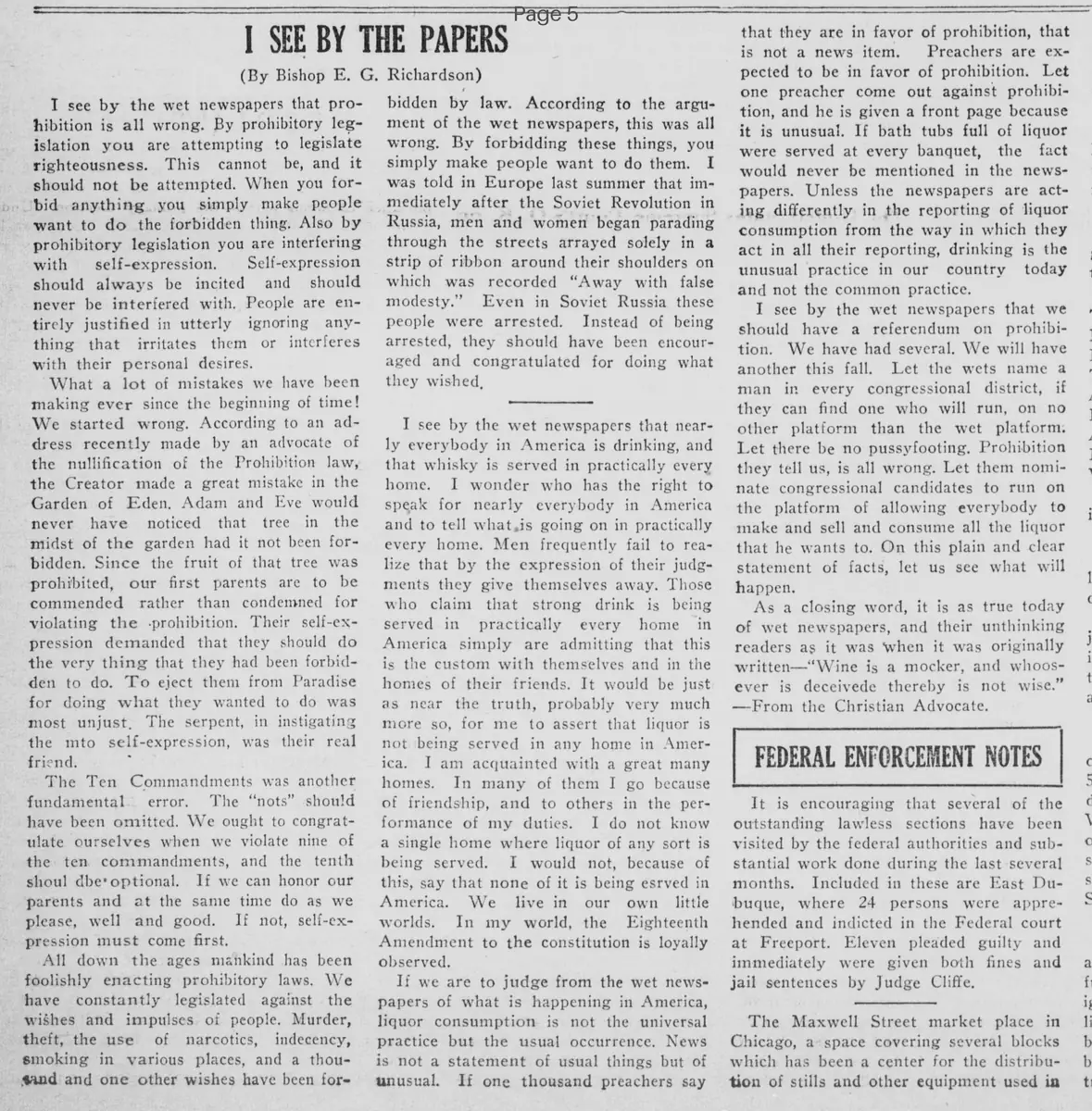
I SEE BY THE PAPERS
(By Bishop E. G. Richardson)
I see by the wet newspapers that prohibition is all wrong. By prohibitory legislation you are attempting to legislate righteousness. This cannot be, and it should not be attempted. When you forbid anything you simply make people want to do the forbidden thing. Also by prohibitory legislation you are interfering with self-expression. Self-expression should always be incited and should never be interfered with. People are entirely justified in utterly ignoring anything that irritates them or interferes with their personal desires.
What a lot of mistakes we have been making ever since the beginning of time! We started wrong. According to an address recently made by an advocate of the nullification of the Prohibition law, the Creator made a great mistake in the Garden of Eden. Adam and Eve would never have noticed that tree in the midst of the garden had it not been forbidden. Since the fruit of that tree was prohibited, our first parents are to be commended rather than condemned for violating the prohibition. Their self-expression demanded that they should do the very thing that they had been forbidden to do. To eject them from Paradise for doing what they wanted to do was most unjust. The serpent, in instigating them to self-expression, was their real friend.
The Ten Commandments was another fundamental error. The "nots" should have been omitted. We ought to congratulate ourselves when we violate nine of the ten commandments, and the tenth should be optional. If we can honor our parents and at the same time do as we please, well and good. If not, self-expression must come first.
All down the ages mankind has been foolishly enacting prohibitory laws. We have constantly legislated against the wishes and impulses of people. Murder, theft, the use of narcotics, indecency, smoking in various places, and a thousand and one other wishes have been forbidden by law. According to the argument of the wet newspapers, this was all wrong. By forbidding these things, you simply make people want to do them. I was told in Europe last summer that immediately after the Soviet Revolution in Russia, men and women began parading through the streets arrayed solely in a strip of ribbon around their shoulders on which was recorded "Away with false modesty." Even in Soviet Russia these people were arrested. Instead of being arrested, they should have been encouraged and congratulated for doing what they wished.
I see by the wet newspapers that nearly everybody in America is drinking, and that whisky is served in practically every home. I wonder who has the right to speak for nearly everybody in America and to tell what is going on in practically every home. Men frequently fail to realize that by the expression of their judgments they give themselves away. Those who claim that strong drink is being served in practically every home in America simply are admitting that this is the custom with themselves and in the homes of their friends. It would be just as near the truth, probably very much more so, for me to assert that liquor is not being served in any home in America. I am acquainted with a great many homes. In many of them I go because of friendship, and to others in the performance of my duties. I do not know a single home where liquor of any sort is being served. I would not, because of this, say that none of it is being served in America. We live in our own little worlds. In my world, the Eighteenth Amendment to the constitution is loyally observed.
If we are to judge from the wet newspapers of what is happening in America, liquor consumption is not the universal practice but the usual occurrence. News is not a statement of usual things but of unusual. If one thousand preachers say that they are in favor of prohibition, that is not a news item.
Preachers are expected to be in favor of prohibition. Let one preacher come out against prohibition, and he is given a front page because it is unusual. If bath tubs full of liquor were served at every banquet, the fact would never be mentioned in the newspapers. Unless the newspapers are acting differently in the reporting of liquor consumption from the way in which they act in all their reporting, drinking is the unusual practice in our country today and not the common practice.
I see by the wet newspapers that we should have a referendum on prohibition. We have had several. We will have another this fall. Let the wets name a man in every congressional district, if they can find one who will run, on no other platform than the wet platform. Let there be no pussyfooting. Prohibition they tell us, is all wrong. Let them nominate congressional candidates to run on the platform of allowing everybody to make and sell and consume all the liquor that he wants to. On this plain and clear statement of facts, let us see what will happen.
As a closing word, it is as true today of wet newspapers, and their unthinking readers as it was when it was originally written-"Wine is a mocker, and whosoever is deceived thereby is not wise."
—From the Christian Advocate.
(By Bishop E. G. Richardson)
I see by the wet newspapers that prohibition is all wrong. By prohibitory legislation you are attempting to legislate righteousness. This cannot be, and it should not be attempted. When you forbid anything you simply make people want to do the forbidden thing. Also by prohibitory legislation you are interfering with self-expression. Self-expression should always be incited and should never be interfered with. People are entirely justified in utterly ignoring anything that irritates them or interferes with their personal desires.
What a lot of mistakes we have been making ever since the beginning of time! We started wrong. According to an address recently made by an advocate of the nullification of the Prohibition law, the Creator made a great mistake in the Garden of Eden. Adam and Eve would never have noticed that tree in the midst of the garden had it not been forbidden. Since the fruit of that tree was prohibited, our first parents are to be commended rather than condemned for violating the prohibition. Their self-expression demanded that they should do the very thing that they had been forbidden to do. To eject them from Paradise for doing what they wanted to do was most unjust. The serpent, in instigating them to self-expression, was their real friend.
The Ten Commandments was another fundamental error. The "nots" should have been omitted. We ought to congratulate ourselves when we violate nine of the ten commandments, and the tenth should be optional. If we can honor our parents and at the same time do as we please, well and good. If not, self-expression must come first.
All down the ages mankind has been foolishly enacting prohibitory laws. We have constantly legislated against the wishes and impulses of people. Murder, theft, the use of narcotics, indecency, smoking in various places, and a thousand and one other wishes have been forbidden by law. According to the argument of the wet newspapers, this was all wrong. By forbidding these things, you simply make people want to do them. I was told in Europe last summer that immediately after the Soviet Revolution in Russia, men and women began parading through the streets arrayed solely in a strip of ribbon around their shoulders on which was recorded "Away with false modesty." Even in Soviet Russia these people were arrested. Instead of being arrested, they should have been encouraged and congratulated for doing what they wished.
I see by the wet newspapers that nearly everybody in America is drinking, and that whisky is served in practically every home. I wonder who has the right to speak for nearly everybody in America and to tell what is going on in practically every home. Men frequently fail to realize that by the expression of their judgments they give themselves away. Those who claim that strong drink is being served in practically every home in America simply are admitting that this is the custom with themselves and in the homes of their friends. It would be just as near the truth, probably very much more so, for me to assert that liquor is not being served in any home in America. I am acquainted with a great many homes. In many of them I go because of friendship, and to others in the performance of my duties. I do not know a single home where liquor of any sort is being served. I would not, because of this, say that none of it is being served in America. We live in our own little worlds. In my world, the Eighteenth Amendment to the constitution is loyally observed.
If we are to judge from the wet newspapers of what is happening in America, liquor consumption is not the universal practice but the usual occurrence. News is not a statement of usual things but of unusual. If one thousand preachers say that they are in favor of prohibition, that is not a news item.
Preachers are expected to be in favor of prohibition. Let one preacher come out against prohibition, and he is given a front page because it is unusual. If bath tubs full of liquor were served at every banquet, the fact would never be mentioned in the newspapers. Unless the newspapers are acting differently in the reporting of liquor consumption from the way in which they act in all their reporting, drinking is the unusual practice in our country today and not the common practice.
I see by the wet newspapers that we should have a referendum on prohibition. We have had several. We will have another this fall. Let the wets name a man in every congressional district, if they can find one who will run, on no other platform than the wet platform. Let there be no pussyfooting. Prohibition they tell us, is all wrong. Let them nominate congressional candidates to run on the platform of allowing everybody to make and sell and consume all the liquor that he wants to. On this plain and clear statement of facts, let us see what will happen.
As a closing word, it is as true today of wet newspapers, and their unthinking readers as it was when it was originally written-"Wine is a mocker, and whosoever is deceived thereby is not wise."
—From the Christian Advocate.
What sub-type of article is it?
Temperance
Moral Or Religious
What keywords are associated?
Prohibition
Temperance
Wet Newspapers
Self Expression
Eighteenth Amendment
Liquor Consumption
Moral Legislation
What entities or persons were involved?
Bishop E. G. Richardson
Wet Newspapers
Adam And Eve
Soviet Russia
Editorial Details
Primary Topic
Defense Of Prohibition Against Wet Newspapers' Arguments
Stance / Tone
Strongly Pro Prohibition, Satirical Critique
Key Figures
Bishop E. G. Richardson
Wet Newspapers
Adam And Eve
Soviet Russia
Key Arguments
Prohibition Does Not Legislate Righteousness But Is Necessary; Forbidding Things Does Not Always Increase Desire
Biblical Prohibitions Like Eden And Ten Commandments Are Justified, Not Errors
Anti Prohibition Claims Exaggerate Liquor Use; Author's Experience Shows Compliance
Newspapers Highlight Unusual Events, So Drinking Is Not Common
Challenge Wets To Run Candidates On Repeal Platform
Quote From Proverbs Against Wine