Thank you for visiting SNEWPapers!
Sign up free
Alexandria Gazette & Daily Advertiser
Alexandria, Virginia
What is this article about?
U.S. Senate proceedings on April 7-8, 1820 (implied year). Discussed and acted on bills including pensions, navigation, Savannah fire relief, Missouri expedition funding, eighth Circuit Court, and district judges' salaries. Passed several measures after debates; adjourned without setting earlier next session.
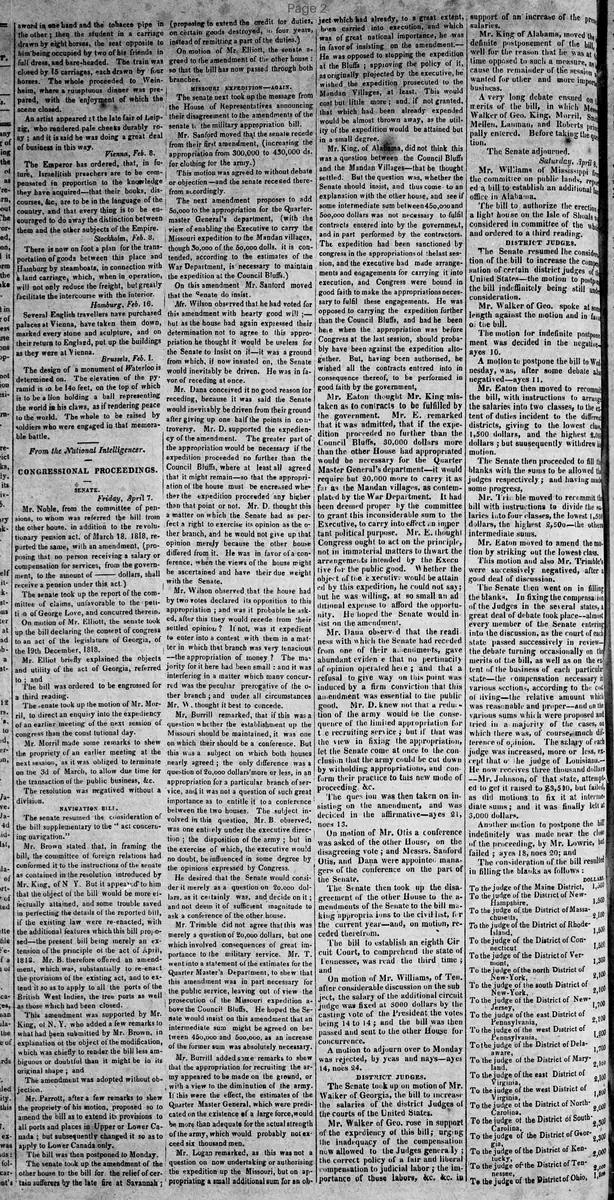
Merged-components note: Continuation of the congressional proceedings article detailing Senate discussions and judge salary increases across pages 2 and 3; text flows directly from one to the other.
Clippings
1 of 2
OCR Quality
Full Text
CONGRESSIONAL PROCEEDINGS.
SENATE.
Friday, April 7.
Mr. Noble, from the committee of pensions, to whom was referred the bill from the other house, in addition to the revolutionary pension act, of March 18, 1818, reported the same, with an amendment, (proposing that no person receiving a salary or compensation for services, from the government, to the amount of five hundred dollars, shall receive a pension under this act.)
The senate took up the report of the committee of claims, unfavorable to the petition of George Love, and concurred therein.
On motion of Mr. Elliott, the senate took up the bill declaring the consent of congress to an act of the legislature of Georgia, of the 19th December, 1818.
Mr. Elliot briefly explained the objects and utility of the act of Georgia, referred to; and
The bill was ordered to be engrossed for a third reading.
The Senate took up the motion of Mr. Morril, to direct an enquiry into the expediency of an earlier meeting of the next session of congress than the constitutional day.
Mr. Morril made some remarks to shew the propriety of an earlier meeting at the next session, as it was obliged to terminate on the 3d of March, to allow due time for the transaction of the public business, &c.
The resolution was negatived without a division.
NAVIGATION BILL.
The senate resumed the consideration of the bill supplementary to the "act concerning navigation."
Mr. Brown stated that, in framing the bill, the committee of foreign relations had conformed it to the instructions of the senate as contained in the resolution introduced by Mr. King, of N Y. But it appeared to him that the object of the bill would be more effectually attained, and some trouble saved in perfecting the details of the reported bill, if the existing law were re-enacted, with the additional features which this bill proposed—the present bill being merely an extension of the principle of the act of April, 1818. Mr. B. therefore offered an amendment, which was, substantially to re-enact the provisions of the existing act, and to extend it so as to apply to all the ports of the British West Indies, the free ports as well as those which had been closed.
This amendment was supported by Mr. King, of N. Y. who added a few remarks to what had been submitted by Mr. Brown, in explanation of the object of the modification, which was chiefly to render the bill less ambiguous or doubtful than it might be in its original shape; and
The amendment was adopted without objection.
Mr. Parrott, after a few remarks to shew the propriety of his motion, proposed so to amend the bill as to extend its provisions to all ports and places in Upper or Lower Canada; but subsequently changed it so as to apply to Lower Canada only.
The bill was then postponed to Monday
The senate took up the amendment of the other house to the bill for the relief of certain sufferers by the late fire at Savannah;
(proposing to extend the credit for duties, on certain goods destroyed, to four years instead of remitting a part of the duties.)
On motion of Mr. Elliott, the senate agreed to the amendment of the other house: so that the bill has now passed through both branches.
MISSOURI EXPEDITION—AGAIN.
The senate next took up the message from the House of Representatives announcing their disagreement to the amendments of the senate to the military appropriation bill.
Mr. Sanford moved that the senate recede from their first amendment, (increasing the appropriation from 300,000 to 430,000 ds. for clothing for the army.)
This motion was agreed to without debate or objection—and the senate receded therefrom accordingly.
The next amendment proposes to add 50,000 to the appropriation for the Quarter-Master General's department, (with the view of enabling the Executive to carry the Missouri expedition to the Mandan villages, though 30,000 of the 50,000 dolls. it is contended, according to the estimates of the War Department, is necessary to maintain the expedition at the Council Bluffs.)
On this amendment Mr. Sanford moved that the Senate do insist.
Mr. Wilson observed that he had voted for this amendment with hearty good will ;— but as the house had again expressed their determination not to agree to this appropriation he thought it would be useless for the Senate to insist on it—it was a ground from which, if now insisted on, the Senate would inevitably be driven. He was in favor of receding at once.
Mr. Dana conceived it no good reason for receding, because it was said the Senate would inevitably be driven from their ground after giving up one half the points in controversy. Mr. D. supported the expediency of the amendment. The greater part of the appropriation would be necessary if the expedition proceeded no further than the Council Bluffs, where at least all agreed that it might remain—so that the appropriation of the house must be increased whether the expedition proceeded any higher than that point or not. Mr. D. thought this a matter on which the Senate had as perfect a right to exercise its opinion as the other branch, and he would not give up that opinion merely because the other house differed from it. He was in favor of a conference, when the views of the house might be ascertained and have their due weight with the Senate.
Mr. Wilson observed that the house had by two votes declared its opposition to this appropriation; and was it probable, he asked, after this they would recede from their settled opinion? If not, was it expedient to enter into a contest with them in a matter in which that branch was very tenacious—the appropriation of money? The majority for it here had been small: and it was interfering in a matter which many concurred was the peculiar prerogative of the other branch; and under all circumstances Mr. W. thought it best to concede.
Mr. Burrill remarked, that if this was a question whether the establishment up the Missouri should be maintained, it was one on which there should be a conference. But this was a subject on which both houses nearly agreed; the only difference was a question of 20,000 dollars more or less, in an appropriation for a particular branch of service, and it was not a question of such great importance as to entitle it to a conference between the two houses. The subject involved in this question, Mr. B. observed, was one entirely under the executive direction; the disposition of the army; but in the exercise of which, the executive would no doubt, be influenced in some degree by the opinions expressed by Congress.
He desired that the Senate would consider it merely as a question on 20,000 dollars, as it certainly was, and decide on it; and not deem it of sufficient magnitude to ask a conference of the other house.
Mr. Trimble did not agree that this was merely a question of 20,000 dollars, but one which involved consequences of great importance to the military service. Mr. T. went into a statement of the estimates for the Quarter Master's Department, to shew that this amendment was in part necessary for the public service, leaving out of view the prosecution of the Missouri expedition above the Council Bluffs, He hoped the Senate would insist on this amendment that an intermediate sum might be agreed on between 450,000 and 500,000, as an increase of the former sum was absolutely necessary.
Mr. Burrill added some remarks to shew that the appropriation for recruiting the army appeared to be made on the ground, or with a view to the diminution of the army.
If this were the effect, the estimates of the Quarter Master General, which were predicated on the existence of a large force, would be more than adequate for the actual strength of the army, which would probably not exceed six thousand men.
Mr. Logan remarked, as this was not a question on now undertaking or authorising the expedition up the Missouri, but on appropriating a small additional sum for an object which had already, to a great extent, been carried into execution, and which was of great national importance, he was in favor of insisting on the amendment.
He was opposed to stopping the expedition at the Bluffs; approving the policy of it, as originally projected by the executive, he wished the expedition prosecuted to the Mandan Villages, at least. This would cost but little more; and, if not granted, that which had been already expended would be almost thrown away, as the utility of the expedition would be attained but in a small degree.
Mr. King, of Alabama, did not think this was a question between the Council Bluffs and the Mandan Villages—that he thought settled. But the question was, whether the Senate should insist, and thus come to an explanation with the other house, and see if some intermediate sum between 450,000 and 500,000 dollars was not necessary to fulfil contracts entered into by the government, and in part performed by the contractors.
The expedition had been sanctioned by congress in the appropriations of the last session, and the executive had made arrangements and engagements for carrying it into execution, and Congress were bound in good faith to make the appropriations necessary to fulfil these engagements. He was opposed to carrying the expedition further than the Council Bluffs, and had he been here when the appropriation was before Congress at the last session, should probably have been against the expedition altogether. But, having been authorised, he wished all the contracts entered into in consequence thereof, to be performed in good faith by the government.
Mr. Eaton thought Mr. King mistaken as to contracts to be fulfilled by the government. Mr. E. remarked that it was admitted, that if the expedition proceeded no further than the Council Bluffs, 30,000 dollars more than the other House had appropriated would be necessary for the Quarter Master General's department --it would require but 20,000 more to carry it as far as the Mandan villages, as contemplated by the War Department. It had been deemed proper by the committee to grant this inconsiderable sum to the Executive, to carry into effect an important political purpose. Mr. E. thought Congress ought to act on the principle, not in immaterial matters to thwart the arrangements intended by the Executive for the public good. Whether the object of the Executive would be attained by this expedition, he could not say; but he was willing, at so small an additional expense to afford the opportunity. He hoped the Senate would insist on the amendment.
Mr. Dana observed that the readiness with which the Senate had receded from one of their amendments, gave abundant evidence that no pertinacity of opinion operated here; and that a refusal to give way on this point was induced by a firm conviction that this amendment was essential to the public good. Mr. D. knew not that a reduction of the army would be the consequence of the limited appropriation for the recruiting service; but if that was the view in fixing the appropriation, let the Senate come at once to the conclusion that the army could be cut down by withholding appropriations, and conform their practice to this new mode of proceeding, &c.
The question was then taken on insisting on the amendment, and was decided in the affirmative—ayes 21, noes 13.
On motion of Mr. Otis a conference was asked of the other House, on the disagreeing vote; and Messrs. Sanford, Otis, and Dana were appointed managers of the conference on the part of the Senate.
The Senate then took up the disagreement of the other House to the amendments of the Senate to the bill making appropriations to the civil list, for the current year—and, on motion, receded therefrom.
The bill to establish an eighth Circuit Court, to comprehend the state of Tennessee, was read the third time; and
On motion of Mr. Williams, of Ten. after considerable discussion on the subject, the salary of the additional circuit judge was fixed at 3500 dollars by the casting vote of the President the votes being 14 to 14; and the bill was then passed and sent to the other House for concurrence.
A motion to adjourn over to Monday was rejected, by yeas and nays—ayes 14, noes 24.
DISTRICT JUDGES.
The Senate took up on motion of Mr. Walker of Georgia, the bill to increase the salaries of the district Judges of the courts of the United States.
Mr. Walker of Geo. rose in support of the expediency of this bill; urging the inadequacy of the compensation now allowed to the Judges generally; the correct policy of a fair and liberal compensation to judicial labor; the importance of those labors, &c. &c. in support of an increase of the present salaries.
Mr. King of Alabama, moved the indefinite postponement of the bill.
Well for the reason that he was at all times opposed to such a measure, as the remainder of the session was wanted for other and more important business.
A very long debate ensued on the merits of the bill, in which Messrs. Walker of Geo. King, Morril, Smith, Mellen, Lanman, and Roberts principally entered. Before taking the question.
The Senate adjourned.
Saturday, April 8.
Mr. Williams of Mississippi from the committee on public lands, reported a bill to establish an additional land office in Alabama.
The bill to authorize the erection of a light house on the Isle of Shoals was considered in committee of the whole and ordered to a third reading.
DISTRICT JUDGES.
The Senate resumed the consideration of the bill to increase the compensation of certain district judges of the United States—the motion to postpone the bill indefinitely being still under consideration.
Mr. Walker of Geo. spoke at some length against the motion and in favor of the bill.
The motion for indefinite postponement was decided in the negative— ayes 10.
A motion to postpone the bill to Wednesday, was, after some debate also negatived—ayes 11.
Mr. Eaton then moved to recommit the bill, with instructions to arrange the salaries into two classes, to the extent of duties incident to the different districts, giving to the lowest class 1,500 dollars, and the highest 2,000 dollars; but subsequently withdrew his motion.
The Senate then proceeded to fill the blanks with the sums to be allowed the judges respectively; and having made some progress,
Mr. Trimble moved to recommit the bill with instructions to divide the salaries into four classes, the lowest 1,500 dollars, the highest 2,500—the others intermediate sums.
Mr. Eaton moved to amend the motion by striking out the lowest class.
This motion and also Mr. Trimble's were successively negatived, after a good deal of discussion.
The Senate then went on in filling the blanks. In fixing the compensation of the Judges in the several states, a great deal of debate took place—almost every member of the Senate entering into the discussion, as the court of each state passed successively in review— the debate turning occasionally on the merits of the bill, as well as on the extent of the business of each particular state—the compensation necessary in various sections, according to the cost of living—the relative amount which was reasonable and proper—and on the various sums which were proposed and tried in a majority of the cases, on which there was, of course, much difference of opinion. The salary of each judge was increased, more or less, except that of the judge of Louisiana.— He now receives three thousand dollars—Mr. Johnson, of that state, attempted to get it raised to 3,500, but failed, as did motions to fix it at intermediate sums; and it was finally left at 3,000 dollars.
Another motion to postpone the bill indefinitely was made near the close of the proceeding, by Mr. Lowrie, but failed; ayes 18, noes 20; and
The consideration of the bill resulted in filling the blanks as follows:
DOLLARS.
To the judge of the Maine District, 1,500
To the judge of the District of New-Hampshire, 1,500
To the judge of the District of Massachusetts, 2,100
To the judge of the District of Rhode Island, 1,500
To the judge of the District of Connecticut 1,500
To the judge of the District of Vermont, 1,300
To the judge of the north District of New-York, 2,100
To the judge of the south District of New-York, 2,100
To the judge of the District of New-Jersey, 1,700
To the judge of the east District of Pennsylvania, 2,100
To the judge of the west District of Pennsylvania, 1,800
To the judge of the District of Delaware, 1,700
To the judge of the District of Maryland, 2,100
To the judge of the east District of Virginia, 2,100
To the judge of the west District of Virginia, 1,800
To the judge of the District of North-Carolina, 2,000
To the judge of the District of South-Carolina, 2,300
To the judge of the District of Georgia, 2,300
To the judge of the District of Kentucky, 2,000
To the judge of the District of Tennessee. 2,000
To the judge of the District of Ohio, 1,800
To the judge of the District of Louisiana, $3,000.
To the judge of the District of Indiana, $3,000.
To the judge of the District of Illinois, $1,500.
To the judge of the District of Mississippi, $2,150.
To the judge of the District of Alabama, $2,000.
The blank for fixing the commencement of the new salaries was filled with the 1st of June next; and thus all the blanks having been filled,
The Senate adjourned.
What sub-type of article is it?
What keywords are associated?
What entities or persons were involved?
Where did it happen?
Domestic News Details
Primary Location
Washington
Event Date
Friday, April 7 And Saturday, April 8
Key Persons
Outcome
bills passed or amended on pensions, navigation, savannah fire relief, missouri expedition funding (insisted on amendment, conference requested), eighth circuit court established with judge salary at $3500; district judges' salaries increased variably by state/district, effective june 1; other motions defeated or receded from.
Event Details
The Senate considered multiple bills and motions: reported amendments to pension bill; concurred on claims petition; consented to Georgia act; rejected earlier congress meeting; amended and postponed navigation bill; agreed to House amendment on Savannah fire relief; debated and insisted on military appropriation amendment for Missouri expedition, requesting conference; receded on civil appropriations; passed eighth Circuit Court bill; debated and increased district judges' salaries after extensive discussion on each district.