Thank you for visiting SNEWPapers!
Sign up free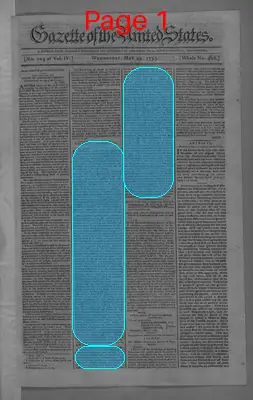
Gazette Of The United States
New York, New York County, New York
What is this article about?
A letter to Mr. Fenno justifying the French Revolution by paralleling it with the English Civil War of the previous century, arguing that the value of liberty outweighs the temporary horrors of civil war compared to perpetual despotism.
Merged-components note: Split parts of the same letter to the editor justifying the French revolution.
Clipping
OCR Quality
Full Text
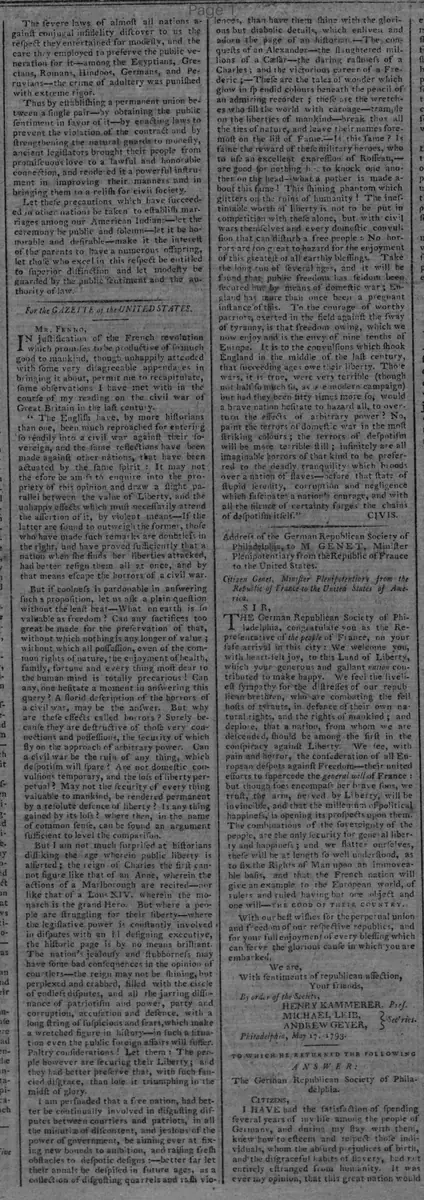
MR. FENNO,
IN justification of the French revolution I which promises to be productive of so much good to mankind, though unhappily attended with some very disagreeable appendages in bringing it about, permit me to recapitulate, some observations I have met with in the course of my reading on the civil war of Great Britain in the last century.
"The English have, by more historians than one, been much reproached for entering so readily into a civil war against their sovereign, and the same reflections have been made against other nations, that have been actuated by the same spirit : It may not therefore be amiss to enquire into the propriety of this opinion and draw a slight parallel between the value of Liberty, and the unhappy effects which must necessarily attend the assertion of it, by violent means--If the latter are found to outweigh the former, those who have made such remarks are doubtless in the right, and have proved sufficiently that a nation when she finds her liberties attacked, had better resign them all at once, and by that means escape the horrors of a civil war. But if coolness is pardonable in answering such a proposition, let us ask a plain question without the least heat-What on earth is so valuable as freedom? Can any sacrifices too great be made for the preservation of that, without which nothing is any longer of value ; without which all possession, even of the common rights of nature, the enjoyment of health, family, fortune and every thing most dear to the human mind is totally precarious ! Can any one hesitate a moment in answering this query ? A florid description of the horrors of a civil war, may be the answer. But why are these effects called horrors ? Surely because they are destructive of those very connections and possessions, the security of which fly on the approach of arbitrary power. Can a civil war be the ruin of any thing, which despotism will spare ? Are not domestic convulsions temporary, and the loss of liberty perpetual ? May not the security of every thing valuable to mankind, be rendered permanent by a resolute defence of liberty ? Is any thing gained by its loss ? where then, in the name of common sense, can be found an argument sufficient to level the comparison.
But I am not much surprised at historians disliking the age wherein public liberty is asserted; the reign, of Charles the first cannot figure like that of an Anne, wherein the actions of a Marlborough are recited-nor like that of a Louis XIV. wherein the monarch is the grand Hero. But where a people are struggling for their liberty-where the legislative power is constantly involved in disputes with an ill designing executive, the historic page is by no means brilliant. The nation's jealousy and stubbornness may have some bad consequences in the opinion of courtiers-the reign may not be shining, but perplexed and crabbed, filled with the circle of endless disputes, and all the jarring dissonance of patriotism and power, party and corruption, accusation and defence, with a long string of suspicions and fears, which make a wretched figure in history--in such a situation even the public foreign affairs will suffer. Paltry considerations ! Let them : The people however are securing their Liberty; and they had better preserve that, with such fancied disgrace, than lose it triumphing in the midst of glory.
I am persuaded that a free nation, had better be continually involved in disputing disputes between courtiers and patriots, in all the minutiae of discontent, and jealous of the power of government, be aiming ever at fixing new bounds to ambition, and raising fresh obstacles to despotic designs :-better far let their annals be despised in future ages, as a collection of disgusting quarrels and rash violences, than have them shine with the glorious but diabolic details, which enliven and adorn the page of an historian.-The conquests of an Alexander-the slaughtered millions of a Cæsar--the daring rashness of a Charles; and the victorious career of a Frederic ;-These are the tales of wonder which glow in splendid colours beneath the pencil of an admiring recorder ; these are the wretches who fill the world with carnage-trample on the liberties of mankind-break thus all the ties of nature. and leave their names foremost on the list of Fame.Is this fame ? Is fame the reward of these military heroes, who to use an excellent expression of Rousseau,-are good for nothing but- to knock one another on the head- what a pother is made about this fame ! This shining phantom which glitters on the ruins of humanity ! The inestimable worth of liberty is not to be put in competition with these alone, but. with civil wars themselves and every domestic convulsion that can disturb a free people : No horrors are too great to hazard for the enjoyment of this greatest of all earthly blessings. Take the long run of several ages, and it will be found that public freedom has seldom been secured but by means of domestic war ; England has more than once been a pregnant instance of this. T'o the courage of worthy patriots, exerted in the field against the way of tyranny, is that freedom owing, which we now enjoy and is the envy of nine tenths of Europe. It is to the convulsions which shook England in the middle of the last century, that succeeding ages owe their liberty. Those wars, it is true, were very terrible (though not half so much so, as de modern campaign) but had they been fifty times more so, would a brave nation hesitate to hazard all, to overturn the effects of arbitrary power? No, paint the terrors of domestic war in the most striking colours; the terrors of despotism will be more terrible still; infinitely are all imaginable horrors of that kind to be preferred to the deadly, tranquility: which broods over a nation of slaves-before that state of stupid servility, corruption and negligence which fascinates a nation's courage. and with all the silence of certainty forges the chains of despotism itself."
CIVIS.
What sub-type of article is it?
What themes does it cover?
What keywords are associated?
What entities or persons were involved?
Letter to Editor Details
Author
Civis
Recipient
Mr. Fenno
Main Argument
the french revolution is justified despite its violent means, as the pursuit and preservation of liberty outweigh the temporary horrors of civil war, which are preferable to the perpetual tyranny of despotism, as illustrated by the english civil war against charles i.
Notable Details