Thank you for visiting SNEWPapers!
Sign up free
Alexandria Advertiser And Commercial Intelligencer
Alexandria, Virginia
What is this article about?
U.S. House of Representatives debate on February 8, 1803, over Mr. Bayard's motion to discuss a constitutional amendment on presidential and vice-presidential elections, opposed due to timing and attendance concerns. Motion fails. House then debates Mr. Bacon's resolutions to cede District of Columbia jurisdiction back to Virginia and Maryland, with arguments on constitutional implications, citizen rights, and government convenience.
Merged-components note: Continuation of the congressional debate story across pages 2 and 3, as the text flows directly from the end of the first component to the start of the second.
Clippings
1 of 2
OCR Quality
Full Text
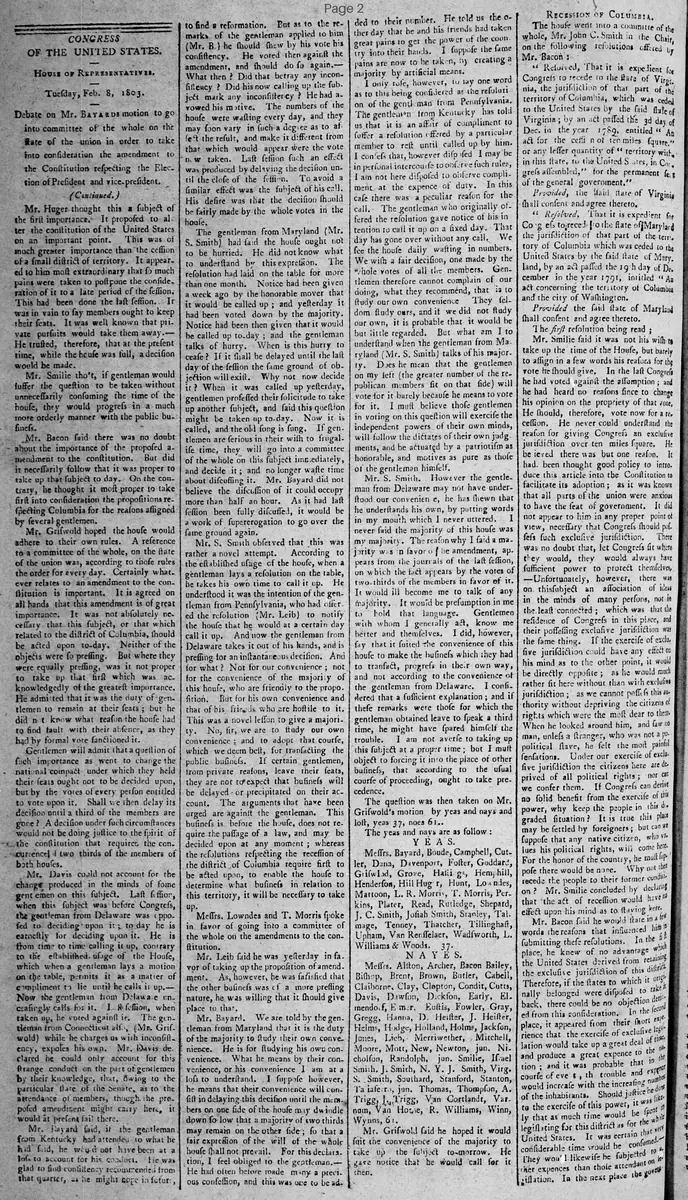
OF THE UNITED STATES.
HOUSE OF REPRESENTATIVES
Tuesday, Feb. 8, 1803.
Debate on Mr. Bayard's motion to go into committee of the whole on the state of the union in order to take into consideration the amendment to the Constitution respecting the Election of President and Vice-President.
(Continued.)
Mr. Huger thought this a subject of the first importance. It proposed to alter the constitution of the United States on an important point. This was of much greater importance than the cession of a small district of territory. It appeared to him most extraordinary that so much pains were taken to postpone the consideration of it to a late period of the session. This had been done the last session. It was in vain to say members ought to keep their seats. It was well known that private pursuits would take them away.
He trusted, therefore, that at the present time, while the house was full, a decision would be made.
Mr. Smilie thought, if gentlemen would suffer the question to be taken without unnecessarily consuming the time of the house, they would progress in a much more orderly manner with the public business.
Mr. Bacon said there was no doubt about the importance of the proposed amendment to the constitution. But did it necessarily follow that it was proper to take up that subject to-day. On the contrary, he thought it most proper to take first into consideration the propositions respecting Columbia for the reasons assigned by several gentlemen.
Mr. Griswold hoped the house would adhere to their own rules. A reference to a committee of the whole, on the state of the union was, according to those rules, the order for every day. Certainly whatever relates to an amendment to the constitution is important. It is agreed on all hands that this amendment is of great importance. It was not absolutely necessary that this subject, or that which related to the district of Columbia, should be acted upon to-day. Neither of the objects were so pressing. But where they were equally pressing, was it not proper to take up that first which was acknowledgedly of the greatest importance. He admitted that it was the duty of gentlemen to remain at their seats; but he did not know what reason the house had to find fault with their absence, as they had by formal vote sanctioned it.
Gentlemen will admit that a question of such importance as went to change the national compact--under which they held their seats ought not to be decided upon, but by the votes of every person entitled to vote upon it. Shall we then delay its decision until a third of the members are gone? A decision under such circumstances would not be doing justice to the spirit of the constitution that requires the concurrence of two thirds of the members of both houses.
Mr. Davis could not account for the change produced in the minds of some gentlemen on this subject. Last session, when this subject was before Congress, the gentleman from Delaware was opposed to deciding upon it; to-day he is earnestly for deciding upon it. He is from time to time calling it up, contrary to the established usage of the House, which when a gentleman lays a motion on the table, permits it as a matter of compliment to lie until he calls it up.
Now the gentleman from Delaware unceasingly calls for it. Last session, when taken up, he voted against it. The gentleman from Connecticut also, (Mr. Griswold) while he charges us with inconsistency, exposes his own. Mr. Davis declared he could only account for this strange conduct on the part of gentlemen by their knowledge that, owing to the particular state of the Senate, as to the attendance of members, though the proposed amendment might carry here, it would at present fail there.
Mr. Bayard said, if the gentleman from Kentucky had attended to what he had said, he could not have been at a loss to account for his conduct. He was glad to find consistency recommended from that quarter, as he might cope in future, to find a reformation. But as to the remarks of the gentleman applied to him (Mr. B.) he should shew by his vote his consistency. He voted then against the amendment, and should do so again.
What then? Did that betray any inconsistency? Did his now calling up the subject mark any inconsistency? He had avowed his motive. The numbers of the house were wasting every day, and they may soon vary in such a degree as to affect the result, and make it different from that which would appear were the vote now taken. Last session such an effect was produced by delaying the decision until the close of the session. To avoid a similar effect was the subject of his call. His desire was that the decision should be fairly made by the whole votes in the house.
The gentleman from Maryland (Mr. S. Smith) had said the house ought not to be hurried. He did not know what to understand by this expression. The resolution had laid on the table for more than one month. Notice had been given a week ago by the honorable mover that it would be called up: and yesterday it had been voted down by the majority. Notice had been then given that it would be called up to-day; and the gentleman talks of hurry. When is this hurry to cease? If it shall be delayed until the last day of the session the same ground of objection will exist. Why not now decide it? When it was called up yesterday, gentlemen professed their solicitude to take up another subject, and said this question might be taken up to-day. Now it is called, and the old song is sung. If gentlemen are serious in their wish to husband time, they will go into a committee of the whole on this subject immediately, and decide it; and no longer waste time about discussing it. Mr. Bayard did not believe the discussion of it could occupy more than half an hour. As it had last session been fully discussed, it would be a work of supererogation to go over the same ground again.
Mr. S. Smith observed that this was rather a novel attempt. According to the established usage of the house, when a gentleman lays a resolution on the table, he takes his own time to call it up. He understood it was the intention of the gentleman from Pennsylvania, who had offered the resolution (Mr. Leib) to notify the house that he would at a certain day call it up. And now the gentleman from Delaware takes it out of his hands, and is pressing for an instantaneous decision. And for what? Not for our convenience; not for the convenience of the majority of this house, who are friendly to the proposition. But for his own convenience and that of his friends who are hostile to it. This was a novel lesson to give a majority. No, sir,--we are to study our own convenience: and to adopt that course, which we deem best, for transacting the public business. If certain gentlemen, from private reasons, leave their seats, they are not to expect that business will be delayed--or precipitated on their account. The arguments that have been urged are against the gentleman. This business is before the house, does not require the passage of a law, and may be decided upon at any moment; whereas the resolutions respecting the cession of the district of Columbia require first to be acted upon, to enable the house to determine what business in relation to this territory, it will be necessary to take up.
Messrs. Lowndes and T. Morris spoke in favor of going into a committee of the whole on the amendments to the constitution.
Mr. Leib said he was yesterday in favor of taking up the proposition of amendment. As, however, he was satisfied that the other business was of a more pressing nature, he was willing that it should give place to that.
Mr. Bayard. We are told by the gentleman from Maryland that it is the duty of the majority to study their own convenience. He is for studying his own convenience. What he means by their convenience, or his convenience I am at a loss to understand. I suppose however, he means that their convenience will consist in delaying this decision until the members on one side of the house may dwindle down so low that a majority of two thirds may remain on the other side; so that a fair expression of the will of the whole house shall not prevail. For this declaration, I feel obliged to the gentleman.
He had often before made many a precious confession, and this was one to be added to their number. He told us the other day that he and his friends had taken great pains to get the power of the country into their hands. I suppose the same pains are now to be taken, by creating a majority by artificial means.
I only rose, however, to say one word as to this being considered as the resolution of the gentleman from Pennsylvania. The gentleman from Kentucky has told us that it is an affair of compliment to suffer a resolution offered by a particular member to rest until called up by him. I confess that, however disposed I may be in personal intercourse to observe such rules, I am not here disposed to observe compliment at the expense of duty. In this case there was a peculiar reason for the call. The gentleman who originally offered the resolution gave notice of his intention to call it up on a fixed day. That day has gone over without any call. We see the house daily wasting in numbers. We wish a fair decision, one made by the whole votes of all the members. Gentlemen therefore cannot complain of our doing, what they recommend, that is to study our own convenience They seldom study ours, and if we did not study our own, it is probable that it would be but little regarded. But what am I to understand when the gentleman from Maryland (Mr. S. Smith) talks of his majority. Does he mean that the gentlemen on my left (the greater number of the republican members sit on that side) will vote for it barely because he means to vote for it. I must believe those gentlemen in voting on this question will exercise the independent powers of their own minds, will follow the dictates of their own judgments, and be actuated by a patriotism as honorable, and motives as pure as those of the gentleman himself.
Mr. S. Smith. However the gentleman from Delaware may not have understood our convenience, he has shewn that he understands his own, by putting words in my mouth which I never uttered. I never said the majority of this house was my majority. The reason why I said a majority was in favor of the amendment, appears from the journals of the last session, on which the fact appears by the votes of two-thirds of the members in favor of it. It would ill become me to talk of any majority. It would be presumption in me to hold that language. Gentlemen with whom I generally sit, know me better and themselves. I did, however, say that it suited the convenience of this house to make the business which they had to transact, progress in their own way, and not according to the convenience of the gentleman from Delaware. I considered that a sufficient explanation: and if these remarks were those for which the gentleman obtained leave to speak a third time, he might have spared himself the trouble. I am not averse to taking up this subject at a proper time; but I must object to forcing it into the place of other business, that according to the usual course of proceeding, ought to take precedence.
The question was then taken on Mr. Griswold's motion, by yeas and nays and lost, yeas 37, noes 61.
The yeas and nays are as follow:
YEAS.
Messrs. Bayard, Boude, Campbell, Cutler, Dana, Davenport, Foster, Goddard, Griswold, Grove, Hastings, Hemphill, Henderson, Hill, Huger, Hunt, Lowndes, Mattoon, L. R. Morris, T. Morris, Perkins, Plater, Read, Rutledge, Shepard, J. C. Smith, Josiah Smith, Stanley, Taliaferro, Tenney, Thatcher, Tillinghast, Upham, Van Rensselaer, Wadsworth, L. Williams & Woods. 37.
NAYES.
Messrs. Alston, Archer, Bacon, Bailey, Bishop, Brent, Brown, Butler, Cabell, Claiborne, Clay, Clopton, Condit, Cutts, Davis, Dawson, Dickson, Early, Elmendorf, Elmer, Eustis, Fowler, Gray, Gregg, Hanna, D. Heister, J. Heister, Helms, Hodge, Holland, Holmes, Jackson, Jones, Leib, Meriwether, Mitchell, Moore, Mott, New, Newton, jun. Nicholson, Randolph, jun. Smilie, Israel Smith, J. Smith, N. Y. J. Smith, Virg. S. Smith, Southard, Stanford, Stanton, Taliaferro, jun. Thomas, Thompson, A. Trigg, J. Trigg, Van Cortlandt, Varnum, Van Horne, R. Williams, Winn, Wynns, 61.
Mr. Griswold said he hoped it would suit the convenience of the majority to take up the subject to-morrow. He gave notice that he would call for it then.
The house went into a committee of the whole, Mr. John C. Smith in the Chair, on the following resolutions offered by Mr. Bacon:
"Resolved, That it is expedient for Congress to recede to the State of Virginia, the jurisdiction of that part of the territory of Columbia, which was ceded to the United States by the said state of Virginia; by an act passed the 3d day of Dec. in the year 1789, entitled 'An act for the cession of ten miles square, or any lesser quantity of territory within this state, to the United States, in Congress assembled,' for the permanent seat of the general government."
Provided, the said state of Virginia shall consent and agree thereto.
"Resolved, That it is expedient for Congress to recede to the state of Maryland the jurisdiction of that part of the territory of Columbia which was ceded to the United States by the said State of Maryland, by an act passed the 19th day of December in the year 1791, entitled 'An act concerning the territory of Columbia and the city of Washington.'"
Provided the said state of Maryland shall consent and agree thereto.
The first resolution being read;
Mr. Smilie said it was not his wish to take up the time of the House, but barely to assign in a few words his reasons for the vote he should give. In the last Congress he had voted against the assumption; and he had heard no reasons since to change his opinion on the propriety of that vote. He should, therefore, vote now for a recession. He never could understand the reason of giving Congress an exclusive jurisdiction over ten miles square. He believed there was but one reason. It had been thought good policy to introduce this article into the Constitution to facilitate its adoption; as it was known that all parts of the union were anxious to have the seat of government. It did not appear to him in any proper point of view, necessary that Congress should possess such exclusive jurisdiction. There was no doubt that, let Congress sit where they would, they would always have sufficient power to protect themselves.
Unfortunately, however, there was on this subject an association of ideas in the minds of many persons, not in the least connected: which was that the residence of Congress in this place, and their possessing exclusive jurisdiction was the same thing. If the exercise of exclusive jurisdiction could have any effect on his mind as to the other point, it would be directly opposite: as he would much rather sit here without than with exclusive jurisdiction; as we cannot possess this authority without depriving the citizens of rights which were the most dear to them. When he looked around him, and saw no man, unless a stranger, who was not a political slave, he felt the most painful sensations. Under our exercise of exclusive jurisdiction the citizens here are deprived of all political rights; nor can we confer them. If Congress can derive no solid benefit from the exercise of this power, why keep the people in this degraded situation? It is true this place may be settled by foreigners: but can we suppose that any native citizen, who values his political rights, will come here. For the honor of the country, he most sincerely hoped there would be no such. Why not then recede the people to their former condition. He supposed there would be none. Why not then that the act of recession would have no effect upon his mind--as to staying here.
Mr. Bacon said he would state in a few words the reasons that influenced him in submitting these resolutions. In the first place, he knew of no advantage which the United States derived from retaining the exclusive jurisdiction of this district. Therefore, if the states to which it originally belonged were disposed to take it back, there could be no objection derived from this consideration. In the second place, it appeared from their short experience that the exercise of exclusive legislation would take up a great deal of time and produce a great expense to the national government: and it was probable that in the course of events, this trouble and expense would increase with the increasing number of the inhabitants. Should justice be done to the exercise of this power, it was likely to the exercise of this power, it was likely much time would be spent legislating for this district as for the whole United States. It was certain that very considerable time would be consumed. They would likewise be subjected to other expenses than those attendant on legislation. In the next place the government...
The government would be very different from that in other parts of the union. He would rather see the government in the United States uniform. Here the citizens would be governed by laws in the making of which they have no voice; by laws not made with their own consent, but by the United States for them; by men who have not the least interest in the laws they possess; by men not acquainted with the minute and local interests of the place, coming as they did from distances of 500 to 1000 miles. From these considerations he inferred their incompetency to legislate for this district, whatever their disposition might be. Those were the principal reasons that influenced his mind.
They might, however, perhaps, be easily obviated by the reasons of other gentlemen, which he would be glad to hear.
Mr. Huger was opposed to the resolutions. First, because he was not inclined hastily to make alterations in the great national compact that held us together. It appeared to him that though they might not always understand the reasons, on which a particular part of it was founded, yet it was prudent not to change it until experience had clearly proved its inconvenience. It must be obvious, that it was easy to perceive the effects that may ensue from a change.
The constitution contemplates the exercise by Congress of exclusive legislation over ten miles square. It must impress itself upon the mind of every gentleman that the wise men who framed the constitution deemed it proper. Congress also had thought it proper, as well as two of the most respectable states in the union, the one by receiving and the other by granting the territory. All these considerations impressed his mind with a disinclination hastily to alter the course that had been pursued.
Another reason, which weighed with him, was that though they had been here three winters, they had no reason to believe that a majority or any considerable portion of the people wished to be ceded.
Great force has been attached to an argument derived from the present situation of the people of the territory--from their deprivation of rights. He felt for them. But, because they are now disfranchised of their rights, it does not follow that they are always to remain so. He hoped they would not recede from them on this account. He looked forward to the period, when the inhabitants from their numbers, and riches, would be entitled to a representation on this floor. And with respect to their local concerns, when they grew more numerous and wealthy, there would be no difficulty in giving them a territorial legislature.
The gentleman from Massachusetts (Mr. Bacon) founded one of his arguments on the idea that the government of the United States could derive no advantage from the ten miles square. While, however, he (Mr. H.) felt a great respect for the states, he must think that the government of the United States should be placed where it might find its own convenience. Though under the states it might in most cases proceed without material inconvenience, yet he could suppose some circumstances that might expose the government to great inconvenience. This was one reason on which the article of the Constitution was grounded. Such an occurrence had taken place at Philadelphia, where Congress had been surrounded by the soldiery, and had not been able to get aid to relieve them.
Another reason against the cession was his belief that it would affect property injuriously. Citizens in various parts of the union, and foreigners had made purchases in consequence of the cession. Without pretending to say that property would be less safe under state governments, he could conceive that foreigners might consider it more safe under the protection of the national government.
It is said that much time is taken up, and great expense incurred, in attending to the affairs of the territory. When a day or two is taken up in any discussion we are always told of the expense. But to prove that the expense would be diminished if we had not these objects to attend to, it was necessary to show that the session would be shortened. He believed if there was not one third of the usual business before Congress: the session would not have terminated before the 3d of March.
Besides much of the inconvenience we now experience arises from the novelty of the business. A sufficient attention has not been yet paid to the organization of the territory, which, when properly arranged, will remove a great deal of our trouble. He had no doubt that when the government became acquainted with the wants and the wishes of the people, the government of them by the United States would be rendered as agreeable to them as that of the states.
Gentlemen, in looking at the inconvenience attached to the people of the territory, do not sufficiently regard the superior convenience they possess. Though the citizens may not possess full political rights, they have a greater influence upon the measures of the government than any equal number of citizens in any other part of the union.
Mr. H. concluded by observing that he felt no disposition to go at large into the discussion. He had barely made these remarks to show, that the propriety of a cession was not so plain a case as might be inferred from the arguments of gentlemen who had preceded him.
Mr. Dennis regretted that he had been called out of the house, when this subject was taken up, as in the remarks which he considered it his duty to make, he could not avail himself of the ideas suggested by other gentlemen, and as he might repeat what had been perhaps already said. He would undertake, however, to show that the proposed resolutions were objectionable in every point of view that could be taken of them. They presented two aspects. Admitting in the first place, that they could be carried into effect so far as to restore the people of the territory to the situation in which they were placed before the cession, yet it appeared to him a strong objection that all the advantages of exclusive jurisdiction would be thereby lost. He had always thought that part of the constitution, which gave Congress, exclusive jurisdiction over a district of ten miles square, wise and proper; and that a government whose laws were to pervade the whole United States ought not to be subjected to the whim or caprice of any part of the United States.
It was extraordinary to assert, and the whole system of our legislation went to prove it, that the possessing exclusive jurisdiction should be made the sine qua non of accepting a trifling spot for a light house or a fortification, and yet that in an affair of so much importance as the present, that jurisdiction should be abandoned. If in the former cases sole jurisdiction was insisted upon, it was infinitely more important to have a control over that district in which the government itself exercised its powers.
But, in the second place, it is evident that these resolutions, if agreed to cannot have the effect of restoring the people to the situation in which they were placed before the cession. The provision in the constitution is imperative; and it is impossible by any act of ours to divest ourselves of the ultimate jurisdiction over the territory. For the constitution declares "that congress shall have power to exercise exclusive legislation in all cases whatsoever, over such district (not exceeding ten miles square) as may, by cession of particular states, and the acceptance of Congress, become the seat of the government of the United States."
By exclusive legislation, he understood the exclusion to the states of all participation in legislation. He admitted that it was competent to congress to sanction the acts of Maryland and Virginia; but he believed no one would contend that congress could divest themselves of an ultimate control. They might admit the legislature of Maryland and Virginia to legislate for the territory; but congress possessed the power of controlling or modifying their acts. He would wish to know what advantage there could be in giving this legislative agency to these states. If given, no doubt could be entertained of many acts passed by them being disagreeable to the people of the territory, who would apply to congress to repeal them. The next congress too would have the power of resuming the jurisdiction which would still remain in congress. Under such a qualified cession, it would be presumed the legislatures of Virginia and Maryland would refuse to act. For, why should they legislate for people not in their limits? The power of legislation might as well be vested in the legislature of Massachusetts. The truth is, that our jurisdiction would be paramount, and the acts of Maryland and Virginia would go into operation merely by our permission--and congress might repeal and amend them whenever and however they pleased.
We should, therefore, be then relieved from no trouble that we now experience. There would then be as many applications to pass laws as there are now.
In another point of view he was astonished at these propositions, and at the quarter from which they came. The gentleman from Massachusetts (Mr. Bacon) has told us that his resolutions are bottomed on the broad basis of the rights of man: But he would ask how this could be, when the resolutions went to transfer 20,000 men without their consent, to a government different from that under which they now live. Gentlemen are going to imitate some of the extraordinary scenes that have lately occurred in Europe, and propose to transfer this district with the same facility that in that quarter of the globe they have transferred an Italian dukedom or a German principality.
Mr. Dennis thought the situation of congress in relation to the people of this territory was not sufficiently understood. He knew that it was always troublesome to legislate for any people. He foresaw these inconveniences when they removed to this place. He had thought then, as he thought now, that some legislative government must be provided for the district. In this opinion he had never varied: but had from successive events become more confirmed in its accuracy.
But if gentlemen object to vesting the people with the power of government, he thought he could suggest a plan better than that of recession, to wit--to vest the president with the power to revise the laws of Maryland and Virginia, and make a report to the next session of congress. The laws of Maryland and Virginia were generally agreeable to the people; but they experienced many inconveniences from local and peculiar circumstances.
Mr. Dennis concluded by observing that he had risen without methodizing his thoughts: but he conceived the resolutions of so mischievous a tendency, so infractive of the constitution, and if adopted, so nugatory, that he conceived it his duty to raise his voice against them.
The committee rose and obtained leave to sit again.
What sub-type of article is it?
What themes does it cover?
What keywords are associated?
What entities or persons were involved?
Where did it happen?
Story Details
Key Persons
Location
House Of Representatives, United States Congress
Event Date
1803 02 08
Story Details
Debate on prioritizing constitutional amendment for presidential elections versus ceding District of Columbia jurisdiction; amendment motion fails 37-61; resolutions for recession debated on grounds of citizen rights, constitutional integrity, and governmental convenience.