Thank you for visiting SNEWPapers!
Sign up free
Literary
January 10, 1901
Delaware Gazette And State Journal
Wilmington, New Castle County, Delaware
What is this article about?
Excerpt explores potential Chinese influences on ancient Maya and Otomi peoples in Mexico and Yucatan, noting similarities in language, architecture, books, carvings, warrior gear, and calendars, while cautioning against over-assumption.
Clipping
OCR Quality
95%
Excellent
Full Text
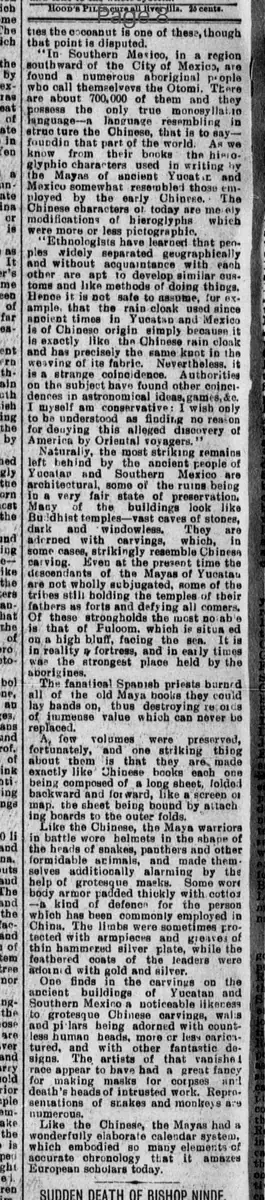
ties the cocoanut is one of these, though that point is disputed.
'In Southern Mexico, in a region southward of the City of Mexico, are found a numerous aboriginal people who call themselves the Otomi. There are about 70,000 of them and they possess the only true monosyllabic language—a language resembling in structure the Chinese, that is to say—found in that part of the world. As we know from their books the hieroglyphic characters used in writing by the Mayas of ancient Yucatan and Mexico somewhat resembled those employed by the early Chinese. The Chinese characters of today are merely modifications of hieroglyphs which were more or less pictographic.
'Ethnologists have learned that peoples widely separated geographically and without acquaintance with each other are apt to develop similar customs and like methods of doing things. Hence it is not safe to assume, for example, that the rain cloak used since ancient times in Yucatan and Mexico is of Chinese origin simply because it is exactly like the Chinese rain cloak and has precisely the same knot in the weaving of its fabric. Nevertheless, it is a strange coincidence. Authorities on the subject have found other coincidences in astronomical ideas, games, etc. I myself am conservative: I wish only to be understood as finding no reason for denying this alleged discovery of America by Oriental voyagers.'
Naturally, the most striking remains left behind by the ancient people of Yucatan and Southern Mexico are architectural, some of the ruins being in a very fair state of preservation. Many of the buildings look like Buddhist temples—vast caves of stones, dark and windowless. They are
adorned with carvings, which, in some cases, strikingly resemble Chinese carving. Even at the present time the descendants of the Mayas of Yucatan are not wholly subjugated, some of the tribes still holding the temples of their fathers as forts and defying all comers.
Of these strongholds the most notable is that of Tulum, which is situated on a high bluff, facing the sea. It is in reality a fortress, and in early times was the strongest place held by the aborigines.
The fanatical Spanish priests burned all of the old Maya books they could lay hands on, thus destroying relics of immense value which can never be replaced.
A few volumes were preserved, fortunately, and one striking thing about them is that they are made exactly like Chinese books each one being composed of a long sheet, folded backward and forward, like a screen or map, the sheet being bound by attaching boards to the outer folds.
Like the Chinese, the Maya warriors in battle wore helmets in the shape of the heads of snakes, panthers and other formidable animals, and made themselves additionally alarming by the help of grotesque masks. Some wore body armor padded thickly with cotton—a kind of defense for the person which has been commonly employed in China. The limbs were sometimes protected with armpieces and greaves of thin hammered silver plate, while the feathered coats of the leaders were adorned with gold and silver.
One finds in the carvings on the ancient buildings of Yucatan and Southern Mexico a noticeable likeness to grotesque Chinese carvings, walls and pillars being adorned with countless human heads, more or less curiously caricatured, and with other fantastic designs. The artists of that vanished race appear to have had a great fancy for making masks for corpses and death's heads of intricate work. Representations of snakes and monkeys are numerous.
Like the Chinese, the Mayas had a wonderfully elaborate calendar system, which embodied so many elements of accurate chronology that it amazes European scholars today.
'In Southern Mexico, in a region southward of the City of Mexico, are found a numerous aboriginal people who call themselves the Otomi. There are about 70,000 of them and they possess the only true monosyllabic language—a language resembling in structure the Chinese, that is to say—found in that part of the world. As we know from their books the hieroglyphic characters used in writing by the Mayas of ancient Yucatan and Mexico somewhat resembled those employed by the early Chinese. The Chinese characters of today are merely modifications of hieroglyphs which were more or less pictographic.
'Ethnologists have learned that peoples widely separated geographically and without acquaintance with each other are apt to develop similar customs and like methods of doing things. Hence it is not safe to assume, for example, that the rain cloak used since ancient times in Yucatan and Mexico is of Chinese origin simply because it is exactly like the Chinese rain cloak and has precisely the same knot in the weaving of its fabric. Nevertheless, it is a strange coincidence. Authorities on the subject have found other coincidences in astronomical ideas, games, etc. I myself am conservative: I wish only to be understood as finding no reason for denying this alleged discovery of America by Oriental voyagers.'
Naturally, the most striking remains left behind by the ancient people of Yucatan and Southern Mexico are architectural, some of the ruins being in a very fair state of preservation. Many of the buildings look like Buddhist temples—vast caves of stones, dark and windowless. They are
adorned with carvings, which, in some cases, strikingly resemble Chinese carving. Even at the present time the descendants of the Mayas of Yucatan are not wholly subjugated, some of the tribes still holding the temples of their fathers as forts and defying all comers.
Of these strongholds the most notable is that of Tulum, which is situated on a high bluff, facing the sea. It is in reality a fortress, and in early times was the strongest place held by the aborigines.
The fanatical Spanish priests burned all of the old Maya books they could lay hands on, thus destroying relics of immense value which can never be replaced.
A few volumes were preserved, fortunately, and one striking thing about them is that they are made exactly like Chinese books each one being composed of a long sheet, folded backward and forward, like a screen or map, the sheet being bound by attaching boards to the outer folds.
Like the Chinese, the Maya warriors in battle wore helmets in the shape of the heads of snakes, panthers and other formidable animals, and made themselves additionally alarming by the help of grotesque masks. Some wore body armor padded thickly with cotton—a kind of defense for the person which has been commonly employed in China. The limbs were sometimes protected with armpieces and greaves of thin hammered silver plate, while the feathered coats of the leaders were adorned with gold and silver.
One finds in the carvings on the ancient buildings of Yucatan and Southern Mexico a noticeable likeness to grotesque Chinese carvings, walls and pillars being adorned with countless human heads, more or less curiously caricatured, and with other fantastic designs. The artists of that vanished race appear to have had a great fancy for making masks for corpses and death's heads of intricate work. Representations of snakes and monkeys are numerous.
Like the Chinese, the Mayas had a wonderfully elaborate calendar system, which embodied so many elements of accurate chronology that it amazes European scholars today.
What sub-type of article is it?
Essay
What keywords are associated?
Otomi Language
Maya Architecture
Chinese Influence
Yucatan Ruins
Tulum Fortress
Maya Books
Warrior Attire
Calendar System
Literary Details
Subject
Similarities Between Ancient Maya/Otomi And Chinese Cultures
Form / Style
Prose Essay On Ethnographic Comparisons
Key Lines
'Ethnologists Have Learned That Peoples Widely Separated Geographically And Without Acquaintance With Each Other Are Apt To Develop Similar Customs And Like Methods Of Doing Things.'
'I Myself Am Conservative: I Wish Only To Be Understood As Finding No Reason For Denying This Alleged Discovery Of America By Oriental Voyagers.'
'Like The Chinese, The Mayas Had A Wonderfully Elaborate Calendar System, Which Embodied So Many Elements Of Accurate Chronology That It Amazes European Scholars Today.'